Metallic Cable Knit: Gold and Silver Foil on Cable Structures
A cable panel is not a difficult surface to foil — it is the reason to foil. One pass of silver turns the rope columns into cast metal and leaves the hollows in the garment's own colour. Which cable structures take gold and silver, and what changes when they do.
Most buyers assume a heavy cable is the wrong place for metallic foil, because the surface is too bumpy for a film to lie flat. The opposite is true. A cable is the surface that makes foil look expensive: the metal follows the relief, lands on the crowns and leaves the troughs in the garment's own colour, so a single press produces a two-tone metal effect that a jacquard can only reach by adding colours to the knit. For the film, adhesive and testing side of the process, read Foil Print Knitwear. This post is about the structures — which cables take gold and silver well, and what changes when they do.
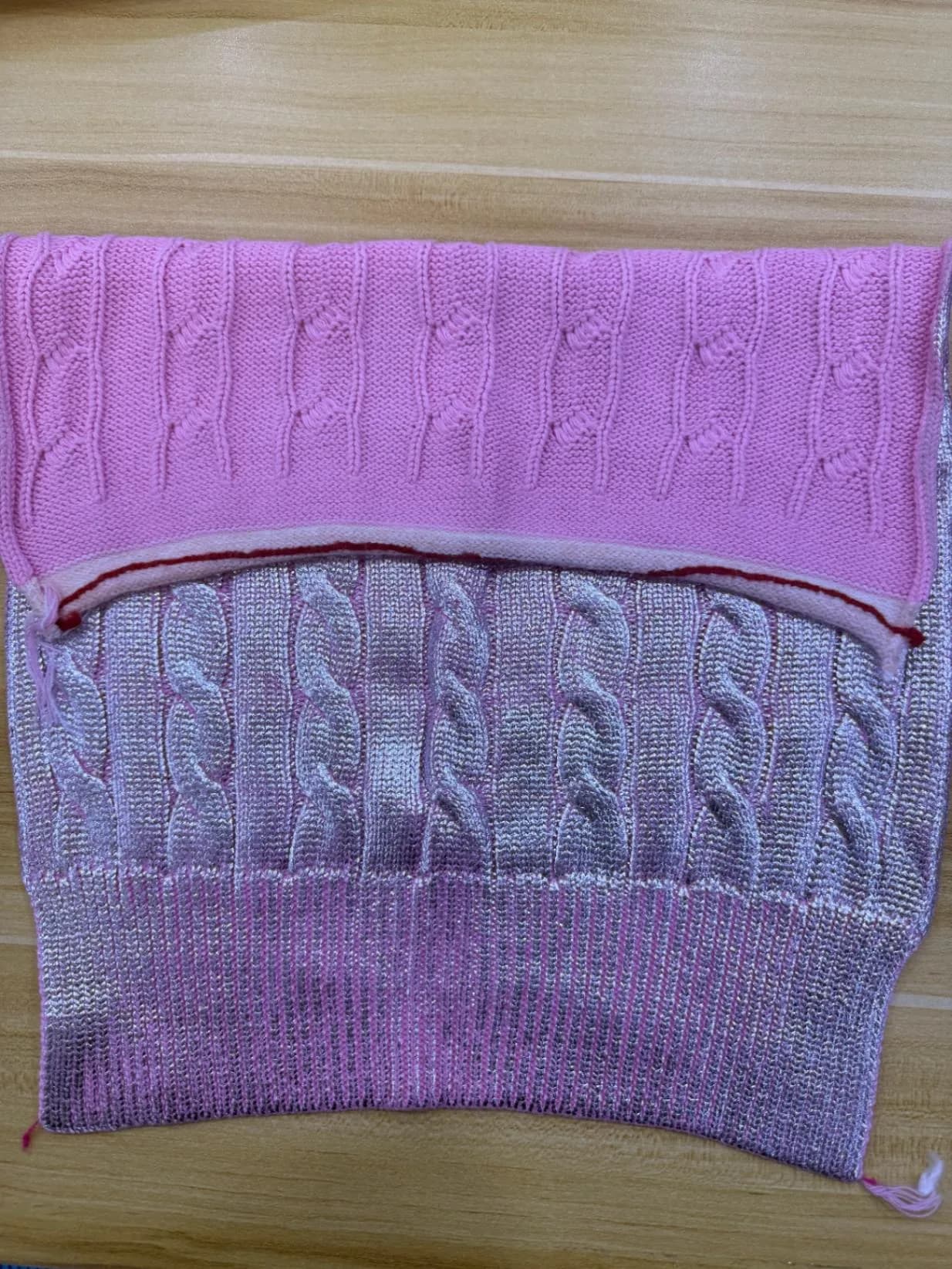
The photographs in this post are a matched pair from the same finishing table: one cable panel straight off the machine in the yarn's own pink, and a second panel of the same structure after a silver foil pass. Nothing has been retouched, and the two are photographed together because that is the only honest way to show what the process does — the metal is not a coating laid over the knit, it is a transfer that happens where the press reached the yarn hardest.
What a Foil Pass Actually Does to a Cable
On a flat jersey panel the adhesive is printed as a shape and the metal arrives as a sheet: even coverage, mirror surface, edges decided by the screen. A cable panel changes one variable — the press — and that changes everything downstream. The heated platen meets the high points of the structure first and hardest, so bond strength is highest on the crowns of the rope columns and weakest in the troughs between them. When the carrier film peels away, the metal stays on the crowns and releases in the hollows. The result looks like cast metal let into a knitted ground, and the shadow sitting in each trough is what separates one cord from the next.
That behaviour is commercially useful in three ways. It produces two colours from one dyed yarn, so a metallic cable costs no extra yarn, no extra feeders and no extra machine time in the knitting — the second colour is a finishing operation, not a knitting programme. It edits itself: the troughs keep the base colour automatically, so there is no registration to hold between the metal and the structure, which is the part that goes wrong on a printed foil graphic. And it leaves the reverse of the panel untouched — no floats, no backing, no interfacing — so the inside of a foiled cable sweater is as clean as a plain one, which matters the moment someone turns a sample inside out in a showroom.
Which Cable Structures Take Metal
Not all relief behaves the same under a press. Three things decide it: how wide the crown is against the stitch pitch, how deep the troughs run, and whether the face is fibrous. Ranked from the most rewarding to the ones we talk buyers out of:
- Rope and plait cable (3/3 and 4/4 twist) — the best carrier there is. The cords are wide, rounded and continuous, so the metal reads as a solid forged line running the length of the panel. This is the structure most buyers mean when they ask for a twisted cable, and it is the one that photographs best in a lookbook.
- Lens, horseshoe and oval cable — strong, and the most interesting of the family. The cable splits and rejoins, leaving an open lens in the centre of every repeat; that lens keeps the base colour, so each repeat carries its own built-in highlight and shadow. The pink sample in this post is this structure.
- Honeycomb and waffle cable — the metal arrives as a field of small cells rather than cords. It reads closer to embossed leather than to jewellery, and it is the most forgiving of the three on a garment that will be worn hard, because no single run of foil is long enough to crack visibly.
- Spiral, wavy and serpentine twist — a diagonal line of metal, very effective on sleeves and on slim fits where a straight vertical would read as a racing stripe. Our wavy cable cardigan uses the same idea in structure alone; a foil pass turns it into a graphic.
- Half-cardigan and fisherman's rib — the film bridges the ribs and reads as a continuous sheet with faint vertical shadowing. Not wrong, but it wastes the relief: you pay for a textured panel and get a metal plate.
- Deep openwork and lace — the film sags into the holes and tears at the edge of each one. Not viable at production speed, whatever the sample says.
- Brushed, napped and looped faces — mohair, brushed lambswool, bouclé, loop stitch. The fibres sit between the film and the adhesive, so the bond is to fluff rather than to yarn. It passes on the sample and fails after two washes, which is the worst possible place for a failure to appear.
If the structure you want is on the bottom half of that list, the answer is usually not a different foil — it is a different metal route, which is the next question worth settling.
Gold or Silver Is a Value Decision Before It Is a Taste Decision
The metal is chosen by the lightness of the base, not by the mood board. Silver, pewter and chrome read as metal only when there is something darker behind them; on ecru, oatmeal or pale pink they collapse into a grey sheen that photographs badly and looks like a print defect in daylight. Gold runs the opposite way: on cream, camel, rust and chocolate it reads warm and inherited, on pure white it reads brassy, and on black it reads like hardware.
The swatch pair here is a deliberate choice of ground. Pink sits in the middle of the value range — dark enough under the metal to hold a real shadow in the troughs, light enough that the silver stays silver instead of turning gunmetal. That is the test to run on any swatch before a colour is signed off: does the trough read as shadow, or does it read as dirt? If the answer is dirt, the base is too light for the metal, and no amount of press pressure will fix it.
Finish matters as much as colour. Bright silver and bright gold give a mirror, and a mirror shows every flex line. Matte silver, champagne, and a soft rose or copper are more forgiving because a matte surface scatters the light that a hairline crack would otherwise reflect — so on a heavy cable, matte metal is the combination that ages most gracefully, and bright mirror is the one that shows its age first at the elbow and the cuff.
Two metals on one garment is where programmes go wrong. It means two passes, two screens, and a second press that re-heats the first foil — which dulls it — over a surface that has relief and therefore does not sit flat under a platen. If the brief genuinely needs silver and gold, put one metal on the cable and the second colour into the knit as a lurex yarn or a quiet jacquard ground, rather than running both through the foil line.
Gauge Decides the Line Weight
The same cable at 3gg reads as forged metal: the cord is 12–20mm wide, the trough is deep, and the shadow does most of the work. That is outerwear and statement knitwear territory, and it is where foil looks most like a material rather than a finish. At 7gg the cord lands around 8–12mm, which is the sweet spot for a retail sweater — the metal is a distinct line but still fine enough to sit on the body without looking like armour.
At 12gg and 14gg the cord compresses to 4–7mm and the effect changes character: the metal becomes a fine ribbed sheen that is beautiful in the hand and almost invisible at three metres. There is a technical reason this scale is more delicate as well. A fine-gauge face scorches sooner than a heavy cable, so the pressing window has to sit lower and the dwell shorter — and a shorter dwell at a lower temperature is a weaker bond. If the brief is a metallic effect that has to read across a room on a fine gauge, foil is the wrong tool; a lurex yarn will do it better.
Foil or Metallic Yarn?
There are two ways to get metal onto a cable and they fail in opposite directions. A metallic yarn — lurex or a film yarn twisted with the base — is knitted into the structure, so it cannot delaminate, lift or crack, and it survives normal laundering. In exchange it is duller, closer to glitter than to mirror; it cannot be confined to a shape, because it goes wherever the yarn goes; and a heavily metallic yarn is harsher against the skin and more prone to snagging on a cable crown.
Foil is the mirror image: a true metal surface, shape-specific, applied after the panel exists, and carrying a care label with it. Neither is better — they answer different briefs. The combination is the one worth knowing, because lurex in the ground plus foil on the cable gives depth: the ground glitters faintly while the rope columns read as solid metal. It also costs less than two foil passes, since the second effect is already in the yarn.
Where the Foil Should Stop
- Chest, upper sleeve and back yoke — low flex, and the areas a buyer actually looks at. Foil here holds its shape for the life of the garment.
- Elbow, cuff edge, underarm and seat — the highest-flex points on any knit. Foil here crazes first, and it crazes in exactly the place a customer inspects before deciding to keep the garment.
- Seams and linking edges — never end a foil zone on a seam. The allowance beneath it flexes independently of the panel, and the foil edge lifts within a few wears. Stop the zone 15–20mm short and let plain knit run into the seam.
- Rib — a dense hem rib takes foil well and the sample here is foiled continuously with the panel, because a hem does not flex the way a cuff does. A foiled cuff rib is a different risk: it has to stretch to let a hand through, and metal sitting on that rib restricts the recovery it needs.
- Neck rib — avoid. The neckline is the first place anyone looks and the first place foil failure becomes visible, and it is also the edge that takes the most handling in fitting rooms.
Care, Stated Plainly
Cold wash inside out, no tumble drying, no dry-cleaning solvents, dry flat and away from direct heat. The wear pattern on a cable is specific: the crowns polish brighter where sleeves and sides rub, then dull as the metal oxidises. On a good panel that reads as patina; on a cheap one it reads as wear — which is an argument for keeping foil off the highest-friction points rather than for promising it will not happen. Put the care instruction on the label, not in a footnote. A foiled cable that goes through a tumble dryer once comes back with a crazed surface that no re-press can recover.
Briefing a Metallic Cable Programme
Four things decide the quote: the cable structure and gauge, sent as the chart or a clear swatch photograph; the foil colour and finish; the placement, including whether the foil should follow the cable rhythm or ignore it — a foil zone that cuts across the cables reads as a printed band, while one keyed to the repeats reads as part of the structure; and the care-label wording your market requires. Send those four and the rest follows.
We press the real panel before quoting, because the swatch pair in this post is exactly that stage: a foil that looks right on jersey can look like paint on a heavy cable, and the only way to know is to press the structure you intend to sell. MOQ follows our standard knitwear programme at 100 pieces per design, sampling in 72 hours from yarn stock confirmation, bulk production 2–3 weeks after PPS approval, DDP door-to-door to US, EU, UK, AU and JP. And the standing policy applies here as everywhere else on this site: foil reproduces whatever the adhesive prints, so the artwork is yours to own — we do not press third-party marks any more than we knit them into a jacquard.
Looking to manufacture this style at scale?
Send us your design brief and we'll quote a direct-factory run with low MOQs, 72h sampling and DDP worldwide delivery, knitted on our own floor in Dalang.
Knitwear you can manufacture right now
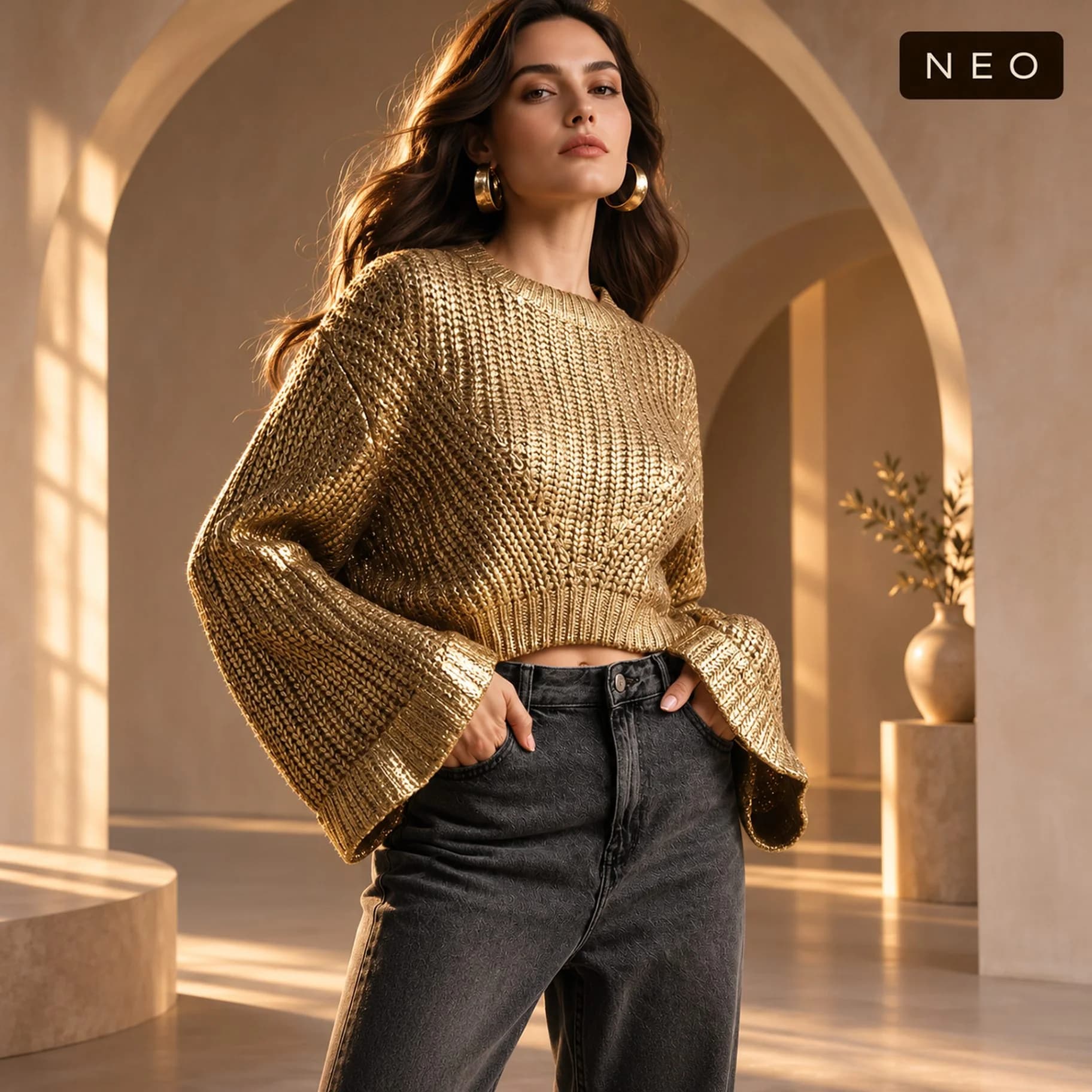
Gold Foil Stamped Chunky Knit Sweater
Hot-stamped gold or silver foil on a heavy-gauge chunky knit — pressed panel by panel before linking, so the metal sits where the platen can actually reach it.
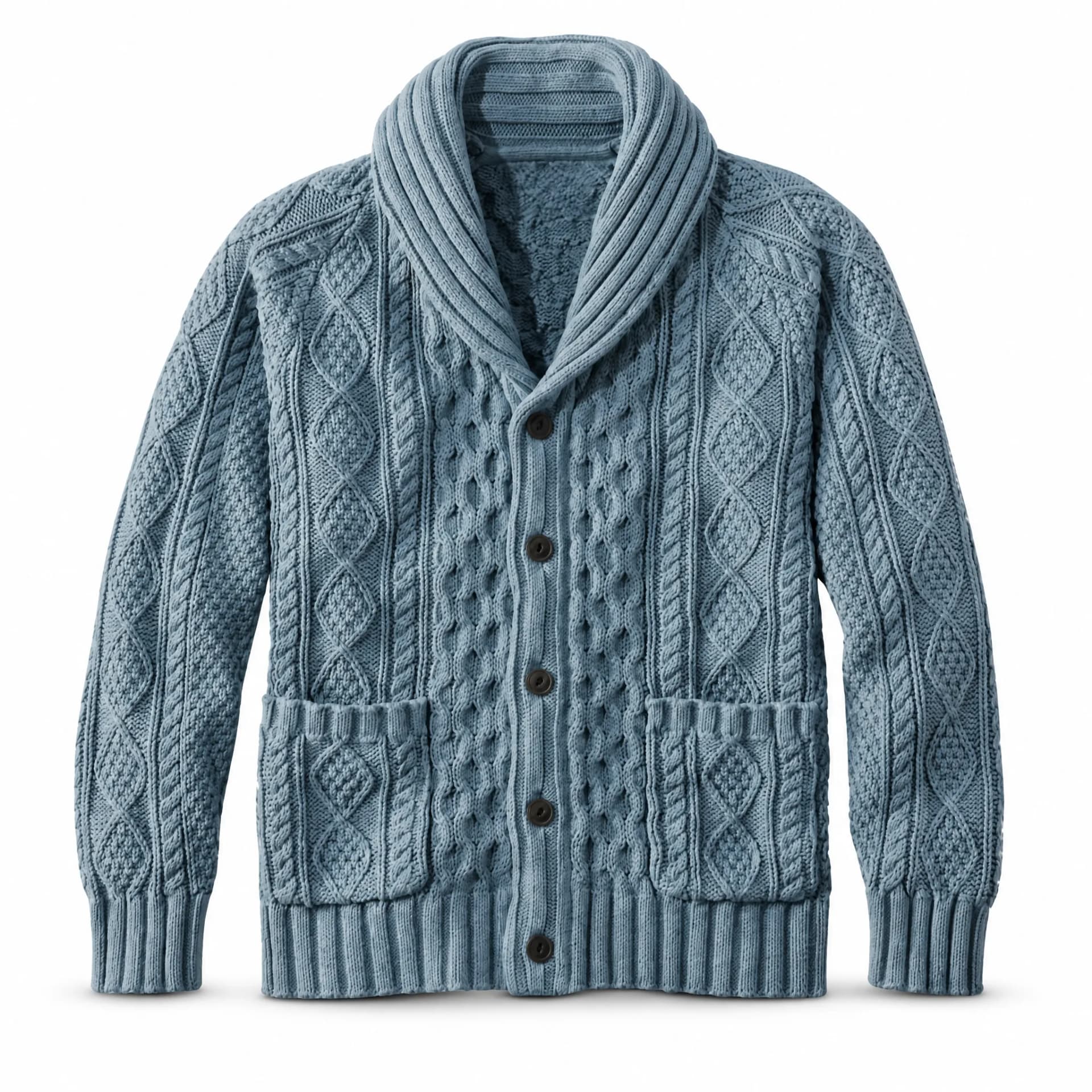
Custom Shawl Collar Cable Knit Cardigan
Chunky cable-and-diamond cardigan with a fully fashioned shawl collar — knitted as structure, never cut and sewn.

Custom Full-Zip Wavy Cable Cardigan
A fold-down rib polo collar and a full-length metal zip over a wandering wavy cable — zip-up knitwear that reads tailored, not sporty.
Keep reading
It's Time to Custom-Own Your Christmas Jumper
A short consumer-oriented overview of the custom Christmas jumper trend — design ideas, group-event tips, and the festive looks defining this year's holiday season.
From Tech Pack to Perfect Sample: How Knitwear Sampling Actually Works
A floor-level walkthrough of the five stages between your tech pack and an approvable knit sample — mock-up and CAD programming, yarn colour matching, swatch testing, and the final PPS.
Sourcing Custom Men's Knitwear: What Separates a Knitwear Factory from a Sweater Mill
Mens knitwear briefs rarely fail on the design. They fail on gauge, size grading and reverse-side finishing — three things most price requests never ask about. Here is what to specify before you ask for a quote.
Send us the piece you were told was too hard.
Reference photo, rough sketch, or full tech pack — our Dalang technical punchers evaluate feasibility, machine gauge, yarn options, and pricing within 24 hours.