Cozy Companions: The Case for Matching Pet and Owner Knitwear
Pet apparel has been a gift-aisle business for a decade. The matching set is what turns it into a clothing category — provided the pet block is drawn rather than scaled, and both pieces come off one dye lot.
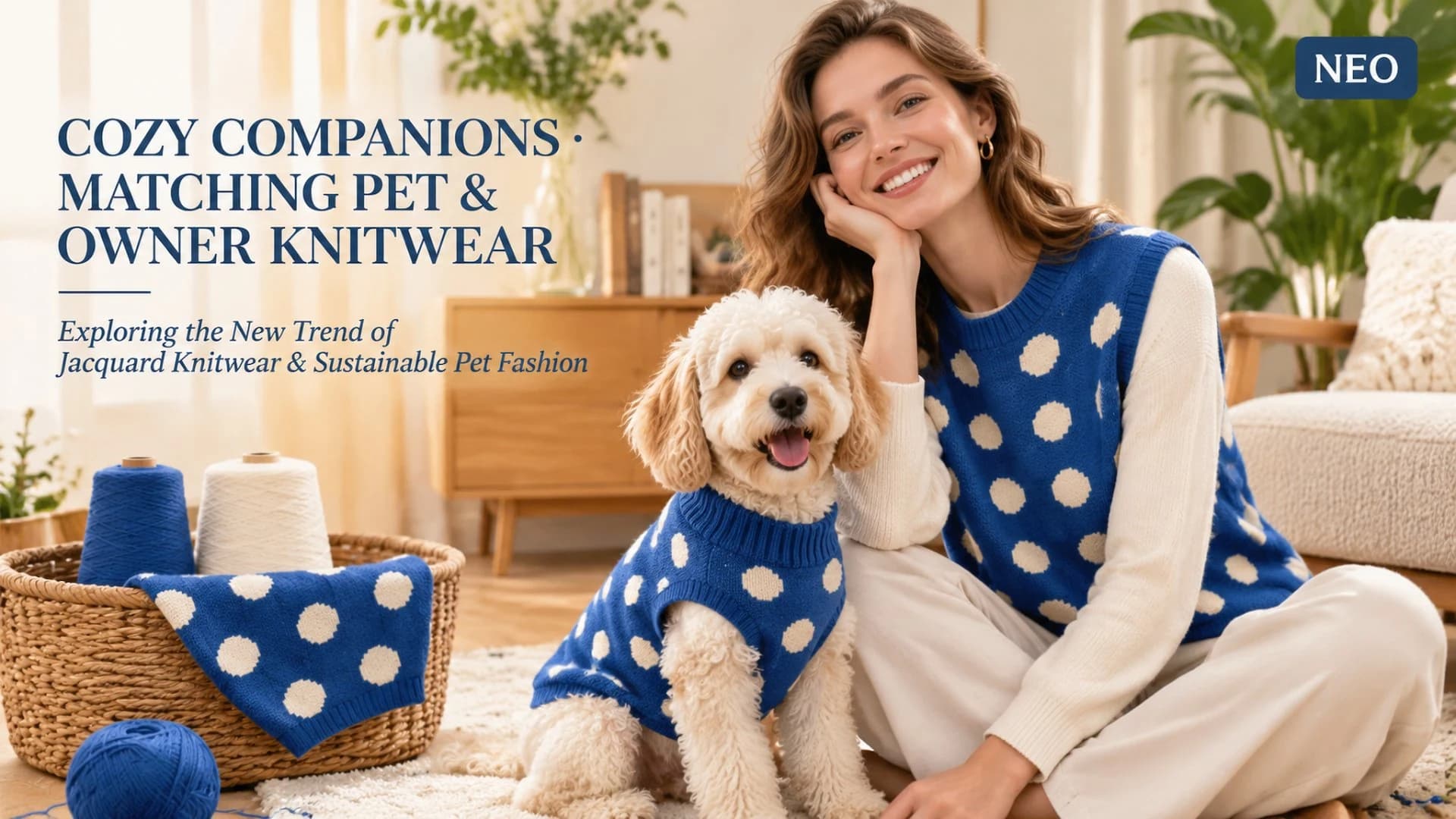
This is the industry read, not the product page. The set itself — the polka-dot crew and the leash-hole vest — is a separate page on this site. What follows is why this category is moving out of the gift aisle, where jacquard breaks when it is knitted at pet scale, and what sustainable actually means once a garment is washed every week rather than every month.
Pet apparel has been a gift-aisle business for a decade and it is turning into a clothing business. The difference is not marketing spend. A gift-aisle product is bought once, for a photograph, and never replaced; a clothing product is bought again because the last one fitted and survived. Almost everything that separates the two is decided in the block and the yarn, weeks before anyone sees the garment.
Why Pet Apparel Stalls After the First Purchase
The category has no shortage of designs and a real shortage of fit. Most pet knitwear is sized by breed name — a size for a poodle, a size for a retriever — and breed is a poor proxy for a garment. Two dogs with the same back length can differ by several centimetres at the chest, and it is the chest, not the back, that decides whether a vest closes comfortably. Cut for a barrel-chested breed and it gapes on a deep-chested one; cut for the deep chest and it rides up on the barrel.
Three failures come back again and again, and none of them is visible in a lookbook.
- The neck. A collar drafted from a human crew neck is too deep and too loose on a dog. It slides, the dog walks out of the garment mid-walk, and the buyer concludes the size was wrong when the block was.
- The front leg. A pet's leg rotates through the shoulder rather than hanging from a fixed joint. An armhole cut to the standing silhouette binds the moment the leg swings forward, which is the first step of the first walk.
- The belly. A hem cut level all the way round sits in the wet zone. Owners stop using the garment for exactly this reason and rarely say so in a review, so the return reason reads as fit when the cause is placement.
The Matching Set Changes the Retail Maths
A matching set is a merchandising decision before it is a design one. Two garments off one photograph, sold as one SKU or two, at a price point a single pet accessory cannot reach. It is also why the category crosses demographics: the owner is buying something for themselves and something for the dog in one transaction, and the second piece is the impulse.
From the factory side it is a simpler proposition than it looks, provided both pieces are built from one programme: one artwork file, one colour separation, one yarn lot, two blocks. That is the whole trick, and it is worth being precise about why. The expensive failure in a matching set is not the pattern — it is colour. Two yarn purchases, even from the same supplier against the same Pantone reference, dye to two slightly different blues, and under retail lighting a set that is two per cent apart reads as two products that were never meant to be together. Knit both pieces first, dye them together from one lot, and the question disappears without anyone having to inspect for it.
A Pet Block Is Drawn, Not Scaled
The most common assumption in this category is that the pet garment is the human garment at a smaller size. It is not, and the reason is structural rather than aesthetic: a dog's proportions differ from a human's in kind, not in degree.
The measurements that matter are chest girth, back length and neck girth, in that order. Chest girth sets the body width, back length sets where the hem lands, and neck girth decides whether the collar sits flat. Breed name is not a measurement. Ask for the three numbers, or ask for the buyer's own fit sample, and the block can be drafted properly on the first attempt instead of the third.
Around those three numbers sit four construction decisions that separate a garment which gets worn from one which gets folded away.
- An armhole allowance that opens. The front leg swings forward through the shoulder, so the armhole has to follow the leg rather than describe a fixed circle around the standing position.
- A belly line cut high. This is hygiene, not styling — a hem that clears the ground keeps urine off the fabric, and it is the difference between a garment worn twice a week and one washed once and put away.
- A leash hole placed as a proportion of back length rather than a fixed distance from the collar. A hole that lands on the shoulder blades instead of between them drags the whole garment sideways as soon as a lead is clipped on.
- No long floats. Pets chew and groom, so a loose carry inside the garment is a hazard rather than a cosmetic issue. Every float beyond a few stitches gets a tie-in stitch on the machine.
Scale runs six graded sizes, from something that fits a toy poodle to something that fits a golden retriever, and the grade is not linear. A size step that adds four centimetres of chest adds less than that at the neck, and the ratio changes across the curve. This is why pet lines graded by scaling one block tend to fit at the two ends and fail in the middle — the middle is where the proportions stop agreeing with the original.
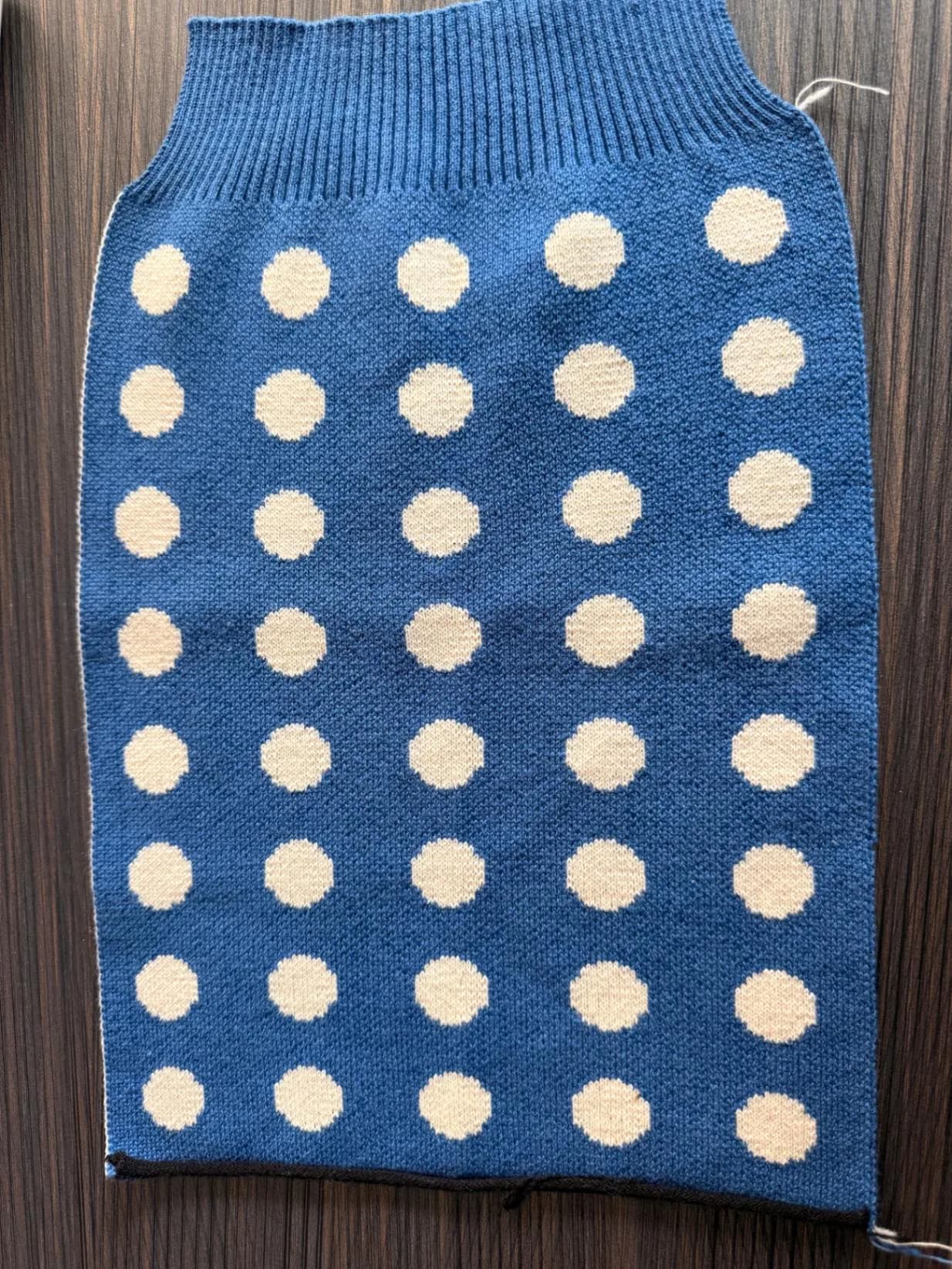
What a Flat Photograph of a Pet Sample Tells You
A buyer looks at a flat photo and sees a cute garment. We look at four things, and all four are visible in this one.
- The neck. Count the ribs and measure the height. A tall rib in a tight gauge is what keeps a collar on a moving dog; a short, open rib is what makes the owner say the size was wrong.
- The dots. Look at the edge of any dot: it steps, in small increments, because it is knitted rather than printed. A dot whose edge is a smooth arc has been printed on, and a print layer cracks at the armhole long before the knit wears out.
- The side seam. It should run straight and vertical. A seam that spirals means the front and back panels came off the machine at different lengths, and no amount of pressing fixes it.
- The hem. On a pet vest it is not symmetrical and should not be. One end runs longer because it sits over the back, the other is cut high over the belly.
Jacquard Breaks at Pet Scale
Jacquard is where the interesting failure lives, because a pattern that is correct on an adult body is not automatically correct on a pet panel — and the reason is arithmetic rather than taste.
A dot cannot be drawn at size on a knitting machine. It is stepped onto the stitch grid, which fixes its diameter by gauge: at 7GG a dot that reads as a circle is roughly twenty to twenty-four stitches across and roughly the same number of courses deep. That is comfortable on a 55 cm adult front panel, where five columns of dots fit with room to spare. Knit the same repeat on a 30 cm pet panel and you get three columns, each reading as an oversized spot — the motif survives, the scale relationship does not, and the set stops looking like a set.
So the pet panel gets its own separation, at roughly sixty per cent of the adult dot diameter, which restores visual density without redrawing the artwork. The spacing carries a second constraint: the repeat has to divide into the needle count, or the columns drift and break at the side seam. On an all-over pattern that is the first defect anyone sees on a flat lay, and it is decided on the chart rather than caught in inspection.
Colour is the quieter decision. The reference pairs on this site all use a cream dot rather than an optical white, because pure white on a saturated navy reads hard under retail lighting and goes chalky after a handful of washes, while cream holds its value against blue, red, green, pink and charcoal equally. Two colours is not a difficult jacquard. Two colours that stay in register at two different scales on two different blocks is the actual work.
Sustainable Pet Fashion Is Mostly a Durability Story
The category's sustainability conversation is usually about fibre, and that is the least useful place to have it. Pet knitwear in the accessible price tier is acrylic, which is petroleum-based and sheds microfibres in the wash. Both of those are true. Neither is fixed by swapping the yarn.
Wool is warmer, which on a dog is often a problem rather than a feature — a double-coated breed in a wool jumper overheats, and the garment comes off. Wool also felts and shrinks under the washing a pet garment actually receives, which is a warm machine wash more often than most owners admit. Cotton is comfortable and washes well but has no loft, so it neither insulates nor holds its shape on a moving animal. The fibre conversation is worth having for a human garment worn once a week against the skin. It is the wrong conversation for a small garment worn by an animal that will be brushed, rained on and washed every seven days.
What actually moves the needle in this category is unglamorous.
- Fit. The largest waste in pet apparel is a garment worn once. A block drafted from three measurements rather than a breed name is the biggest single reduction in returns, and a returned garment is the most carbon-intensive thing a garment ever does.
- Durability. Anti-pill finishing, a tight knit face and reinforced stress points at the leash hole and cuffs extend the life of a small garment further than any fibre swap. A pet knit that survives forty washes replaces four that did not.
- One dye lot, two pieces. Dyeing both panels together uses one bath instead of two and removes the second sample round that a colour mismatch would otherwise cost.
- Stock-service yarns. Ordering a colour the mill already carries avoids a minimum dye batch for a small requirement. A 30 kg dye lot against a 20 kg need is waste before the first garment exists.
- Single-material packaging. A frosted zip bag in one polymer can be recycled; a bag with a printed paper insert, a foil sticker and a plastic hanger cannot.
What we will not do is call a blended knit recyclable. Blends — acrylic with cotton, wool with polyamide — are difficult to separate and mostly do not go back into fibre. Saying otherwise is a claim that fails the first time a customer asks where to send the garment back to.
The one intervention that costs nothing is the care label. A 30°C wash, inside a laundry bag, dried flat, removes a meaningful share of the microfibre a pet knit sheds across its life — and it is printed on a label the buyer is already paying for. Of everything discussed in this section, that is the item with the best ratio of effect to cost.
What Buyers Get Wrong in the Brief
- Sizing by breed rather than by girth. It is the root of most returns, and it is fixed by one line on the tech pack.
- Forgetting where the leash hole goes. It is not a detail — placed wrong, it pulls the whole garment off-centre under load, and the customer blames the fit.
- Reusing the adult colourway without re-checking the scale. A 4 cm motif on a 55 cm panel and the same motif on a 30 cm panel are not the same design, even though the file is identical.
- Skipping the wash test. Pet garments are washed more often than human ones, and a finish that survives ten laboratory washes can pill by wash fifteen in a home machine.
- One size label for both pieces. Adult and pet tags need to be separate, because a shared tag is how a customer orders the wrong dog size and then blames the chart.
How a Set Actually Runs
A matching set is quoted as one programme: one artwork, one yarn lot, two blocks, one PPS. MOQ is 100 sets per design, sampling is 72 hours from yarn stock confirmation, bulk production is 2-3 weeks after PPS approval, and delivery is DDP door to door.
To quote it properly we need four things from the buyer: the three pet measurements per size rather than a breed, the adult size range, a reference garment that fits the way you want this to fit, and the retail structure — one SKU or two, and whether the pair ships in one bag. Those four answers change the block, the grade and the packing, and none of them can be assumed from the artwork.
Frequently Asked
Is a pet sweater just a small human sweater?
No. The stitch pattern can be shared; the block cannot. A pet block is drafted from chest girth, back length and neck girth, with an armhole allowance that opens as the leg swings forward, a belly line cut high for hygiene, and a leash hole placed as a proportion of back length. Scaling a human block down is how a garment ends up fitting at the two ends of a size run and nowhere in the middle.
Can you match the colour of the adult piece exactly?
Yes, by dyeing both pieces together from one yarn lot after knitting rather than buying two yarns in the same reference. Two purchases of the same Pantone can differ enough to read as two products under retail lighting, and once the goods are in a carton there is no way to prove which one was right. One lot removes the question rather than answering it.
What is the most sustainable choice for a pet knit?
Fit and durability, before fibre. A garment that fits gets worn and re-washed; a garment that does not gets returned, and no yarn choice offsets that. After those two: anti-pill finishing, a tight knit face, reinforced stress points, stock-service colours instead of a dedicated dye batch, and a single-material bag. We will not describe a blended knit as recyclable, because mostly it is not.
How many pet sizes do we need to launch?
Three is a workable launch — small, medium and large, graded from measured girths rather than breed names — and most brands widen to six once the style proves out. Keep the adult range separate: the sizes do not correspond, and a customer will assume they do if the tags look alike.
Can we run the set in our own colours and motifs?
Yes. The reference pairs exist so a first order needs no development; changing the ground, the dot or the motif turns it into a Pantone-matched programme, which is a yarn selection rather than new artwork. What does change with a new motif is the separation at pet scale — that is redrawn, not resized.
If you are building a pet line and everything you have seen so far is a scaled-down human knit, send the three measurements and the reference garment. We will draft the pet block properly, knit both pieces from one lot, and settle the colour before it becomes a conversation — so the set reads as one design in a photograph, on a shelf and in a customer's hand. MOQ 100 sets per design, sampling 72 hours from yarn stock confirmation, bulk 2-3 weeks after PPS approval, DDP to US, EU, UK, AU and JP.
Looking to manufacture this style at scale?
Send us your design brief and we'll quote a direct-factory run with low MOQs, 72h sampling and DDP worldwide delivery, knitted on our own floor in Dalang.
Knitwear you can manufacture right now
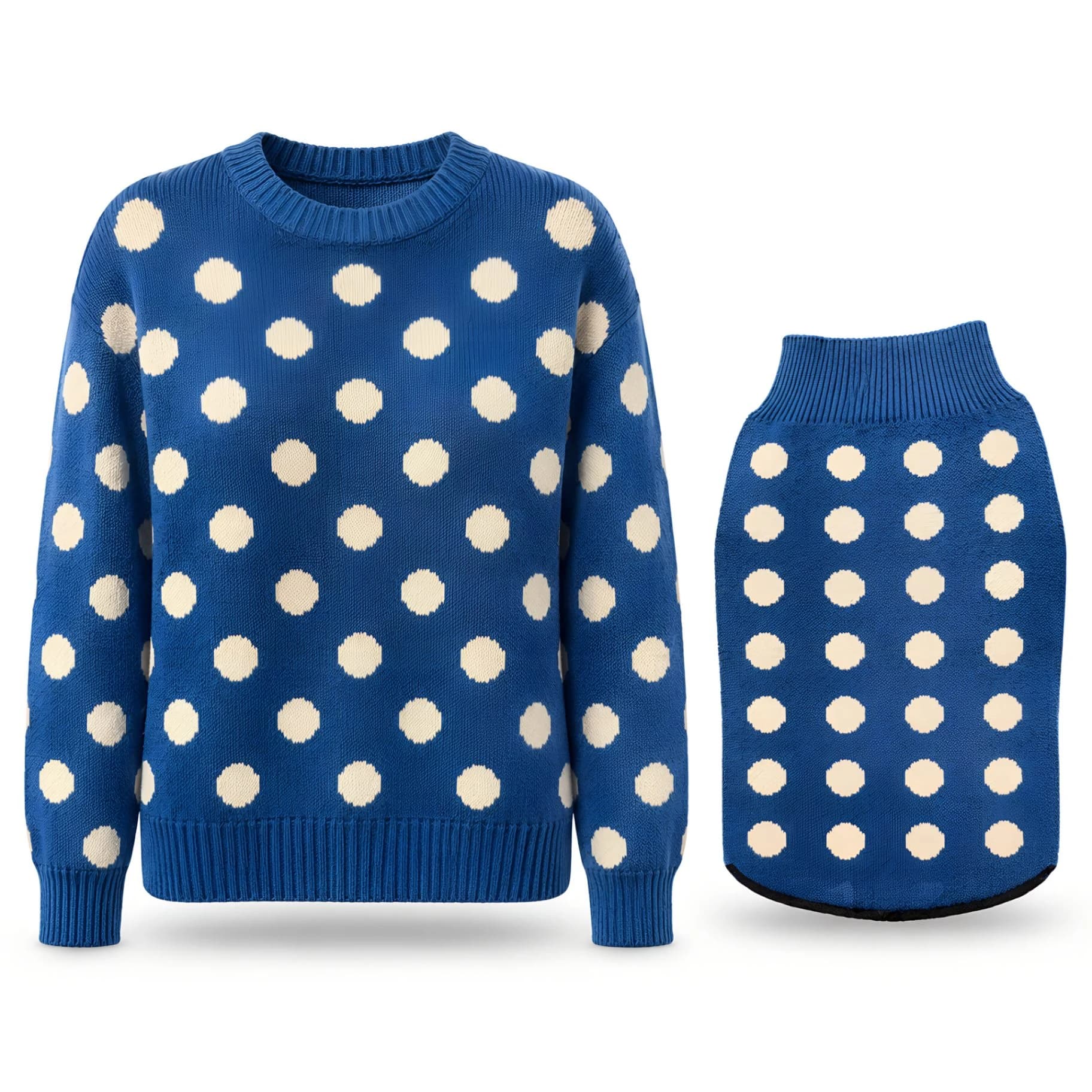
Custom Matching Polka Dot Sweater & Pet Set
One all-over dot programme, two blocks — a 7GG crew neck for the owner and a leash-hole vest for the dog, in five preset colour pairs.
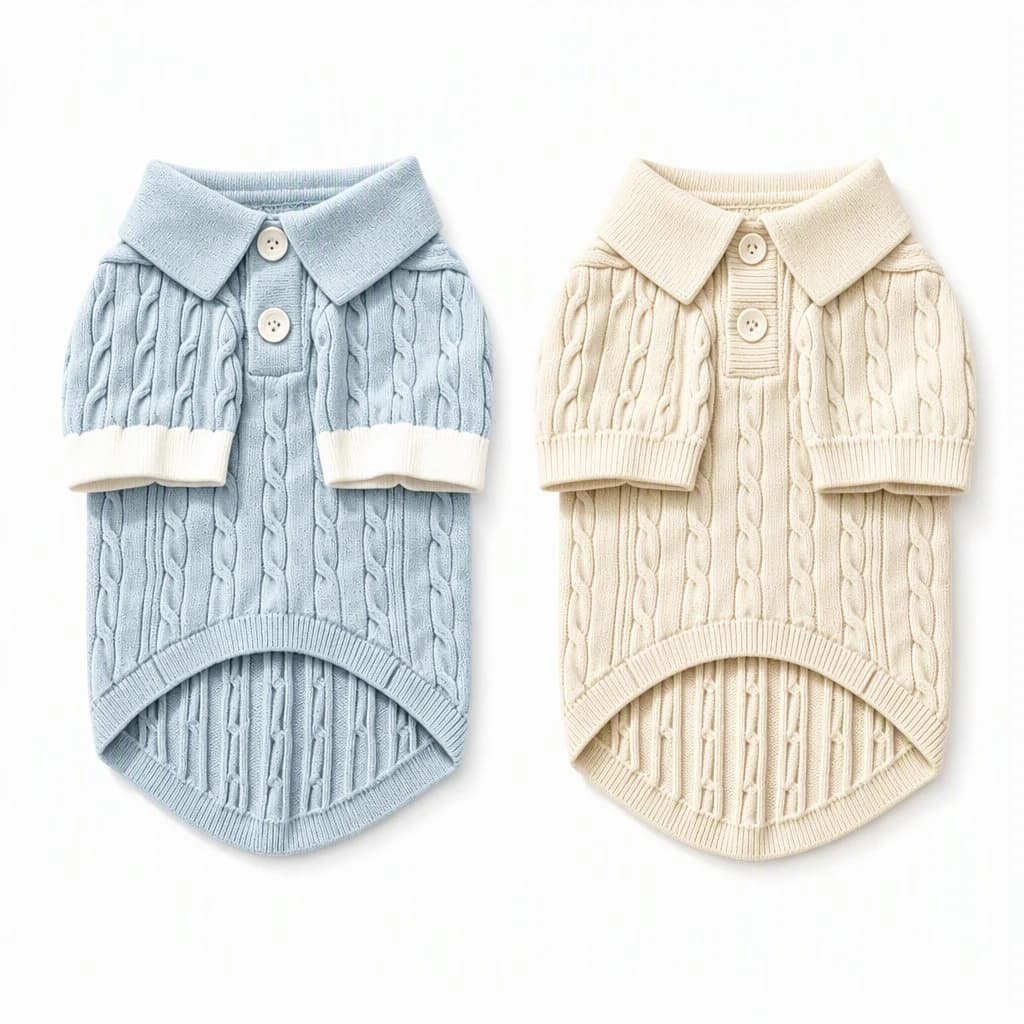
Custom Matching Human & Pet Cable Knit Polo
One cable programme, two size charts — a polo collar for the owner and the same polo for the dog.
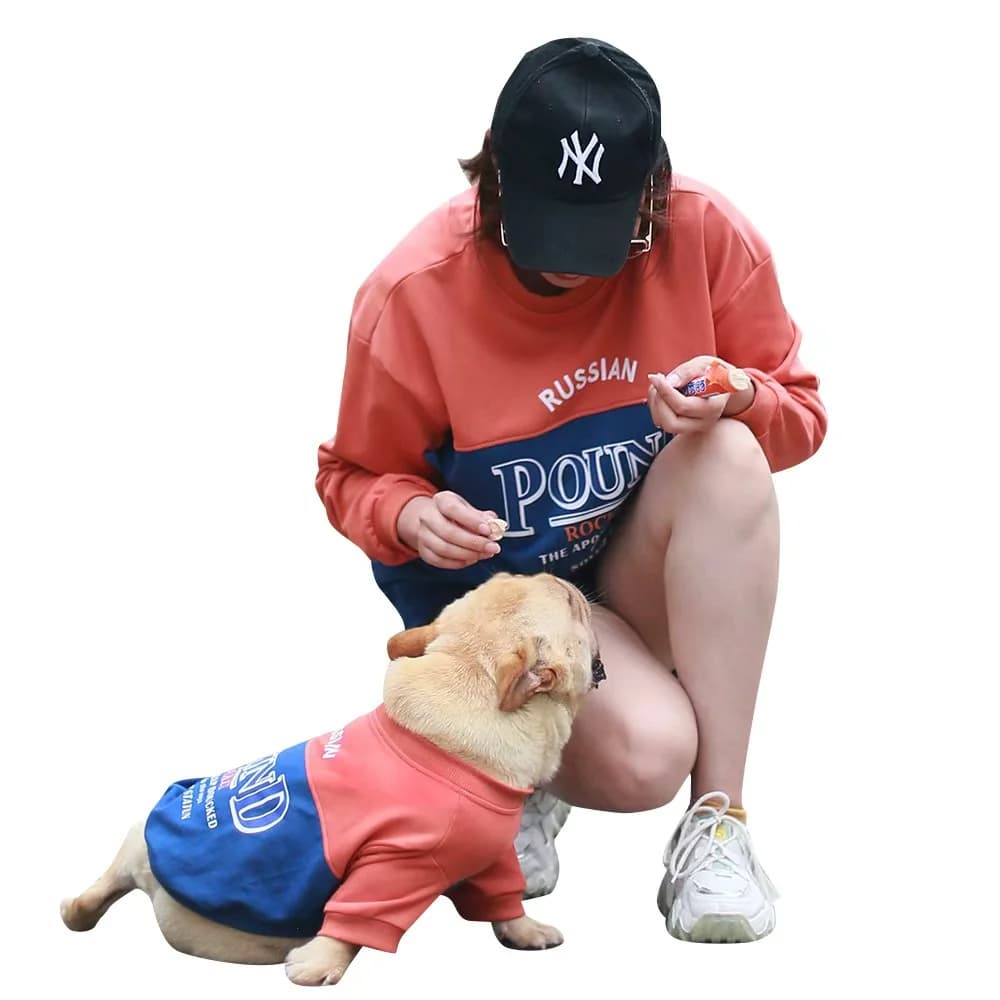
Custom Jacquard Dog & Pet Sweaters
Cute, stretchable knitwear for pets with leash openings and belly cutouts.
Keep reading
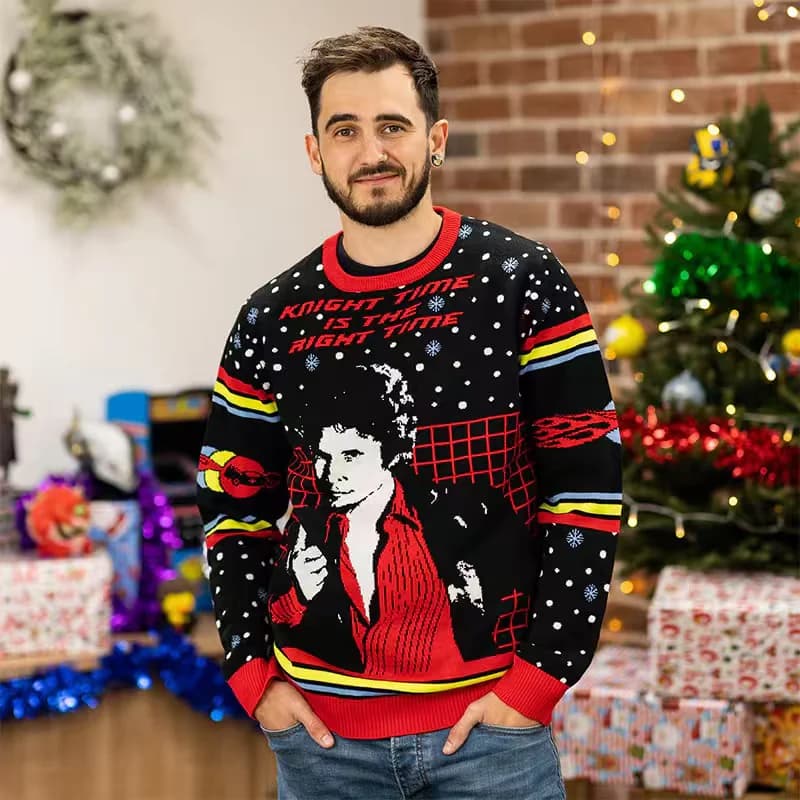
It's Time to Custom-Own Your Christmas Jumper
A short consumer-oriented overview of the custom Christmas jumper trend — design ideas, group-event tips, and the festive looks defining this year's holiday season.
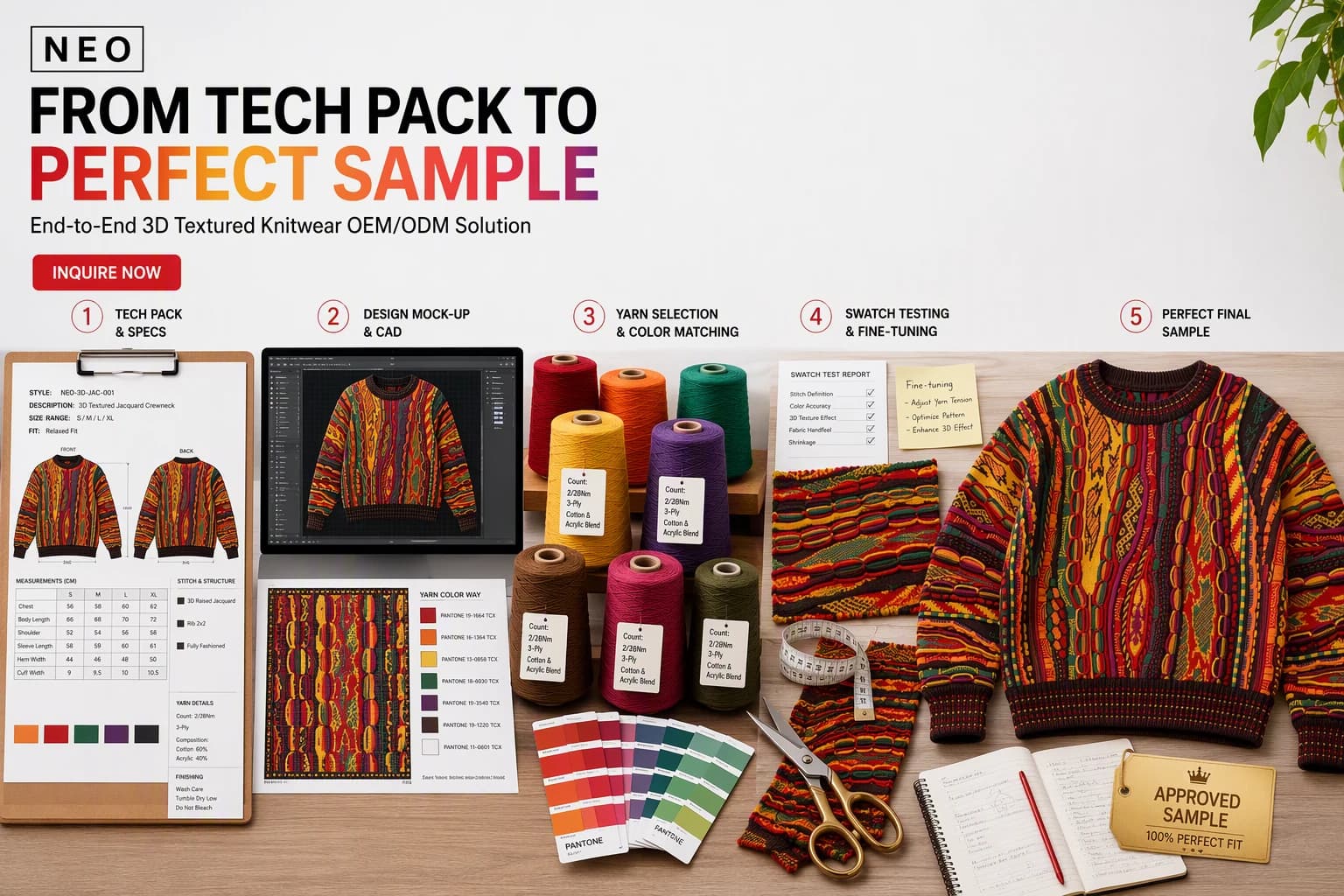
From Tech Pack to Perfect Sample: How Knitwear Sampling Actually Works
A floor-level walkthrough of the five stages between your tech pack and an approvable knit sample — mock-up and CAD programming, yarn colour matching, swatch testing, and the final PPS.
Sourcing Custom Men's Knitwear: What Separates a Knitwear Factory from a Sweater Mill
Mens knitwear briefs rarely fail on the design. They fail on gauge, size grading and reverse-side finishing — three things most price requests never ask about. Here is what to specify before you ask for a quote.
Send us the piece you were told was too hard.
Reference photo, rough sketch, or full tech pack — our Dalang technical punchers evaluate feasibility, machine gauge, yarn options, and pricing within 24 hours.