Matching Kids and Adult Knitwear: The Scale Decision
Two garments that have to read as one design across a 1.4x difference in stitch resolution. The motif-scale decision that sets chart count, gauge, colour lots and the minimum — and the five checks worth writing into a spec.
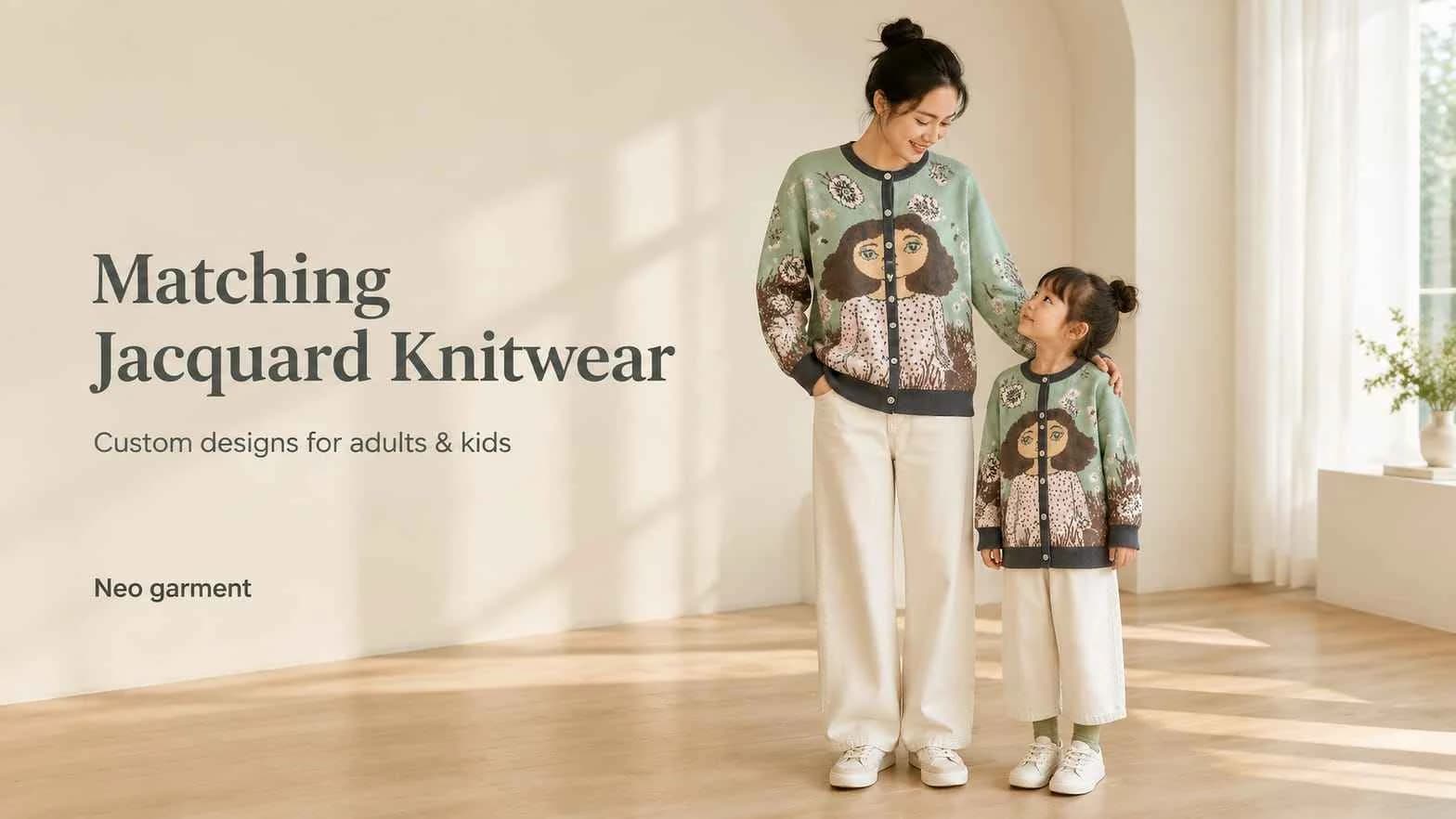
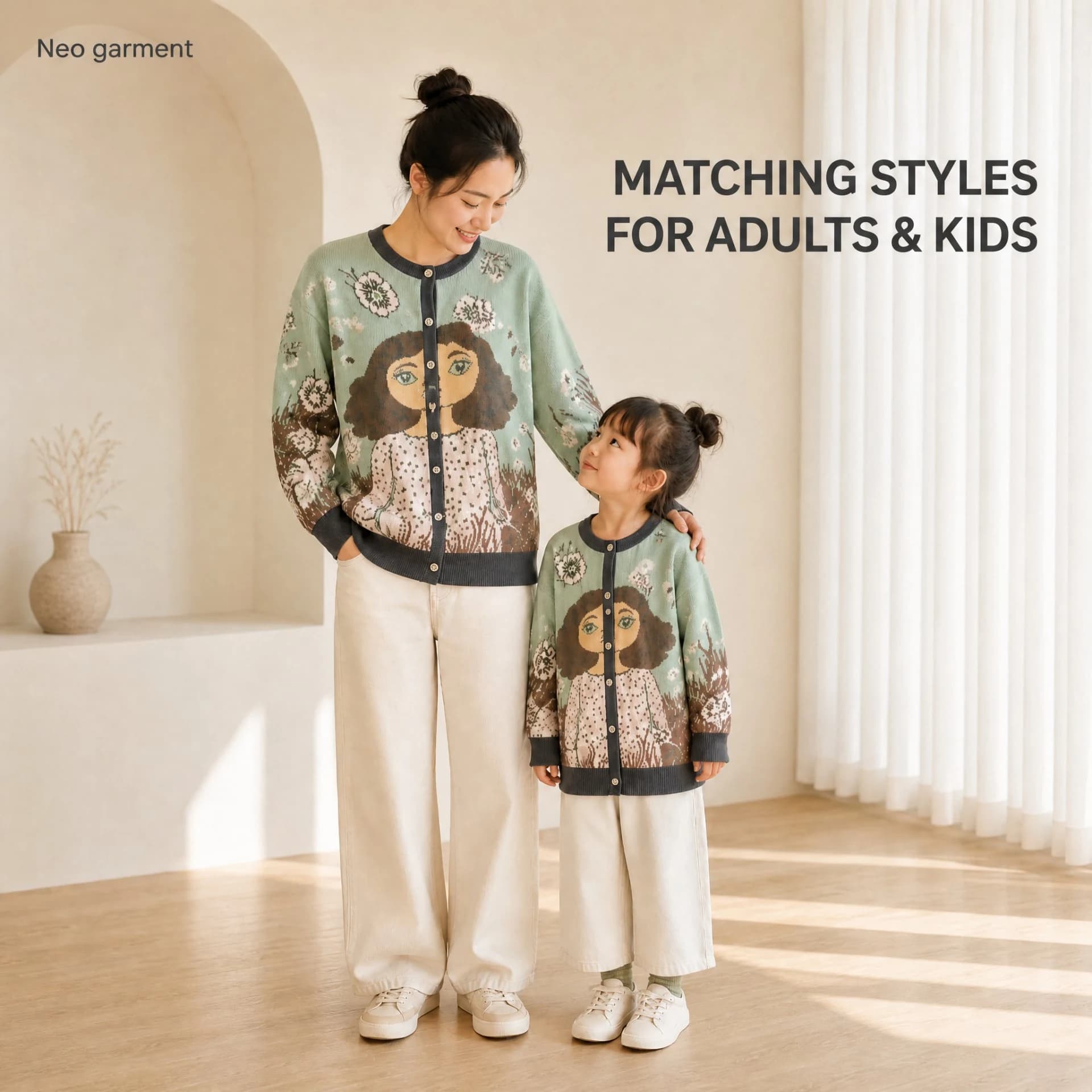
Matching adult and kids knitwear is usually briefed as a sizing job: take the adult artwork, grade the pattern, knit the small ones smaller. The two garments are knitted at the same needle pitch over very different panel widths, so the artwork lands on two different stitch grids — and what looks like a sizing decision is really a decision about scale. Below is the choice, the four costs that follow from it, and the checks worth writing into a spec. The style photographed here is our matching kids and adult jacquard cardigan.
The photograph at the top of this page is the argument in one frame. On the adult cardigan the illustrated face sits on the chest as a motif with room around it — ground visible at the shoulder, a band of pattern running down each sleeve. On the child's cardigan the same face is smaller in absolute size but occupies most of the front panel, because the panel lost width faster than the motif lost height. The sleeves carry a compressed version of the same floral band. Nobody reads those two garments as different designs.
That is what a matching programme is buying, and it is also where the cost sits. A matching pair is not one design made twice. It is a promise that two garments will read as one design when they are seen together — and that promise can be kept in at least three different ways, each of which produces a different garment, a different number of stitch charts and a different price.
Three Ways to Hold a Pair Together
- Hold the physical size. The motif stays the same number of centimetres tall on both garments, so the child's cardigan carries a face the same size as the adult's. It reads as a genuine miniature, and it dominates a 2Y front — the panel is narrower than the motif wants, so the drawing either crowds the placket or loses its ground at the shoulder entirely.
- Hold the proportion. The motif shrinks in step with the panel, keeping the same share of the front on both. Cheapest, and the usual default. It is also the version that most often disappoints in the lookbook, because it produces an adult garment knitted small rather than a design made for a child.
- Hold something in between. Reduce the motif, but by less than the panel ratio, so it grows slightly in share of the front while still getting smaller in absolute size. This is what the pair in these photographs does, and it is the compromise we would start with on most programmes — enough scale reduction to sit properly on a child, enough physical size for the face to survive.
There is no universally correct answer here, and a supplier who offers one without asking about your size range is guessing. What matters is that the choice is made once, in writing, at brief stage — because chart count, gauge lock and the size run all follow from it, and none of them can be recovered later without redoing the artwork.
The Canvas Moves Even When the Artwork Does Not
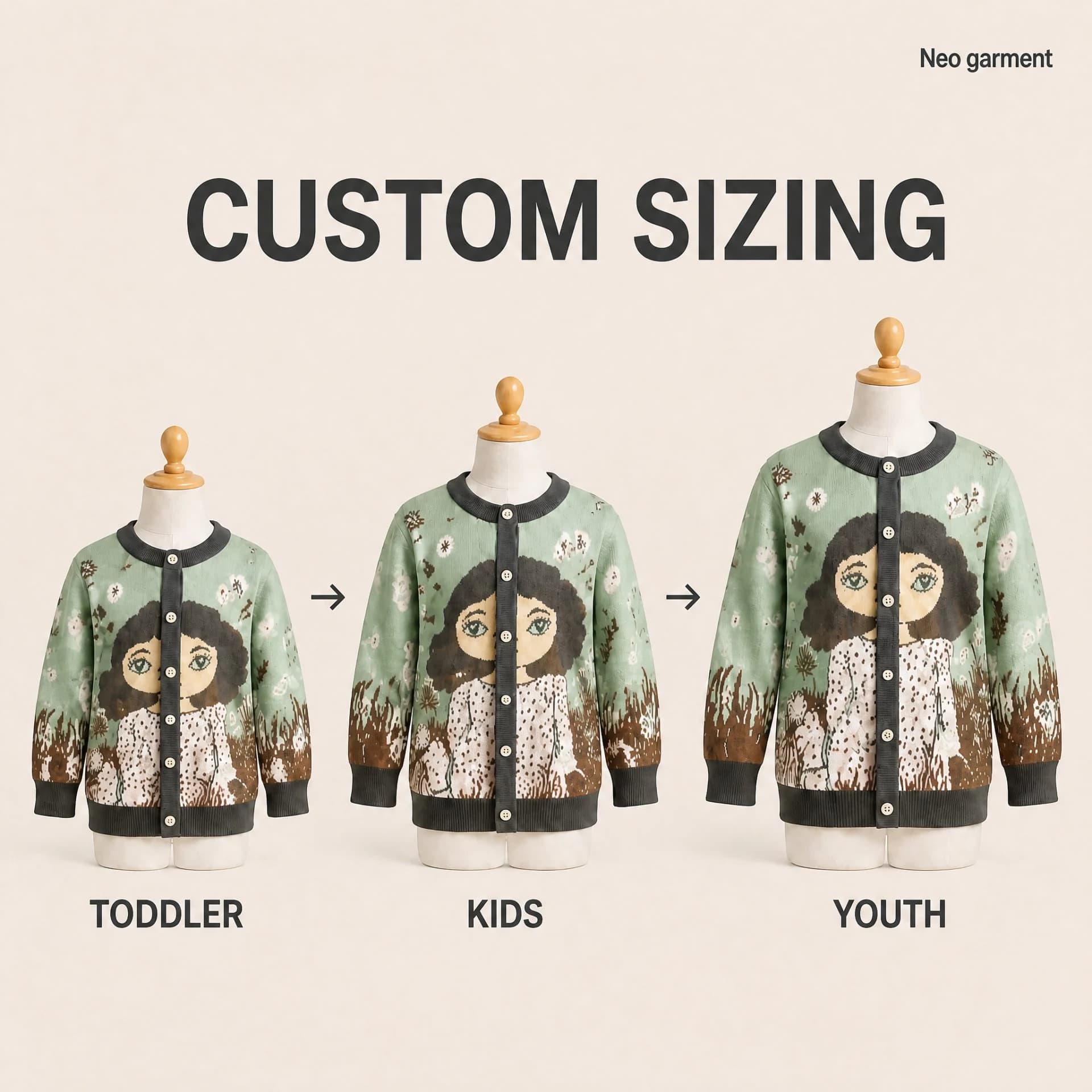
At 7GG the needle pitch is fixed at roughly 2.7 stitches per centimetre across the bed. That number belongs to the machine, not to the size you order, so it does not change between a toddler's front and an adult's. What changes is how many needles the panel is wide. A 2Y front around 40 cm carries about 110 needles; an adult front of the same style carries around 150.
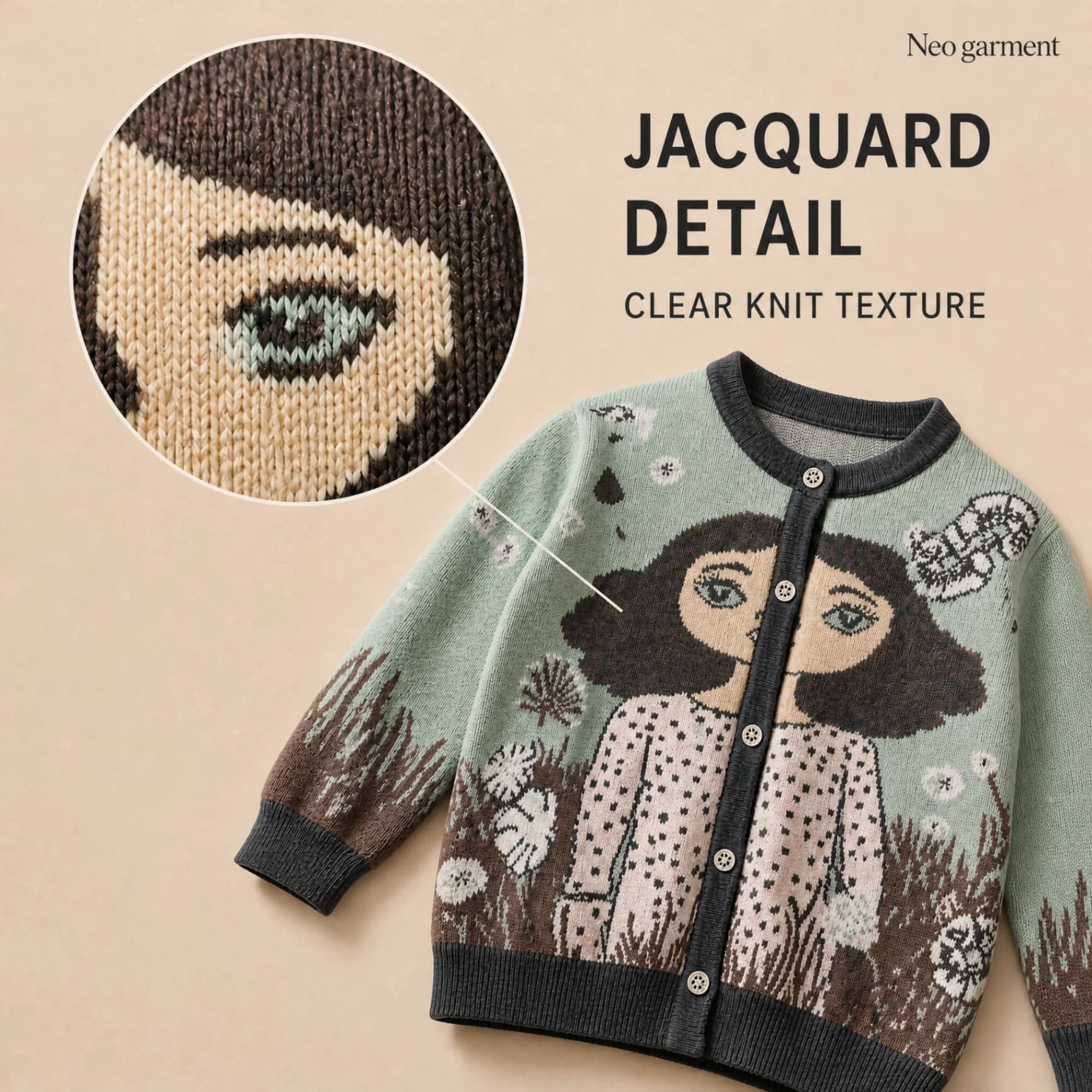
Place the identical artwork, unrescaled and unedited, on both panels and the ratio between motif and panel has already shifted by roughly 1.4x. The drawing did not move — the canvas around it did. That single shift decides whether a character still looks like itself, because recognition lives in the smallest elements of a drawn face: the lash line, the eyelid, the highlight inside the eye, the corner of the mouth. Those go first when a panel loses a third of its needles.
The difference from a geometric motif is worth being blunt about. A geometric pattern degrades gracefully: lose a repeat and it still reads as a pattern. A face does not degrade gracefully. It stops being a face, and it does so somewhere between the adult needle count and the toddler one, which is why a straight proportion grade can produce a garment that looks correct in a technical drawing and wrong on a hanger.
Sleeves Are Where a Scatter Turns Into a Border
Sleeve panels fail differently from fronts, and they fail quietly. A scattered floral repeat on an adult sleeve might place five or six motifs down the arm, which reads as random. Compress the same repeat onto a child's sleeve and only three placements fit. Three is not a scatter — the eye reads three marks in a line as a border, and the sleeve starts to look like a trim instead of a print.
So the sleeve is re-charted against the number of placements the panel can actually carry, not against the scale of the individual flower. That is why the sleeve band on the kids' garment in these photographs is looser than a strict scale-down would make it. Sleeves are also the part of a matching programme most often skipped: fronts get checked because fronts are what the customer looks at, while sleeves get graded because grading is faster. The mismatch then shows up in the photograph, at the angle nobody examined during development.
Gauge Gets Locked Across the Pair
The instinct on a children's style is to knit the small sizes finer — 12GG instead of 7GG gives a lighter garment, uses less yarn, costs less, and produces a surface that feels appropriate for a child. That is sound reasoning on a stand-alone kids' garment and wrong on a matching pair. Gauge fixes the physical size of every stitch, so 7GG beside 12GG means the purl gutters, the motif edges and the surface texture are all at different scales. From two metres away, which is where a family photograph is taken, the two garments stop reading as one design. You end up with a matching colourway and a non-matching surface.
Locking the gauge has a real cost, and it is worth stating plainly: the child's garment carries the same stitch size as the adult's, so it consumes more yarn per square centimetre than a finer-gauge equivalent would, and the usual cost lever on childrenswear disappears. That is the trade a matching programme makes. It should be quoted at brief stage rather than discovered when the sample arrives and the two garments look like cousins.
One Dye Lot, Not One Per Size
A single garment can sit a couple of percent off the approved shade and nobody notices. A pair photographed together cannot. The adult and kids panels are separate runs — different panel widths, often different machines — and if those runs draw from different dye lots, the difference invisible on a hanger becomes the most visible thing in the only photograph the programme exists to produce.
So the yarn lot is treated as one commitment across both runs rather than one per size, and the approved lot is held through repeats. Pale grounds are where this bites hardest: the sage ground in our pair shows a lot shift that a navy or a charcoal would hide. Testing colourfastness on the assembled pair, washed together, catches both lot drift and the ground-against-contrast-rib problem in a single pass.
What a Size Run Does to the Minimum
MOQ is 100 pieces per design, and on a matching programme the kids' garment and the adult garment count separately — they are two stitch charts and two marker sets. A two-garment family set therefore opens at 200 pieces, not 100, and adding a men's version takes it to 300. This is the number that ends most first orders, and it is better to decide the size run against it than to discover it after the artwork has been approved.
The practical move is to narrow the range rather than widen the order. A programme that photographs as matching needs far fewer sizes than a programme that covers a family's wardrobe: toddler, kids and one adult size is enough to shoot, enough to sell a pair, and three charts worth of work. The distinction to hold on to is that a chart is needed per class — where the panel width changes enough to change how the motif reads. Sizes inside a class can be graded off the nearest chart. A four-size kids' range is not four charts; a kids' range plus a youth range plus adult usually is three.
Five Checks Before a Matching Pair Goes to Bulk
- Chart count is written into the spec, per class and not per style. If the spec says one artwork, ask how many charts it becomes and at which size each one starts.
- Gauge is stated as a single number for the whole pair. Two gauges is two surface textures, and no colour match rescues that.
- One dye lot covers both runs, and the approved lot number appears on the paperwork you sign.
- Colourfastness is tested on assembled garments washed together, not on swatches — a contrast rib against a pale ground is the combination that fails first.
- The two garments are photographed together in daylight before shipment, and that photograph is the approval. It catches in ten minutes what a spec sheet only catches after a bulk order.
A photograph is the test that a matching programme is actually designed to pass. If the pair does not read as one design inside a single frame, the charts were wrong somewhere upstream — much better to find that on a pre-production pair than on a shipment.
What to Send Us
To quote a matching programme we need four things: the artwork as a vector or high-resolution file, the size run by age and by adult size, the ground colour plus a count of the motif colours, and the season or landing date. If a reference garment exists, send that too — reversing the band sequence from a real piece is faster and more accurate than working from a flat illustration.
What comes back is a chart per class with its colour separation, a gauge and yarn plan covering both garments, and a lot commitment that spans the pair. Sampling runs 72 hours from yarn stock confirmation, bulk production 2 to 3 weeks after PPS approval, and the minimum above counts kids and adult separately. If your programme needs a character that must survive at 2Y, that conversation belongs at the first brief rather than at the artwork stage.
Looking to manufacture this style at scale?
Send us your design brief and we'll quote a direct-factory run with low MOQs, 72h sampling and DDP worldwide delivery, knitted on our own floor in Dalang.
Knitwear you can manufacture right now
Custom Kids & Adult Matching Jacquard Cardigan
One illustrated jacquard artwork, two stitch charts — toddler to youth and adult from the same design, not one chart scaled down.
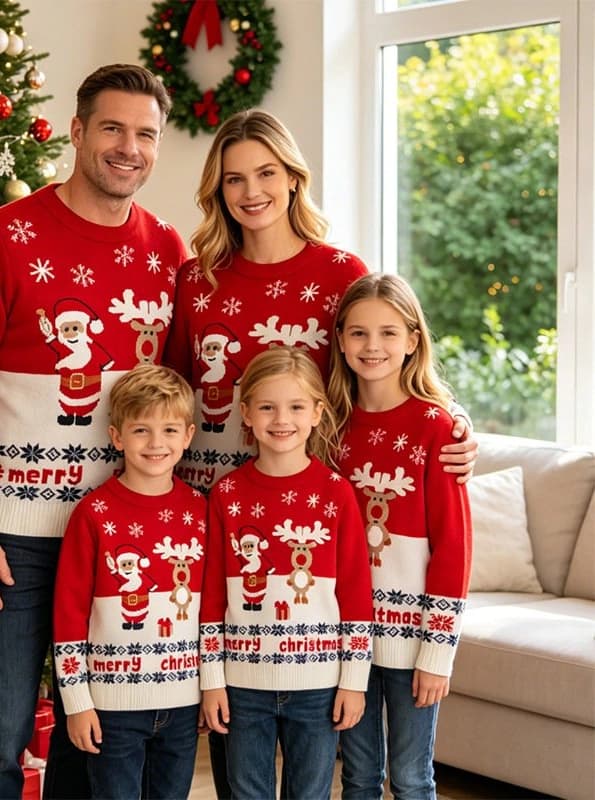
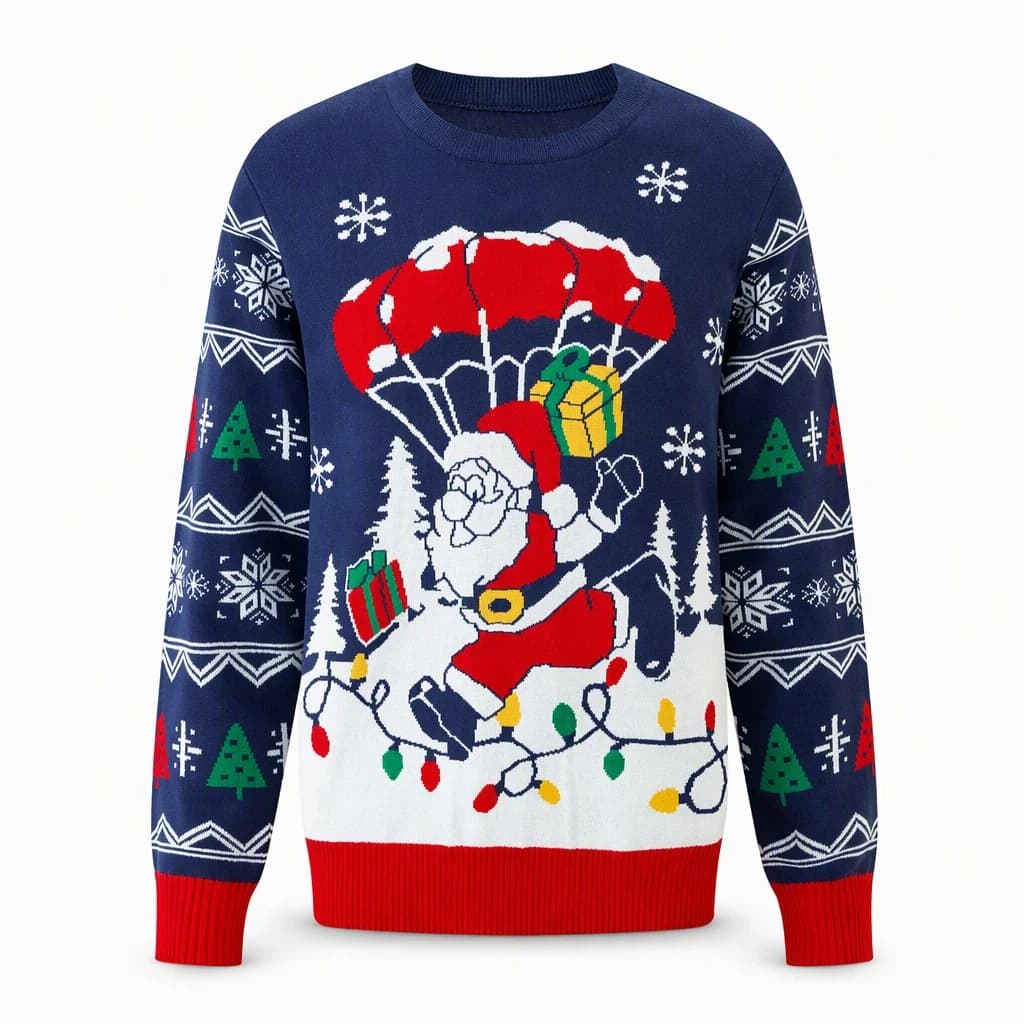
Custom Family Matching Christmas Jumper
Kids and adults graded from one block, so the set reads as a single design instead of six scaled-down copies.
Techniques behind this product
Keep reading
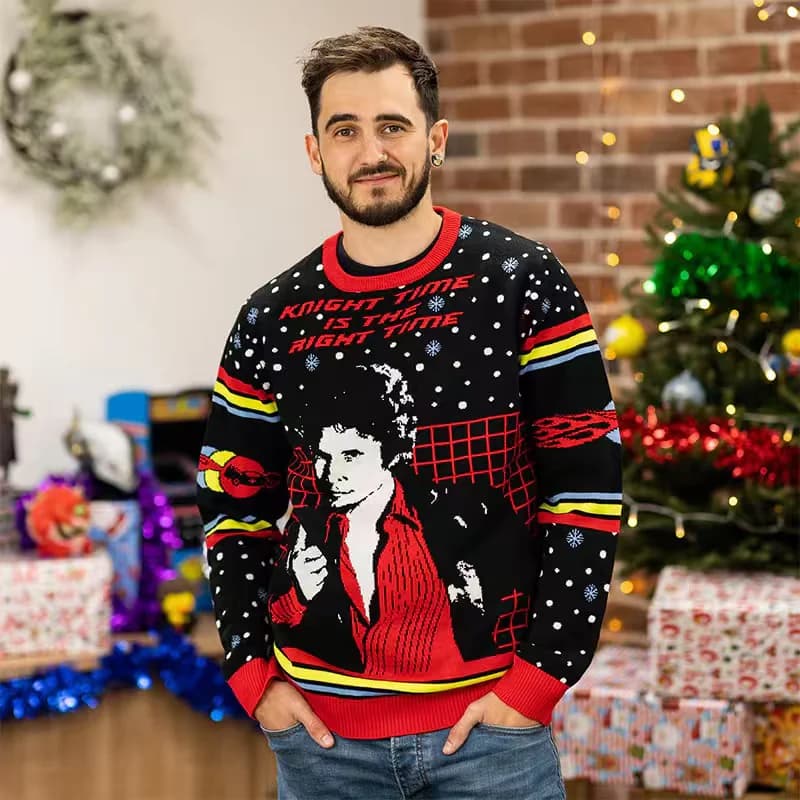
It's Time to Custom-Own Your Christmas Jumper
A short consumer-oriented overview of the custom Christmas jumper trend — design ideas, group-event tips, and the festive looks defining this year's holiday season.
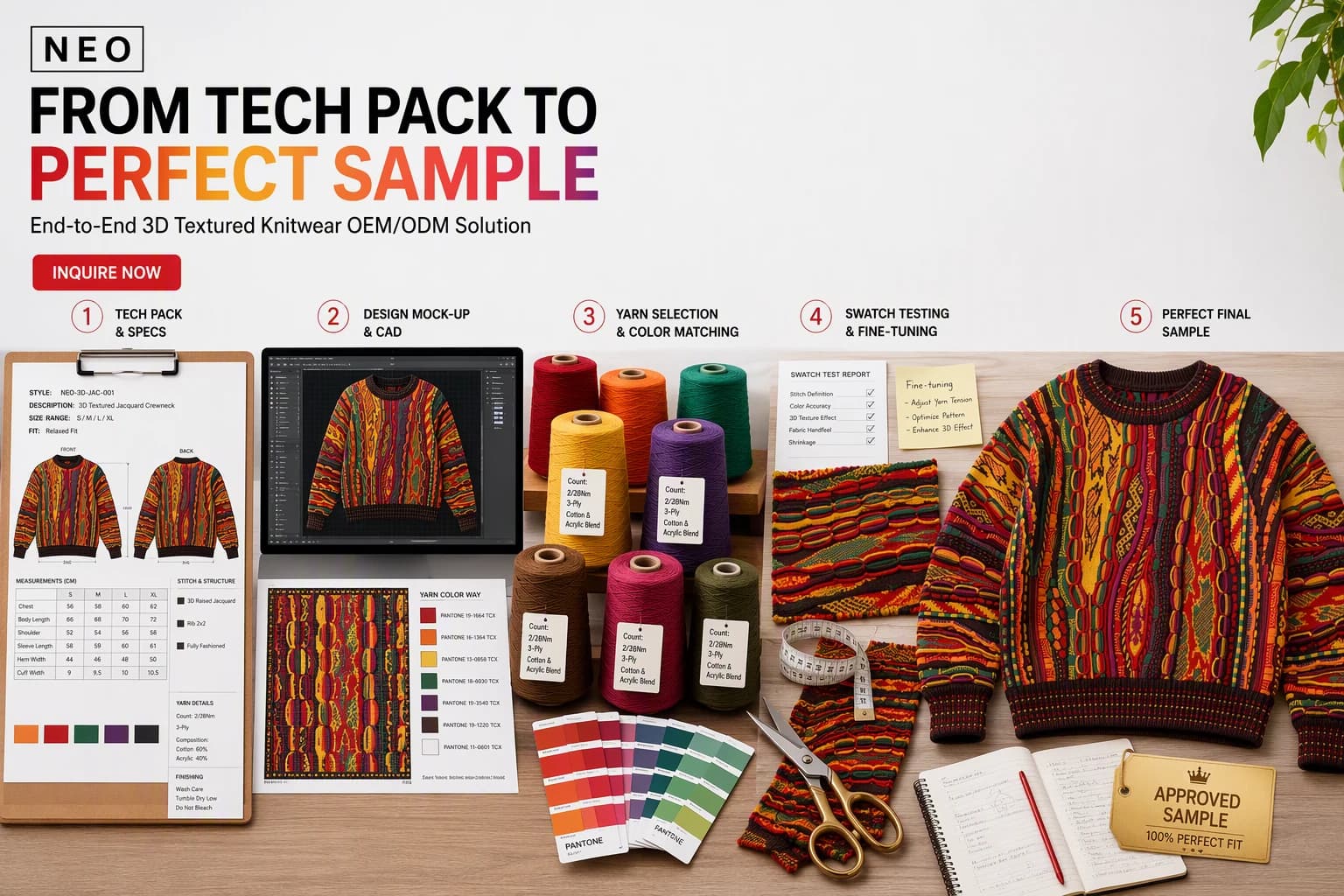
From Tech Pack to Perfect Sample: How Knitwear Sampling Actually Works
A floor-level walkthrough of the five stages between your tech pack and an approvable knit sample — mock-up and CAD programming, yarn colour matching, swatch testing, and the final PPS.
Sourcing Custom Men's Knitwear: What Separates a Knitwear Factory from a Sweater Mill
Mens knitwear briefs rarely fail on the design. They fail on gauge, size grading and reverse-side finishing — three things most price requests never ask about. Here is what to specify before you ask for a quote.
Send us the piece you were told was too hard.
Reference photo, rough sketch, or full tech pack — our Dalang technical punchers evaluate feasibility, machine gauge, yarn options, and pricing within 24 hours.