
Dressed on the Form: The Fit Check Every Sample Goes Through
Before a sample is photographed or approved, it goes onto a form at its own size. Collar sit, shoulder line, armhole, hem balance — what a fitting check catches that a tape measure never will.
This post is about the fitting gate, not the measuring gate. Flat measurement — the points that get measured, the tolerances, the AQL sampling — is a separate article. This one is what happens before the tape measure comes out: the sample on a form, in the sample room, judged by eye and by hand.
Every sample that comes off the linking table goes onto a form before anyone measures it and before anyone photographs it. The form is a fixed block. It does not slouch, it does not shift its weight from one hip to the other, and it does not lean into the garment the way a person unconsciously does. Take the body out of the picture and what is left is the garment's own construction, standing or collapsing on its own merit.
That is the whole argument for using one. A knit can hit every number on a spec sheet and still be wrong, because most of what a buyer actually sees is a relationship between measurements rather than the measurements themselves: where the collar sits against the neck, whether the shoulder line runs level from neck to shoulder point, whether the front hem hangs at the same height as the back. None of those are points on a size chart. All of them are visible in ten seconds on a form.
Why the Form Comes Before the Tape Measure
Flat measurement and form fitting answer different questions, and the order matters. Measured flat, a garment tells you whether it was knitted to spec. On a form, it tells you whether the spec was the right spec. Those are not the same failure. A panel that is 1 cm narrow is a production problem, and it gets caught on the table. A panel that is consistently 1 cm narrow on both the front and the back of a garment whose armhole was drawn for a wider body is a pattern problem, and it will pass every measurement in the sheet on its way to your inbox.
So we fit first and measure second. Fitting is fast and unforgiving; measuring is slow and precise. Doing them the other way round means spending an afternoon verifying numbers on a garment that was never going to hang correctly, and discovering the shape problem anyway once it is on a body.
The Six Checks, in the Order We Do Them
- Collar sit. Where the fold or the stand meets the neck, and whether it stands away at the back. A collar that floats off the nape on a form will float on a person too, because the form has a hard cylindrical neck and a real neck tapers — so a gap here is a warning rather than a verdict, but it never gets better on a body.
- Shoulder line. The seam should run level from the neck to the shoulder point, and the shoulder point should land where the pattern put it rather than extending past the form's shoulder or stopping short of it. This is the fastest read on whether the block itself is right.
- Armhole and sleeve pitch. Does the sleeve hang vertically, or has it rotated forward or backward? Where does the underarm sit relative to the chest? A sleeve that swings forward by two centimetres is a pitch problem, and it will read as a twisted sleeve for the life of the garment.
- Front-to-back balance. Look at the hem from the side. If the front is longer than the back, the hem lifts at the front and the side seams swing forward; if it is shorter, the front rides up. Both can happen entirely inside tolerance.
- Side seam. Vertical, or spiralling toward the front or the back. A spiral means the front and back panels came off the machine at different lengths, or the side seam was linked under uneven tension.
- Details in relation to each other. Placket straight when buttoned, buttons evenly spaced, pockets level with each other, ribbed hem sitting at the same height all the way round. Individually trivial. Collectively the difference between a sample that photographs well and one that looks homemade.
A Garment Can Measure Right and Still Hang Wrong
Take a cardigan with a 50 cm chest and a 40 cm shoulder, both dead centre of a ±1 cm tolerance. Now knit the front panel 1.5 cm longer than the back. Every number in the sheet still passes, because tolerance is a rule applied to one point at a time and nothing in it describes how two points relate to each other. On the form it is obvious within seconds: the front hem drops, the side seams lean forward, and the whole garment appears to be sliding off the shoulders even though nothing has moved.
This is the class of error a size chart cannot hold, and it is the reason the fit check exists as its own step rather than a line item inside inspection. Relationships need a body — even a wooden one — before they can be judged.
Knitwear Has to Rest Before It Can Be Judged
A knitted panel comes off the machine shorter and tighter than it will ever be again. The yarn has been pulled through the needles under tension for hours, and it needs time and moisture to relax into its final dimensions. Fit a sample straight off the linking table and you are fitting the machine's tension, not the garment. So the sample is washed, dried flat and left to rest before it goes anywhere near a form.
This matters far more on a heavy, highly textured piece than on plain jersey. A cable pulls its own panel inward as it relaxes, seed stitch opens up, and a garment that measured correctly on the table can gain a centimetre of length and lose half a centimetre of width by the time it has settled. All of that happens before the customer ever sees it, which is exactly why the form rather than the table is where the last judgement is made.
Where the Weight of the Embellishment Changes the Answer
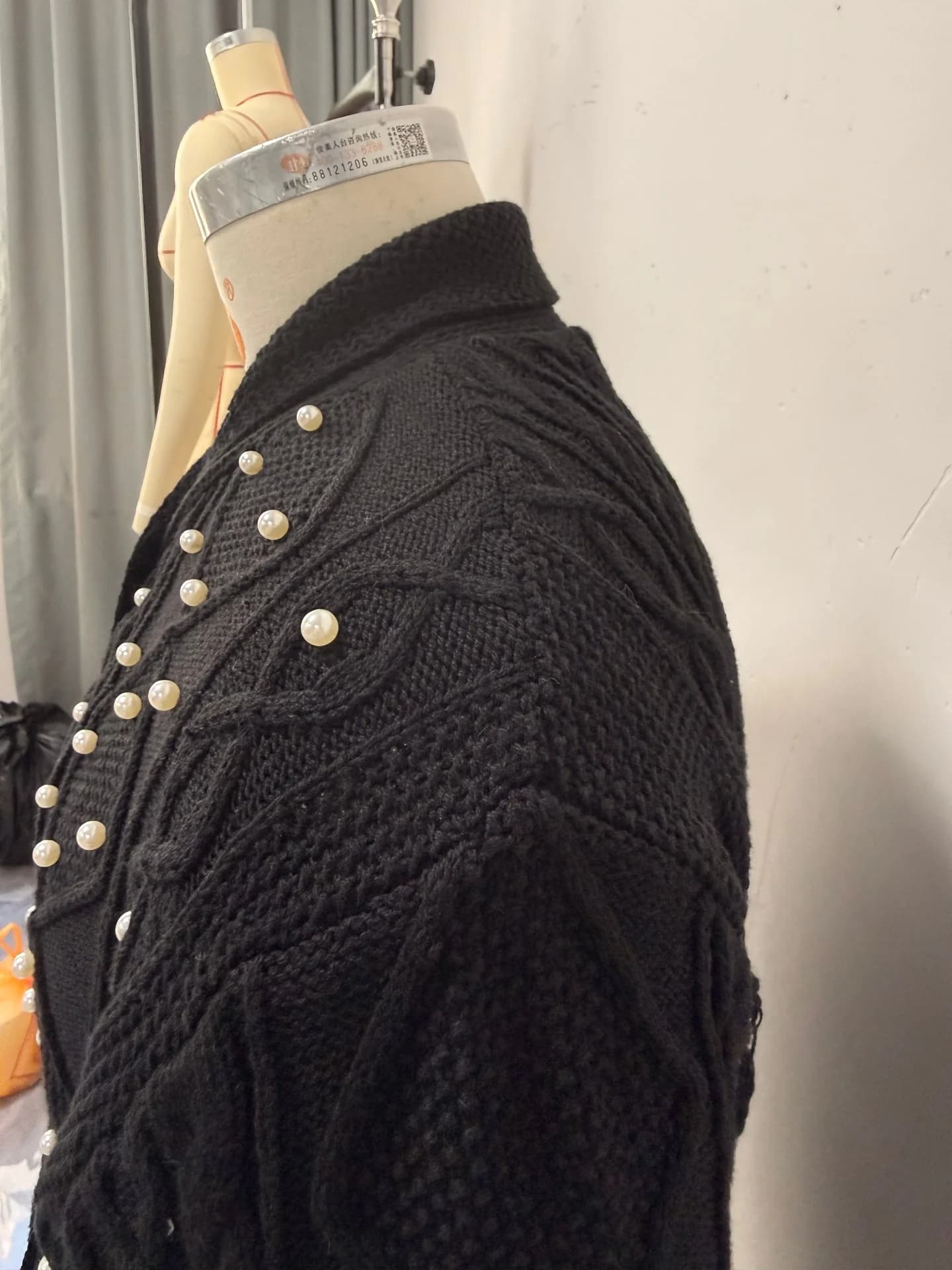
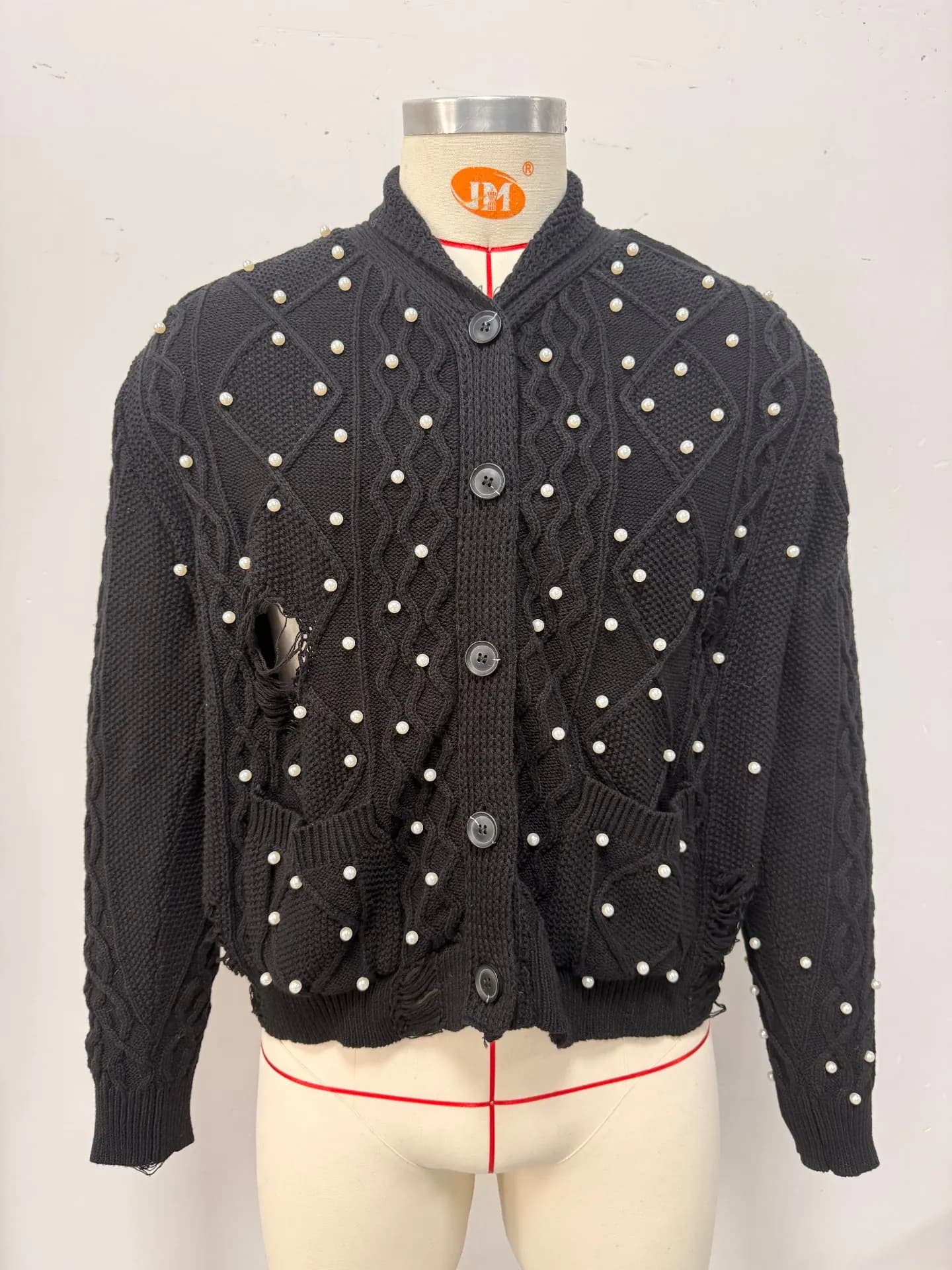
The sample in these photographs is the case in point. The body is a diamond lattice in seed stitch with rope cables running between the diamonds, and the front carries a scatter of pearl beads set at the points of the lattice. That front panel is heavier than the back panel, and the heavier panel drops. On the form you see it as a slightly forward hang and a hem that sits fractionally low at the front.
There are only three ways to answer that, and all three are pattern decisions rather than finishing decisions. Knit the front panel shorter by the amount the weight takes up. Tighten the hem rib so it holds the extra mass. Or accept the drop and set the back panel to match it. Whichever is chosen, it is settled at the form, on the first sample, before anything is graded.
The piece is also a heavy-work garment, and that changes what the check is looking for. The pearls are placed one at a time at the points of the lattice. The rope cables stand proud of the surface instead of sitting flat in it. The seed-stitch diamonds underneath carry the surface. Very little of the labour is in the knitting itself — most of it is in the placement that follows — and that puts two things on the form at once. Weight, as above. And an opening in the front panel that is cut and worked deliberately: a distressed break in the knit, with the raw yarn ends secured so the break stays where it was put rather than travelling. In a photograph it reads as damage. In the sample room it is a design line, and it is inspected as one — the edges of the opening even, the placement matched to the point marked in the pattern, and every size showing the break in the same place once the panel is graded, which is not automatic.
The Side View Catches What the Front Cannot
Most fit problems are invisible head-on. A garment can look immaculate from the front and lean forward in profile, and the profile is where front-to-back balance actually lives. Turn the form ninety degrees and three things become readable at once: whether the collar stands away from the nape, whether the shoulder seam runs level over the shoulder instead of sliding backward, and whether the hem is horizontal or tipped.
The profile also shows the armhole honestly. From the front a sleeve can look correct simply because the arm covers the seam. Side-on, the whole armhole curve is visible, and so is the point where the sleeve head meets the shoulder — the join that decides whether the garment reads as tailored or soft for the rest of its life.
What the Form Cannot Tell You
- Movement. Whether the sleeve rides up when the arm lifts, whether the shoulder pulls on a forward reach, whether the underarm binds. A form has no range of motion, and most real complaints come from exactly this.
- Sitting and bending. Hem length, back rise, how the rib recovers after being stretched over a hip. None of it is visible standing still.
- Soft tissue. A form is hard; a body is not. A garment that hangs cleanly on a block can collapse over a real shoulder or stretch across a real chest.
- How the piece wears in. Knit grows. A fit that is correct on day one is looser on day thirty, and the form cannot show you the direction of that drift.
- Bodies other than this one. One form is one block. If your customer is 157 cm and our form sits at a standard M, the length relationships change even when every circumference is correct.
So the form is a filter, not an approval. It removes the samples that were never going to work and it settles the structural questions early and cheaply, before grading. The last word belongs to a fit model, or to you, wearing the thing.
What We Need From You to Fit It to Your Block
Our form is a standard M block. That is a starting point, not an authority, and it is the one place where the fitting conversation turns into your product rather than ours.
- Your size spec, even a rough one. Chest, shoulder, body length, sleeve length, and the tolerance you can live with. Send the graded sheet if you have one; send the single size you sell best if you do not.
- A fit model's numbers, if you have one. Height, chest, shoulder and arm length — not a size label, because a medium means four different things at four companies.
- The reference garment. The one you already sell that fits the way you want this to fit. It carries the shoulder slope and neckline depth that a page of description loses.
- The intended wear. Layered over a shirt, or next to skin. Same measurements, two different garments.
- Your non-negotiables. If the shoulder must be 40 cm because the piece sits under a coat, say so at the start, because that constraint propagates straight into the armhole, the sleeve head and the chest.
With those five things we fit the sample to your block instead of ours, and the difference between the two usually comes down to a centimetre or two in three places: shoulder width, armhole depth and body length. Individually small. Together, the difference between a garment that looks like your line and one that looks like a factory sample.
What a Fit Comment Actually Changes
A knit panel cannot be let out. There is no seam allowance to release and no fabric to take in, because the panel was knitted to shape rather than cut from cloth. So a fit correction is almost always a re-knit of one or more panels, not an alteration — which is the reason to do the fit check properly the first time.
- Collar and neckline: stand height, neck opening, and the length of the collar band. A collar that gaps at the back is usually a band that is one or two centimetres too long.
- Shoulder: the shoulder width on the pattern, re-graded across the size run, with the armhole redrawn to match.
- Armhole and sleeve: depth, cap height and pitch. Pitch is a rotation rather than a dimension, and it is the correction buyers most often forget to ask for.
- Balance: front and back panel lengths adjusted against each other, then the hem rib re-tensioned.
- Length: body and sleeve, which also move the yarn consumption and therefore the price.
Each of those is a second sample round. On our standard programme a sample takes 72 hours from yarn stock confirmation, and a re-fit after your comments starts that clock again, because it is a new knit rather than an adjustment to the old one.
Frequently Asked
Is the opening in the front panel a defect?
No. It is a deliberate distressed opening, cut and worked into the panel as part of the design, with the raw yarn ends secured so the break stays where it was put. On a heavy-work piece it is a fit-check item in its own right: the opening has to land on the point marked in the pattern, and it has to land there on every size once the panel is graded, which is not automatic. If your design does not call for it, the same panel is knitted closed.
Do you fit every size, or just one?
One base size on the form, then the rest of the run checked flat against the graded spec. A form is a single block, so pulling a size L over a size M form tells you nothing useful — the honest way to verify a whole size run is one physical form per base size, and most programmes do not need that. What we do instead is settle the base size on the form and confirm that the grade between sizes is arithmetically consistent on the table.
Can I see the fitting photographs?
Yes. The two in this article are exactly what that looks like: front and profile, taken on the form, straight out of the sample room. If you want them for a specific sample, ask when you place it and we photograph the fit stage as a matter of course.
What if I do not have a fit model?
Send body measurements and a garment you already sell that fits the way you want this to. Those two together describe a block more accurately than most spec sheets, because the reference carries the shoulder slope and the neckline depth that a measurement list leaves out.
Does the fit check cost extra?
No. Fitting is part of sampling, which is quoted separately from bulk. A second fit round after your comments is a new sample and is priced as one — which is the reason to put everything into the first set of comments instead of sending them in stages.
How long does approval take once I have the sample?
That part is on your side, but the clock on ours is 72 hours from yarn stock confirmation for a re-sample, and bulk production is 2–3 weeks after PPS approval. Every week a fit comment sits unread is a week added to the delivery date, and it is the most common cause of a late order that nobody planned for.
If you have a style in development and you are not sure whether the shoulder or the collar will read the way you want, send the technical drawing and the size you are aiming at. We will fit it on the form and send the two photographs — front and profile — with notes on what moved and what did not. MOQ is 100 pieces per design, sampling runs 72 hours from yarn stock confirmation, bulk production 2–3 weeks after PPS approval, and DDP door-to-door to US, EU, UK, AU and JP.
Looking to manufacture this style at scale?
Send us your design brief and we'll quote a direct-factory run with low MOQs, 72h sampling and DDP worldwide delivery, knitted on our own floor in Dalang.
Knitwear you can manufacture right now
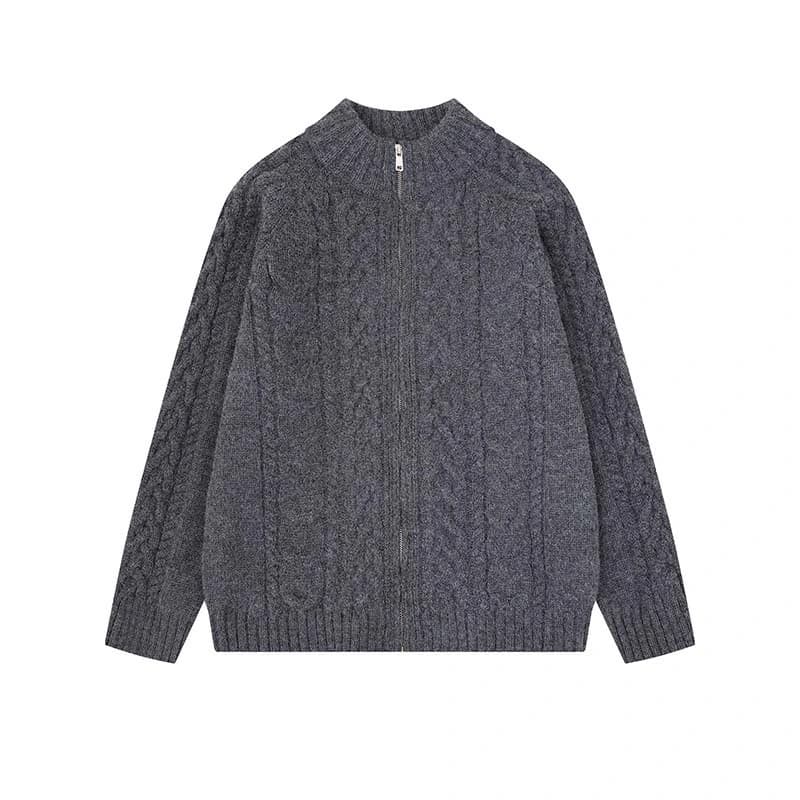
Custom Mock Neck Cable Zip Cardigan
A stand collar that stands, a raglan shoulder that carries the cable over the arm, and a chain cable body — zipped top to hem.

Custom Full-Zip Wavy Cable Cardigan
A fold-down rib polo collar and a full-length metal zip over a wandering wavy cable — zip-up knitwear that reads tailored, not sporty.
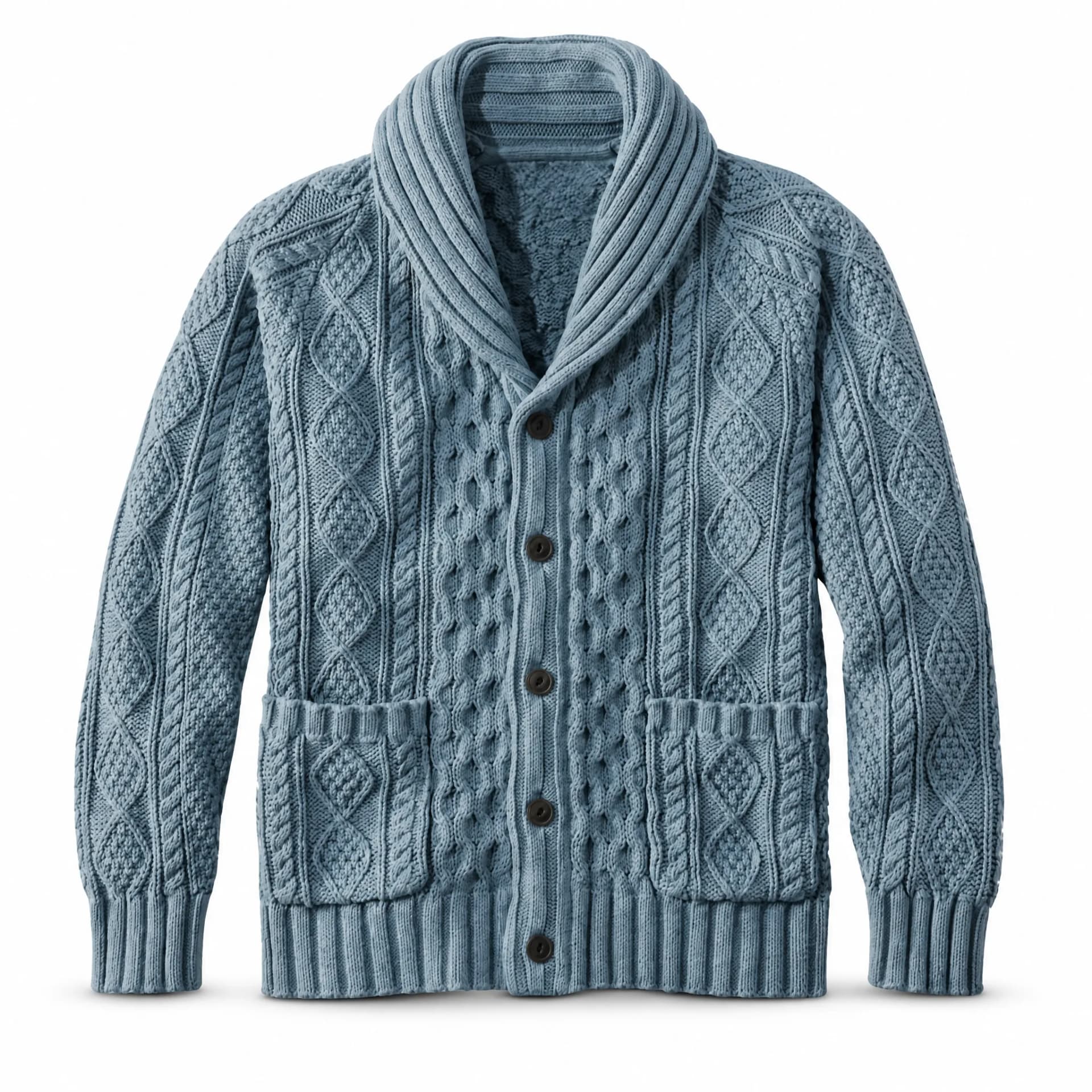
Custom Shawl Collar Cable Knit Cardigan
Chunky cable-and-diamond cardigan with a fully fashioned shawl collar — knitted as structure, never cut and sewn.
Keep reading
It's Time to Custom-Own Your Christmas Jumper
A short consumer-oriented overview of the custom Christmas jumper trend — design ideas, group-event tips, and the festive looks defining this year's holiday season.
From Tech Pack to Perfect Sample: How Knitwear Sampling Actually Works
A floor-level walkthrough of the five stages between your tech pack and an approvable knit sample — mock-up and CAD programming, yarn colour matching, swatch testing, and the final PPS.
Sourcing Custom Men's Knitwear: What Separates a Knitwear Factory from a Sweater Mill
Mens knitwear briefs rarely fail on the design. They fail on gauge, size grading and reverse-side finishing — three things most price requests never ask about. Here is what to specify before you ask for a quote.
Send us the piece you were told was too hard.
Reference photo, rough sketch, or full tech pack — our Dalang technical punchers evaluate feasibility, machine gauge, yarn options, and pricing within 24 hours.