
What a Flat Knitting Line Actually Produces in a Day
Machine count is not output. A look inside a working flat-bed line — what those trays actually hold, why one sweater is five to seven pieces, and how to turn a capacity claim into a number you can plan around.
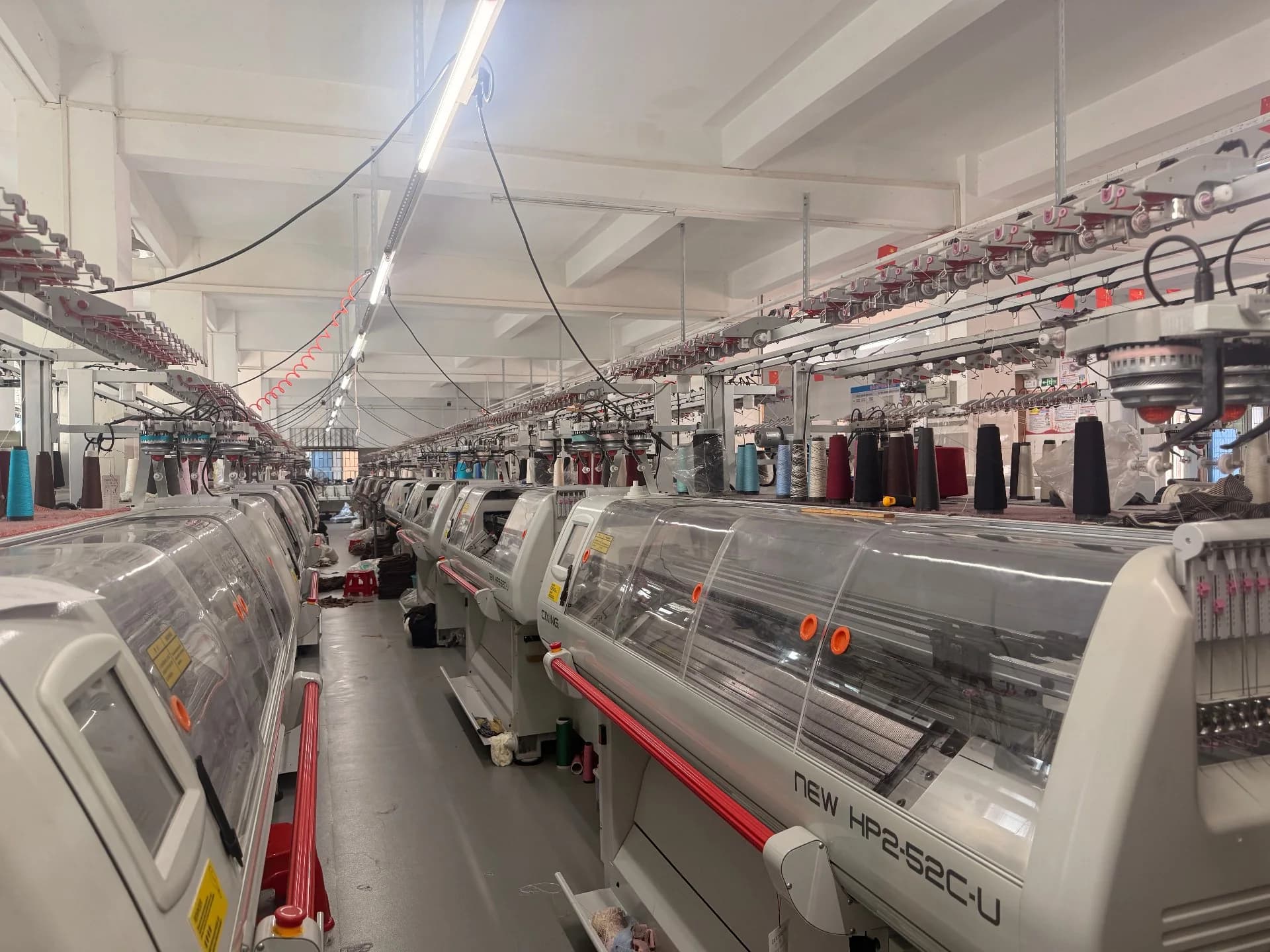
This article explains how flat-bed knitting capacity is actually calculated, using photographs from our own floor in Dalang. If you are planning a production run, the four questions near the end are the part to take into a supplier meeting. For tooling and sampling, start with our manufacturing capabilities.
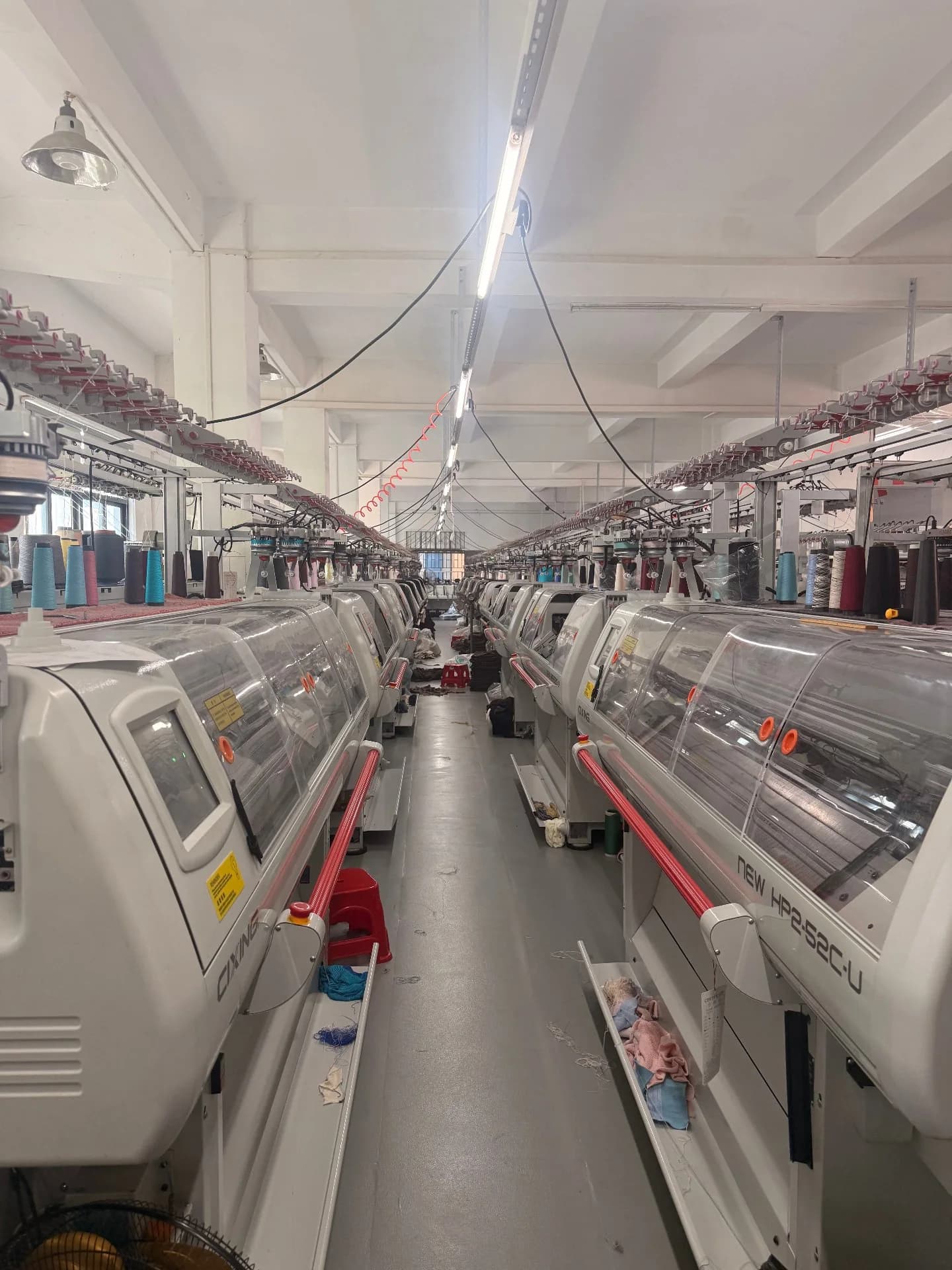
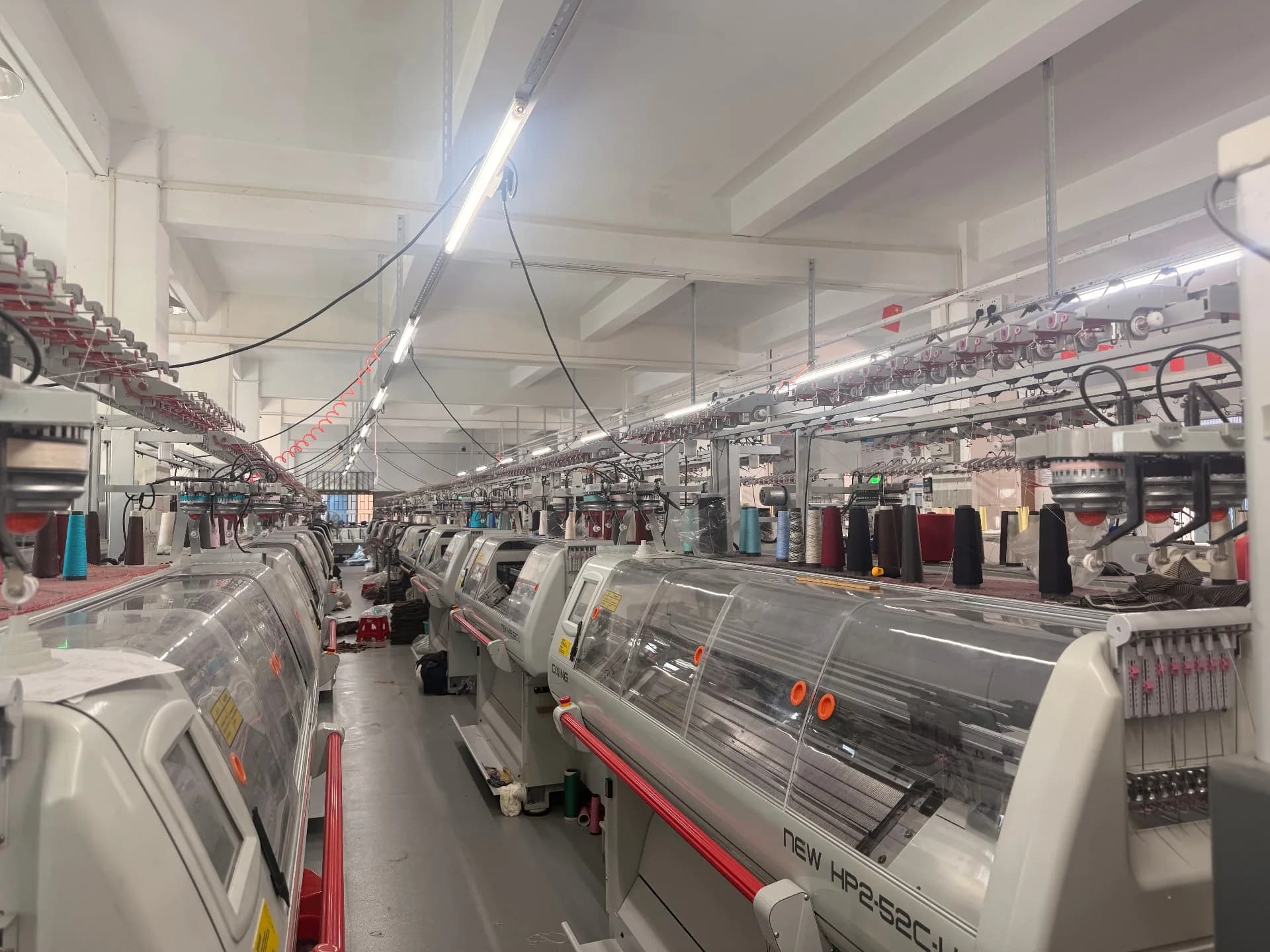
Almost every buyer who walks onto a knitting floor asks the same question within about ninety seconds: how many machines do you have? It is a reasonable question, and for planning a delivery date it is close to the wrong one. The photographs above show a flat-bed line running in our plant — two rows of computerised machines facing a narrow service aisle, yarn packages creeled overhead, and a shallow tray at the base of each machine holding whatever has just come off it.
Nothing in those trays is a garment. That single fact is the difference between a capacity number that survives contact with your order and one that collapses in week three, when you ask for a colour revision and discover the line has to be stopped to do it.
What the Photograph Actually Shows
Three details in the frame carry more weight than the number of machines in it, and all three are things a buyer can verify on a factory visit without opening a single document.
The yarn packages sit on a creel above each machine, not stacked behind it. Every cone on that rail is threaded to a specific carrier, and a carrier is a position the carriage can select as it travels across the bed. A machine with eight packages loaded is not a machine that can knit any eight colours in any arrangement — it is a machine that can present eight yarn ends to the needles, and your design decides how many of them may be live in the same course. That is the physical origin of the colour ceiling most buyers first encounter as a marketing number.
The clear hood covers the needle bed. Underneath are the needles, the sinkers and the carriage track, and the width of that bed is the biggest single constraint on what a given machine can make for you. It is stamped on the model plate, not printed in a brochure.
The tray at the bottom holds panels. On the right-hand machine in the first photograph you can see folded pieces in pale pink and blue waiting to be collected — those are fronts, backs, sleeves or trims, each knitted to its own shape on its own program.
One Sweater Leaves the Machine as Five to Seven Pieces
This is the number that distorts more capacity conversations than any other. A plain crew-neck pullover in a mid size typically leaves the knitting floor as five to seven separate items: a front, a back, two sleeves, a neck trim, and usually a hem or cuff trim knitted as a strip and attached later. A cable or intarsia style can add pieces on top of that, because a panel that has to match at the side seam is sometimes split so the pattern alignment can be controlled at the join.
It also matters how the panel is knitted. A fully fashioned piece is knitted to shape, with the armhole and neckline built in stitch by stitch, so there is nothing to cut afterwards. A cut-and-sew piece is knitted as a rectangle and trimmed after knitting, which is faster on the machine but wastes yarn and adds a separate cutting operation that can introduce its own defects. Neither is better in the abstract; they are different trades between machine time and material.
So when a supplier quotes you a daily figure, the first thing to establish is what is being counted. Thirty pieces a day and thirty garments a day are the same sentence with a five-fold difference hidden inside it.
Why Machine Count Is Not Output
A line of twenty-four machines running three shifts is not twenty-four times a single machine's hourly rate. A flat-bed machine runs one program at a time, so it runs one style at a time — there is no economy of scale inside a single machine, only across a longer run of the same style. Between runs, the same machine absorbs a set of fixed costs that never appear on a quotation:
- Programming and the first panel. A new style has to be drawn, converted into machine language, and knitted as a test piece before production starts. The test piece is usually scrapped, or kept as a sample.
- Yarn changeover. Threading a fresh set of packages, clearing the carriers, and knitting a test band to confirm the tension matches what the program expects. The time scales with the number of colours changed, not with the size of the order.
- Rework. A dropped stitch or a mis-set needle at course 300 of 400 sends the panel back. Small faults on a plain knit are often repaired by hand; on a jacquard they usually are not, because the repair reads as a patch.
- Waiting on yarn. A colour that lands late does not slow the machine down gradually, it stops a whole sequence, because the panels that need it cannot move forward and the panels after them cannot be loaded.
None of that is failure. It is the fixed overhead of equipment that produces one style at a time, and it explains a pattern buyers find confusing: a three-hundred-piece order and a three-thousand-piece order of the same style do not differ by a factor of ten in machine days. It is also why our MOQ guidance is framed around what a run has to consume to be worth setting up, rather than around an arbitrary round number.
The Number on the Model Plate That Sets Your Size Range
The model designation on a flat-bed machine usually encodes two figures, and buyers tend to ask about neither. One is the working width of the needle bed. The other is the gauge. Both are worth reading off the plate for the specific machine that will run your order, rather than accepting an average across a mixed floor.
Working width decides how much you can knit side by side. A wider bed lets a factory lay out a large panel, or two smaller panels at once, without the carriage running past the usable zone. It also quietly sets your size ceiling: once a body panel exceeds the usable width, the pattern has to be split and joined, which changes the structure of the garment and its cost. That is the real mechanism behind the size premium buyers notice at 2XL and above — it is not a different price list, it is a structural limit being crossed.
Gauge decides resolution, and it sets a floor on detail. The same artwork that reads cleanly at three gauge, where every stitch is a visible block, becomes a different design at twelve gauge, where the stitch is fine enough to hold a stepped gradient. Gauge also changes knitting speed in the direction buyers rarely expect: finer needles mean more courses per centimetre, so more minutes per panel for the same silhouette. Our sweater gauge chart covers the resolution side in detail; the capacity point is that the two numbers on the plate trade against each other and neither one alone describes the machine.
Changing Colour Costs Machine Time, Not Just Yarn
Buyers often treat a colour change as a purchasing problem: find the yarn, send it to the factory, done. On a flat-bed line it is a stoppage. The machine stops, the old packages come off, the new ones are threaded through the carriers, and a test band is knitted to confirm the tension matches what the program expects — because a yarn that knits at a different tension will shrink differently from the rest of the garment even when the colour is a perfect match.
The stoppage scales with the number of carrier positions being changed, not with the size of the order, which is why a five-colour revision to a two-colour style is a different order of interruption than a shade correction inside a colour you already run. It is also the practical reason a design that spreads its colours across stacked bands is cheaper to produce than one that needs all of them live at once: the changeovers happen once per band instead of once per course.
The calendar side of all this — how machine days become a delivery date, and where the buffer actually sits — is broken down in our knitwear lead time guide.
Four Questions That Turn a Capacity Claim into a Number
- What is that count measured in — panels or garments? This one question changes the answer by a factor of five, and it costs nothing to ask.
- Which machine will run my order, and what are its working width and gauge? A capacity figure without a machine attached is an average over a floor, and an average hides exactly the constraint your style will hit.
- How many hours does a colour change cost on that machine, and how many changes does my design need? Ask for hours, not for reassurance.
- What was the actual run length and scrap rate on the last three styles that machine ran? A factory that tracks scrap per style can answer this; one that cannot is quoting a best case.
A supplier who answers all four without leaving the room is giving you brochure numbers. A supplier who has to check a schedule and comes back with a range plus a caveat is describing a floor — and the range is the more useful of the two answers.
Frequently Asked
How many sweaters can a flat knitting machine make in a day?
There is no single number, and any supplier who gives you one without asking about your style is quoting a best case. Work in machine hours instead. A plain twelve-gauge pullover in a mid size commonly runs somewhere between one and two machine hours for the full set of panels, which puts a single machine in the region of a dozen garments across a working day once changeover and rework are included. Add colour, add cables, move to a heavier gauge or a larger size and that number falls — sometimes by half. The useful answer is a range with its assumptions attached.
Does a bigger order make each sweater cheaper to knit?
Up to a point, and the point arrives earlier than most buyers expect. Programming, the test panel and the yarn changeover are absorbed once, so the first few hundred pieces carry them and everything after does not. Past that, the marginal cost of the thousandth piece sits very close to the marginal cost of the five-hundredth. What volume genuinely buys is scheduling priority and a secured yarn position — not a lower knitting cost per unit. A supplier quoting a steep step-down at volume is usually moving cost between lines rather than finding real savings.
Can one machine knit both a chunky three-gauge and a fine fourteen-gauge?
Not usefully. Gauge is a property of the needle bed and the needle spacing, so a machine set up for coarse work cannot be re-tooled for fine work without replacing the bed. A factory running both needs both, which is why the machine list matters more than the machine count: twenty machines of a single gauge is a narrower capability than twelve machines spread across three.
The working summary: ask what is being counted, ask which machine will run it, and convert the answer into machine hours before you convert it into a delivery date. The machines in these photographs will knit almost any structure you can draw — the constraint is never the machine's ability, it is how many hours of it your design costs.
Looking to manufacture this style at scale?
Send us your design brief and we'll quote a direct-factory run with low MOQs, 72h sampling and DDP worldwide delivery, knitted on our own floor in Dalang.
Knitwear you can manufacture right now
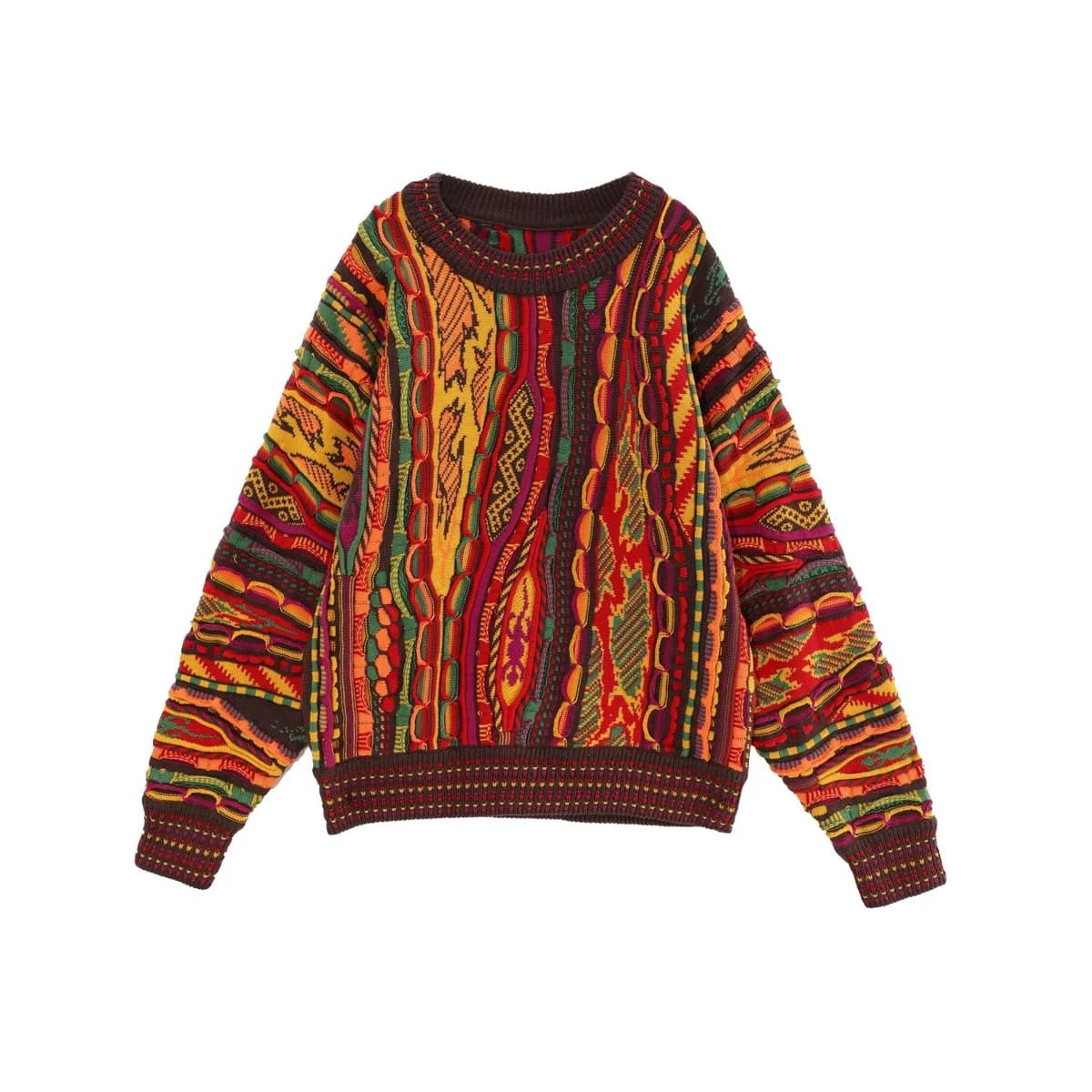
Custom Retro 3D Multi-Texture Knit Sweater
Jacquard, 3D relief and cable braid combined in one programme — the brief most factories decline to quote.
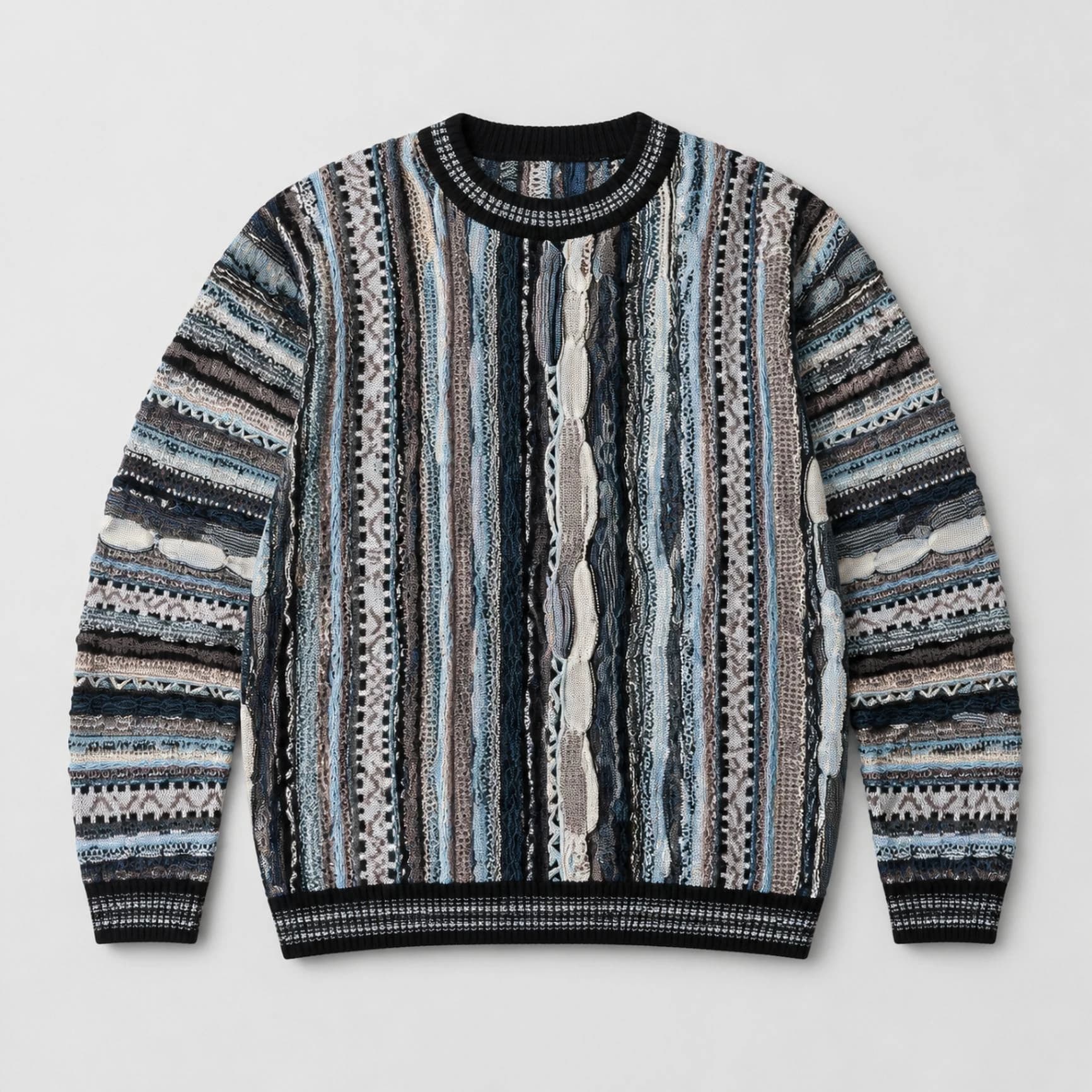
Custom Bitter-Gourd 3D Relief Knit Sweater
One crew-neck body carrying six stitch structures in a single tonal palette — the relief is knitted into the structure, not bonded onto it.
Techniques behind this product
Keep reading

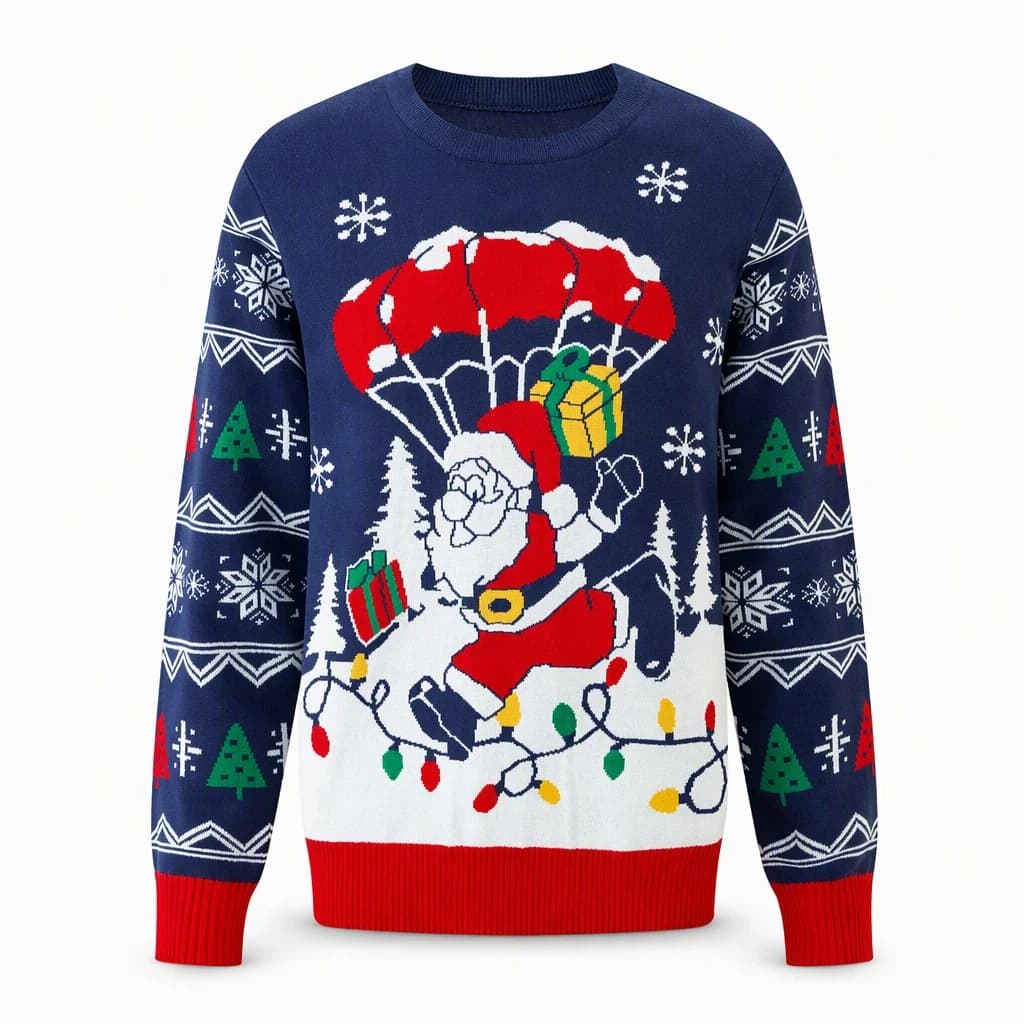
It's Time to Custom-Own Your Christmas Jumper
A short consumer-oriented overview of the custom Christmas jumper trend — design ideas, group-event tips, and the festive looks defining this year's holiday season.
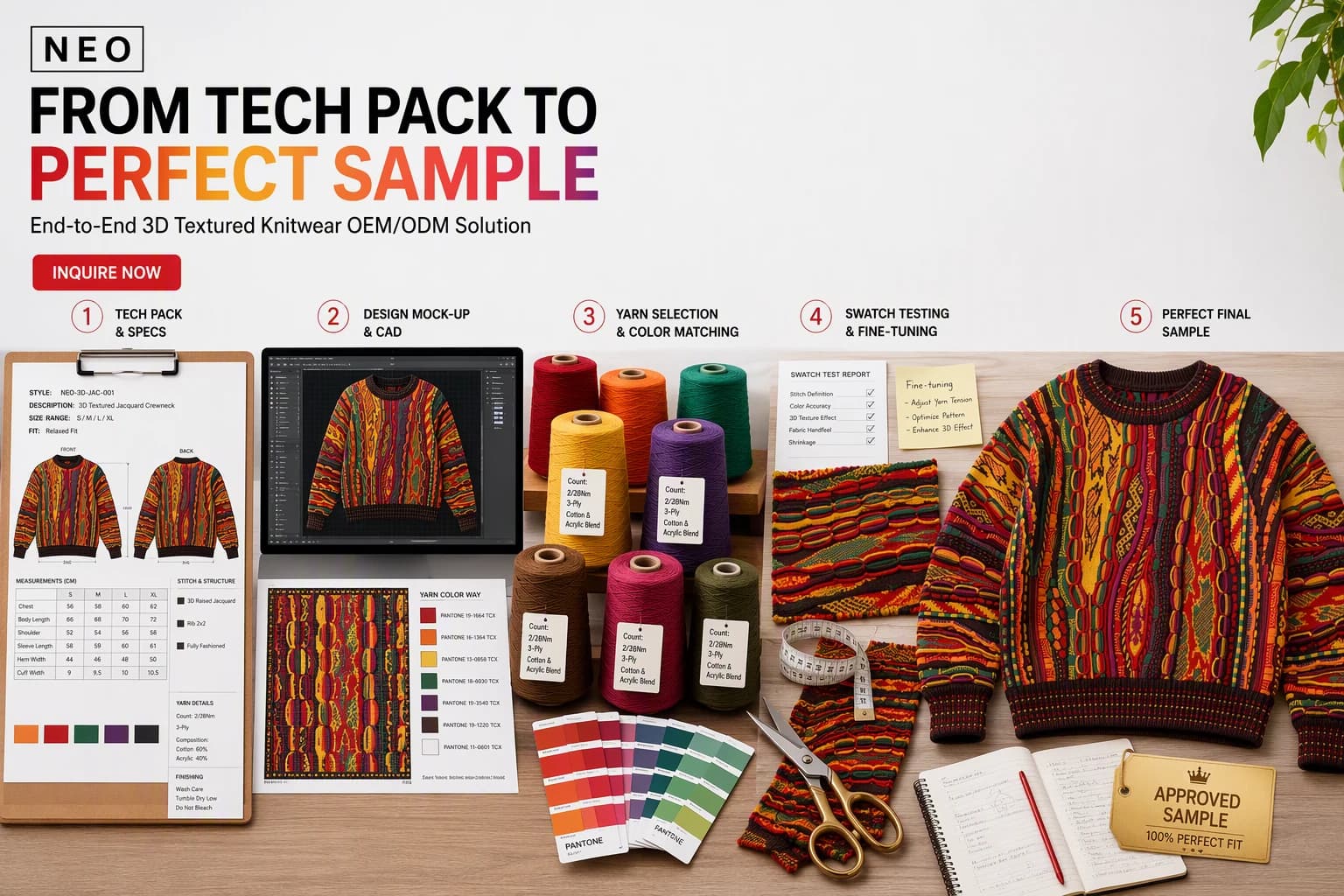
From Tech Pack to Perfect Sample: How Knitwear Sampling Actually Works
A floor-level walkthrough of the five stages between your tech pack and an approvable knit sample — mock-up and CAD programming, yarn colour matching, swatch testing, and the final PPS.
Sourcing Custom Men's Knitwear: What Separates a Knitwear Factory from a Sweater Mill
Mens knitwear briefs rarely fail on the design. They fail on gauge, size grading and reverse-side finishing — three things most price requests never ask about. Here is what to specify before you ask for a quote.
Send us the piece you were told was too hard.
Reference photo, rough sketch, or full tech pack — our Dalang technical punchers evaluate feasibility, machine gauge, yarn options, and pricing within 24 hours.