
Amazon FBA-Ready Knitwear: Poly-Bags, Labels and Cartons
Amazon sellers can't buy 3D knitwear from POD platforms. What a knitwear factory actually does to ship FBA-ready: poly-bags, FNSKU labelling, carton builds and DDP.
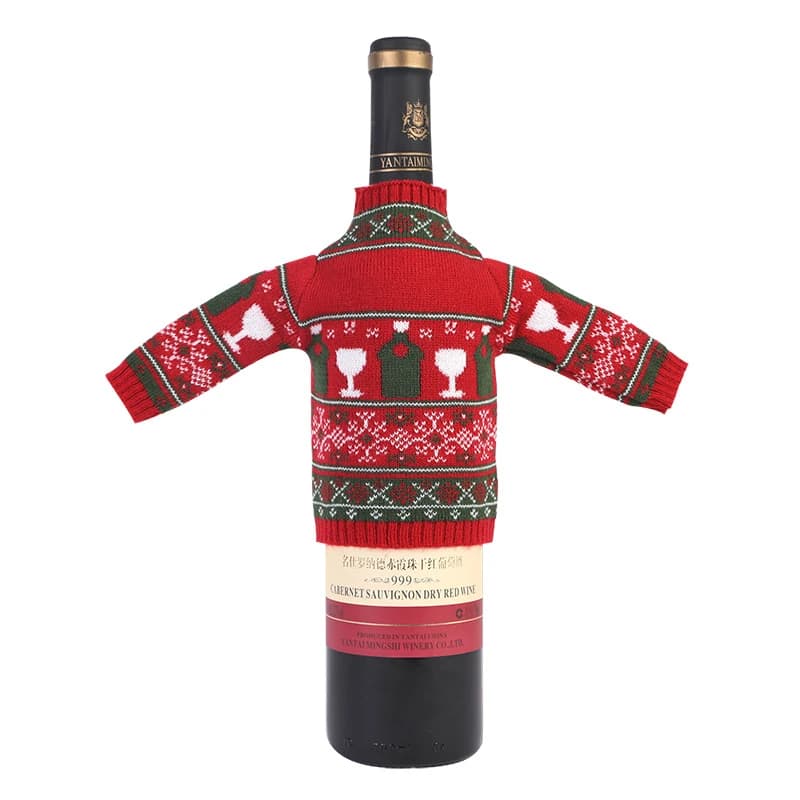
Written the week a US Amazon seller sent us a twelve-page sourcing memo for sleeved drink sweaters — the exact piece in the photograph — comparing three supplier routes before contacting anyone. One of his findings is worth a wider audience: the print-on-demand platforms cannot make this product at all, and the gap between a factory that knits and a factory that ships FBA-ready is where most Amazon knitwear projects stall.
Amazon sellers discover the same wall every Q4: the print-on-demand catalogues — Printful, Printify, Gelato and their cousins — top out at flat sublimated neoprene coolers and zip-up bottle sleeves. A knitted bottle sweater with real sleeves, a roll neck and a jacquard pattern running unbroken from body to cuff cannot come off a direct-to-garment printer, because it is not printed. It is knitted on flatbed jacquard machines, linked by hand at the armholes, and finished on a table. That is why these enquiries end up at factories like ours. But knitting the product is only half of what an Amazon seller is actually buying. The other half is everything that has to happen between the linking table and an FBA receiving dock — and that half is where quotations go quietly wrong.
What FBA-Ready Actually Means on a Factory Floor
Fulfilment by Amazon has one non-negotiable rule: every unit must arrive sellable without an Amazon employee touching it. For knitwear that translates into four concrete operations. First, each piece is sealed in its own poly-bag — not as packaging theatre but as scuff and moisture protection across a five-week ocean crossing, with a suffocation warning printed on the bag because FBA will reject unlabelled poly-bags outright. Second, every unit carries a scannable barcode label: the FNSKU Amazon assigns to your listing, or your own UPC if you are brand-registered. Third, cartons are built to spec — Amazon caps a box at 50 lb (22.7 kg), caps a side at 25 inches on the longest face for standard parcels, and knitwear, being light but bulky, usually runs out of volume long before it runs out of weight, which is actually the good direction. Fourth, the carton itself carries an FBA shipment label on the outside, placed flat, not over a seam. None of this is difficult. All of it has to be agreed before production, because retrofitting labels onto 3,000 individually bagged units is a service invoice nobody budgeted for.
The Label Question: FNSKU, UPC, and Who Prints What
The most common failure we see is not mislabelling — it is assuming the factory will guess the labelling model. Three configurations cover almost every case. With an FNSKU, the seller downloads the label PDF from Seller Central and sends it to us; we print on self-adhesive stock and apply one label per poly-bagged unit, positioned on the outside of the bag, flat and scannable, plus one on each carton as required by the shipment plan. With a UPC, the barcode is printed as part of the packaging or applied the same way — simpler, and the right choice for brand-registered sellers who want the barcode to live in the packaging artwork itself. And with a hybrid, some units go to FBA under one listing while others ship direct to customers under another — perfectly workable, but only if the packing list separates them before the cartons are sealed. What we need from you is boring and absolute: the label PDF at print resolution, the exact units-per-carton split, and written confirmation of which SKU goes in which carton. Sellers who send a screenshot of their Seller Central dashboard instead of a print-ready PDF lose a week; sellers who confirm the carton split in writing get their goods received without a single issue flag.
A Sleeved Drink Sweater, End to End
The memo that prompted this post is a good worked example. The product: mini knitted sweaters with empty decorative sleeves, roll-neck collars and custom jacquard, sized for beer bottles, 750 ml wine bottles and stemmed glasses — a category we wrote about separately in our piece on why a 40-gram knit is not a small project. The seller had compared three routes: knit-focused POD platforms at fourteen to eighteen dollars a unit, domestic merch decorators at six to nine, and overseas jacquard mills at a fraction of either — with the honest trade-offs stated: three to four weeks of lead time, and a meaningful MOQ. His conclusion, which matches what we tell every Amazon client, was that the mill route only works if the factory can also deliver the FBA layer: individual poly-bags, barcode application, and DDP delivery straight to an Amazon fulfilment centre with duties and customs clearance handled at our end. All of that is standard scope for us on any DDP shipment — the only Amazon-specific additions are the label file and the carton build, which cost a few cents a unit and roughly one production day to execute properly.
Five Things to Confirm Before You Brief a Factory
One, the labelling model — FNSKU or UPC — decided before sampling, because label placement can affect the poly-bag size and the fold method. Two, the units-per-carton split per SKU, in writing, because mixed-SKU cartons are the single biggest cause of FBA receiving delays. Three, the carton weight and dimensions against Amazon's parcel limits — with knitwear you are almost always engineering for volume, and a carton that ships as two half-height boxes is often cheaper than one that gets an oversize surcharge. Four, whether you want inspection photos per carton or per SKU before dispatch — for a first Amazon order we recommend per-SKU, because the listing photos you shoot from the sample will not match bulk if the bulk drifted. Five, the calendar backwards from your in-stock date: bulk two to three weeks after sample approval, ocean freight three to five weeks to a US port and onward to FBA, which means a Q4 gift-season listing wants its production slot booked by early autumn — or, if you are reading this in November, a conversation about air freight on the first production run and sea freight on the reorder.
Frequently Asked
Can you ship directly to an Amazon FBA warehouse?
Yes — DDP door-to-door to FBA centres in the US, EU, UK, AU and JP is our default shipping scope. You send the Amazon shipment plan and label files; we produce, poly-bag, label, build the cartons to the plan, clear customs, and deliver to the fulfilment centre with the FBA carton labels applied. You do not need a freight forwarder for a standard knitwear programme.
Do you apply FNSKU labels if we send the PDF?
Yes — send the FNSKU label sheet as a print-ready PDF and we print and apply one label per unit on the poly-bag, plus carton-level labels per the shipment plan. The service adds a few cents per unit and about a production day. Send the file at print resolution, not a screenshot, and confirm the units-per-carton split in writing; both take a minute and prevent every common receiving issue.
What is the MOQ for an Amazon first order?
It follows the product, not the marketplace: 100 pieces per design for garments, 300 for small items like bottle covers where each piece consumes little yarn. For a first Amazon listing, many sellers take one hero design at the standard MOQ, validate the listing, then reorder against sales data — the jacquard programme and labels are already engineered, so the reorder is faster and cheaper than the first run.
If you are building a knitwear listing for Amazon, send the artwork, the target quantities and the destination fulfilment centre — the reply will include the poly-bag and labelling plan, the carton build, and a calendar that tells you honestly whether the season you have in mind is the season you will get. The knitting is the part we make look easy; the shipping is the part we make boring, which is the better compliment.
Looking to manufacture this style at scale?
Send us your design brief and we'll quote a direct-factory run with low MOQs, 72h sampling and DDP worldwide delivery, knitted on our own floor in Dalang.
Knitwear you can manufacture right now
Custom Knitted Wine Bottle Sweater with Sleeves
A bottle cover shaped like an actual jumper — two empty sleeves, a cone-fitted shoulder yoke and jacquard bands that run unbroken from body to cuff.
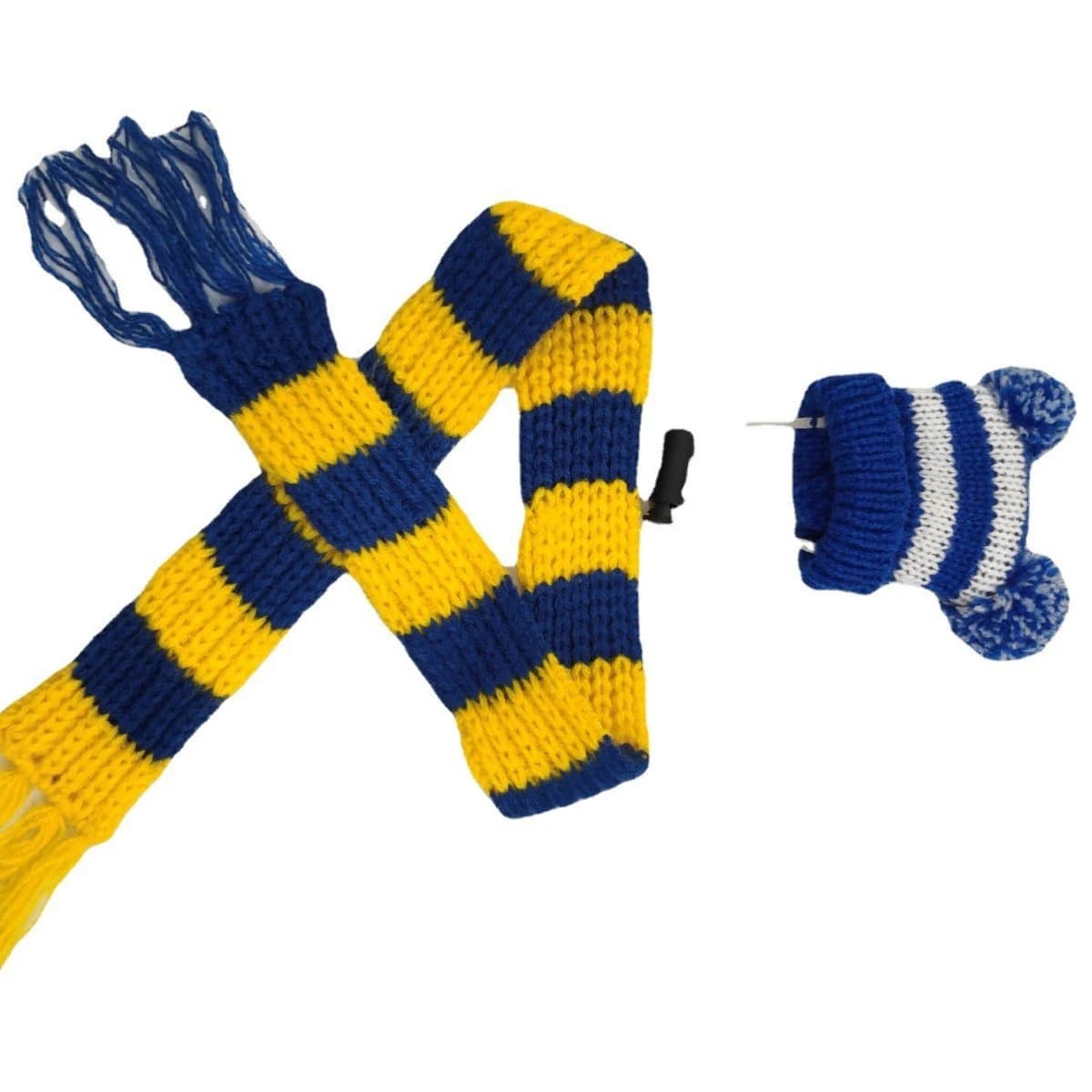
Custom Knitted Wine Bottle Hat & Scarf Set
A tiny beanie on the neck and a fringed scarf down the shoulder — the only bottle dressing in our range that leaves the label completely uncovered.
Techniques behind this product
Keep reading
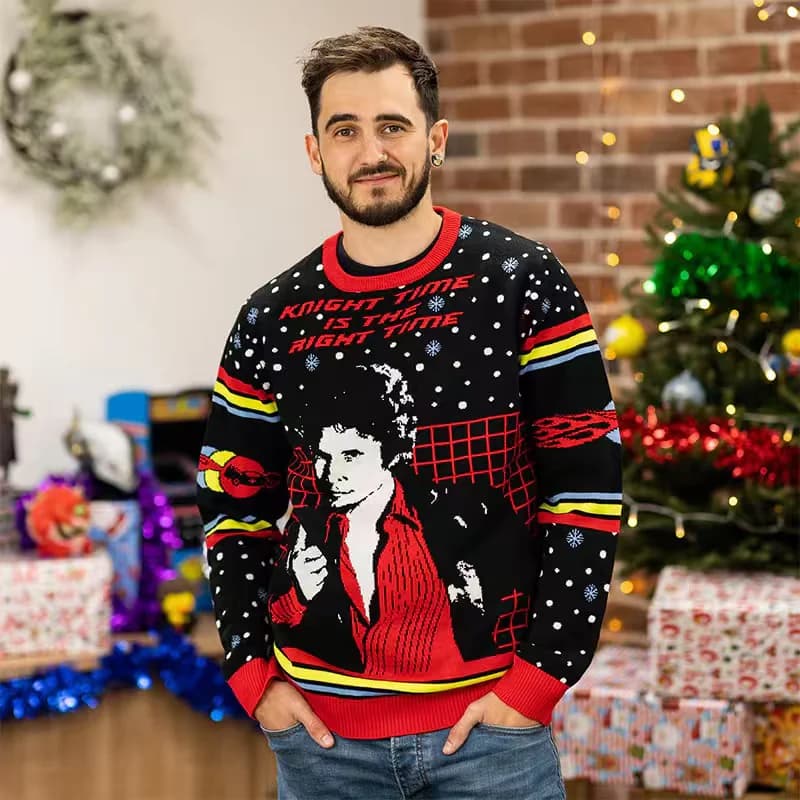
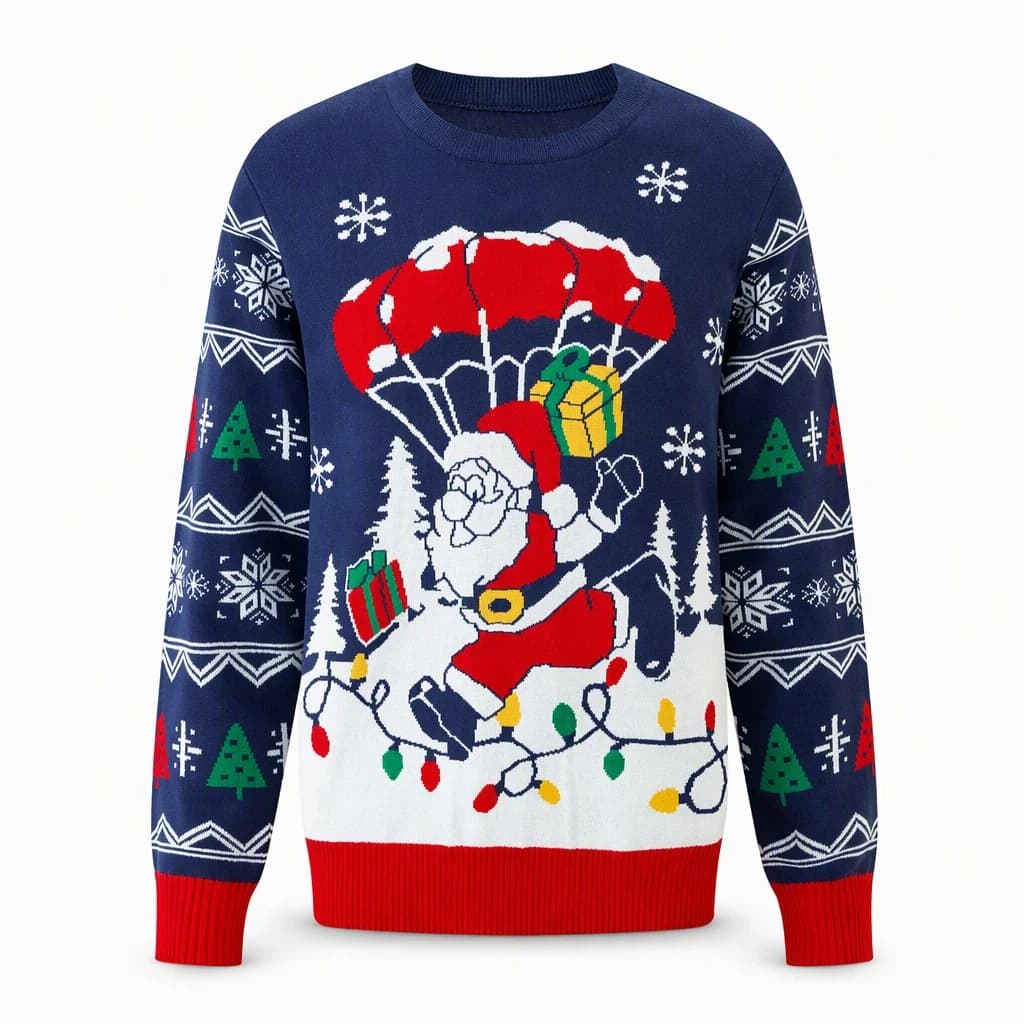
It's Time to Custom-Own Your Christmas Jumper
A short consumer-oriented overview of the custom Christmas jumper trend — design ideas, group-event tips, and the festive looks defining this year's holiday season.
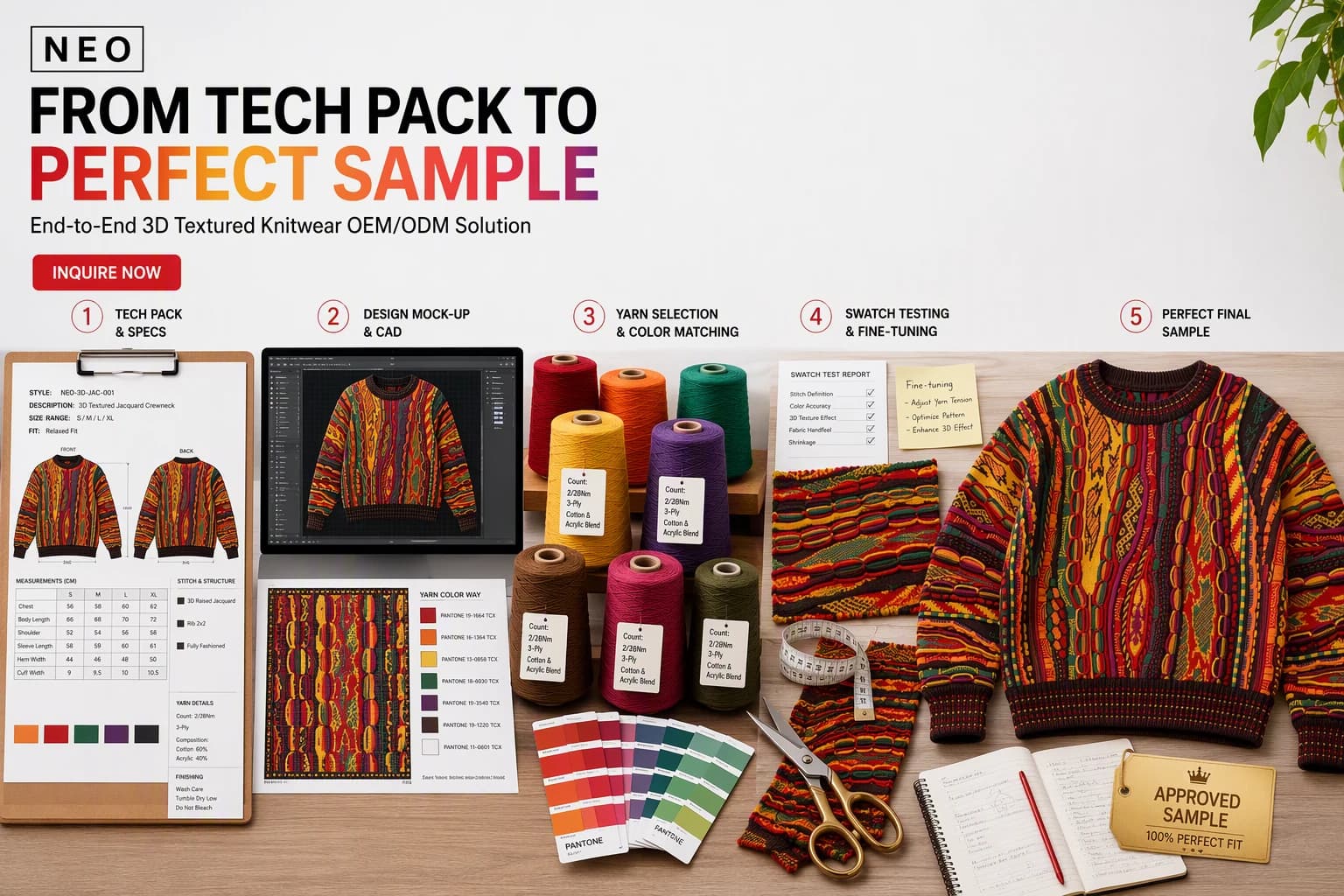
From Tech Pack to Perfect Sample: How Knitwear Sampling Actually Works
A floor-level walkthrough of the five stages between your tech pack and an approvable knit sample — mock-up and CAD programming, yarn colour matching, swatch testing, and the final PPS.
Sourcing Custom Men's Knitwear: What Separates a Knitwear Factory from a Sweater Mill
Mens knitwear briefs rarely fail on the design. They fail on gauge, size grading and reverse-side finishing — three things most price requests never ask about. Here is what to specify before you ask for a quote.
Send us the piece you were told was too hard.
Reference photo, rough sketch, or full tech pack — our Dalang technical punchers evaluate feasibility, machine gauge, yarn options, and pricing within 24 hours.