
The Six-Colour Jacquard Two Factories Couldn't Finish
A six-colour block jacquard that had already been through other factories — one could not get the pattern to hold, one could not hold the date. It passed on the first sample. Here is what had to be decided before the first needle moved.
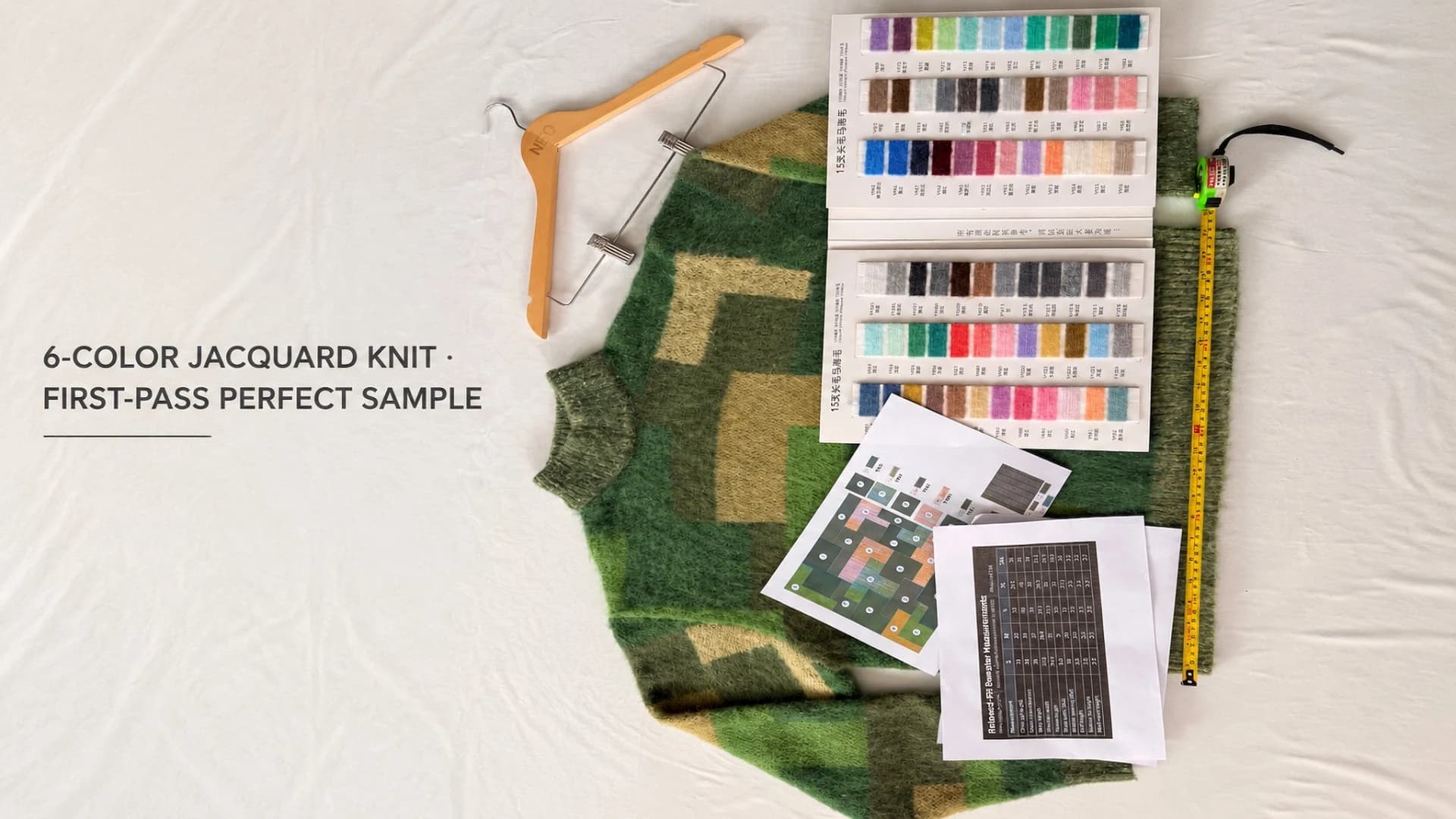
A buyer in the United States had two designs and a date he could not move. The first was this one — a six-colour block jacquard in three greens and two ochres. It had already been through other factories before it reached us: one could not get the pattern to hold, another could not hold the date. By the time it arrived on our floor, the question was no longer whether anyone could knit it. It was whether anyone could knit it and still leave the goods enough time to travel.
Six Colours Was Never the Problem
Colour count is the first thing buyers ask about and the last thing that decides whether a jacquard works. A modern flat bed carries more feeders than this design needs; six colours is not exotic. What six colours actually cost is time — every row that changes colour costs a feeder change, and every feeder change costs machine speed. But that is a price, not an obstacle. A factory that quotes on colour count alone is quoting the easy part.
The obstacles in this pattern were two much smaller things, and neither of them shows up until the fabric exists.
One: the two dark greens
Colour 1 is Y939 and colour 3 is Y905. On a monitor they read as two shades of dark green. Held against a yarn card at arm's length they are a deep pine and a mossier near-black. Set them beside each other in a block pattern and the whole design depends on the eye being able to separate them. If those two drift together in production, the garment stops reading as six blocks and starts reading as five blocks plus a repeat. The buyer's intent — layering greens so the pattern has depth instead of mass — collapses quietly. Nothing looks broken. It just looks cheaper.
That is why the colour matching in the photographs below happened on a table with a yarn card in daylight, not on a screen with a colour picker. A screen will happily show you Y939 and Y905 as different. It cannot tell you whether they will still be different once they are knitted, brushed and seen under a shop light.
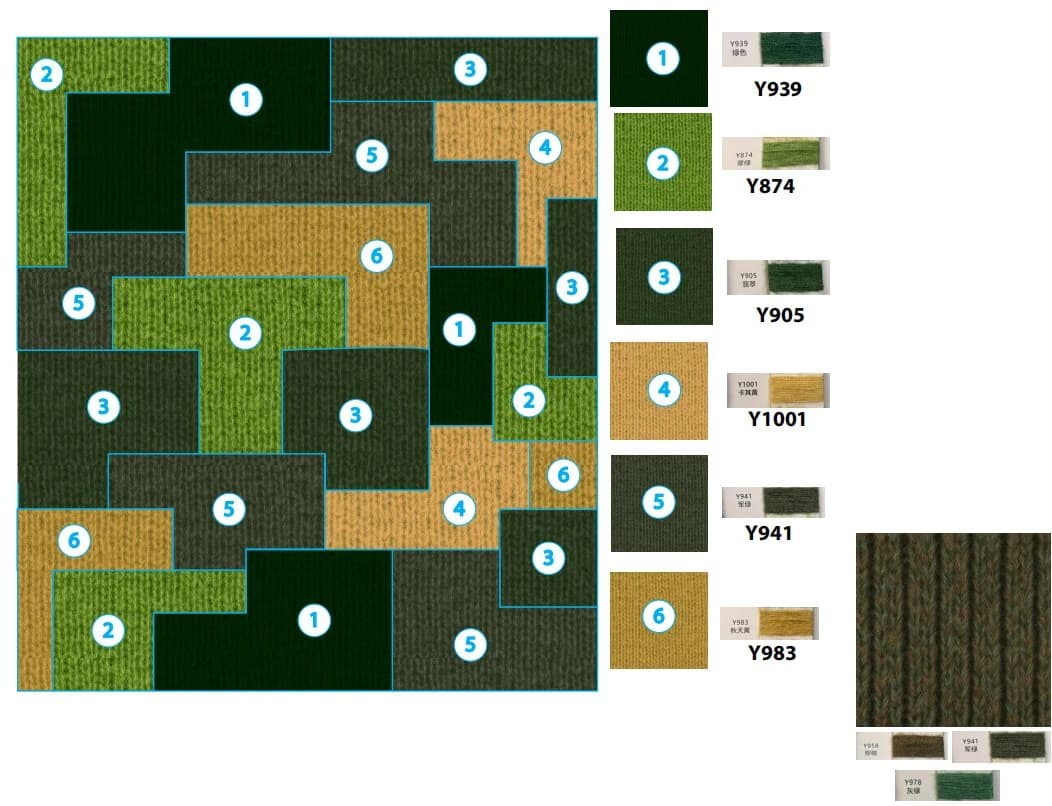
Two: a right angle is not a right angle
Block geometry lives or dies on its corners. At the gauge this garment runs, one needle is several millimetres wide, and a brushed yarn blooms sideways by a fraction of a needle on each edge. A 90° corner in a drawing arrives on the machine as something closer to a soft chamfer. The fix is not a software setting. It is the graph technician over-building the corner — two extra stitches carried into the point, density packed at the turn so the corner pushes out instead of rounding off. That work has no line item on any quotation, and it is the difference between a pattern that looks designed and one that looks printed.
The Screen in the Photograph Is Not a Drawing
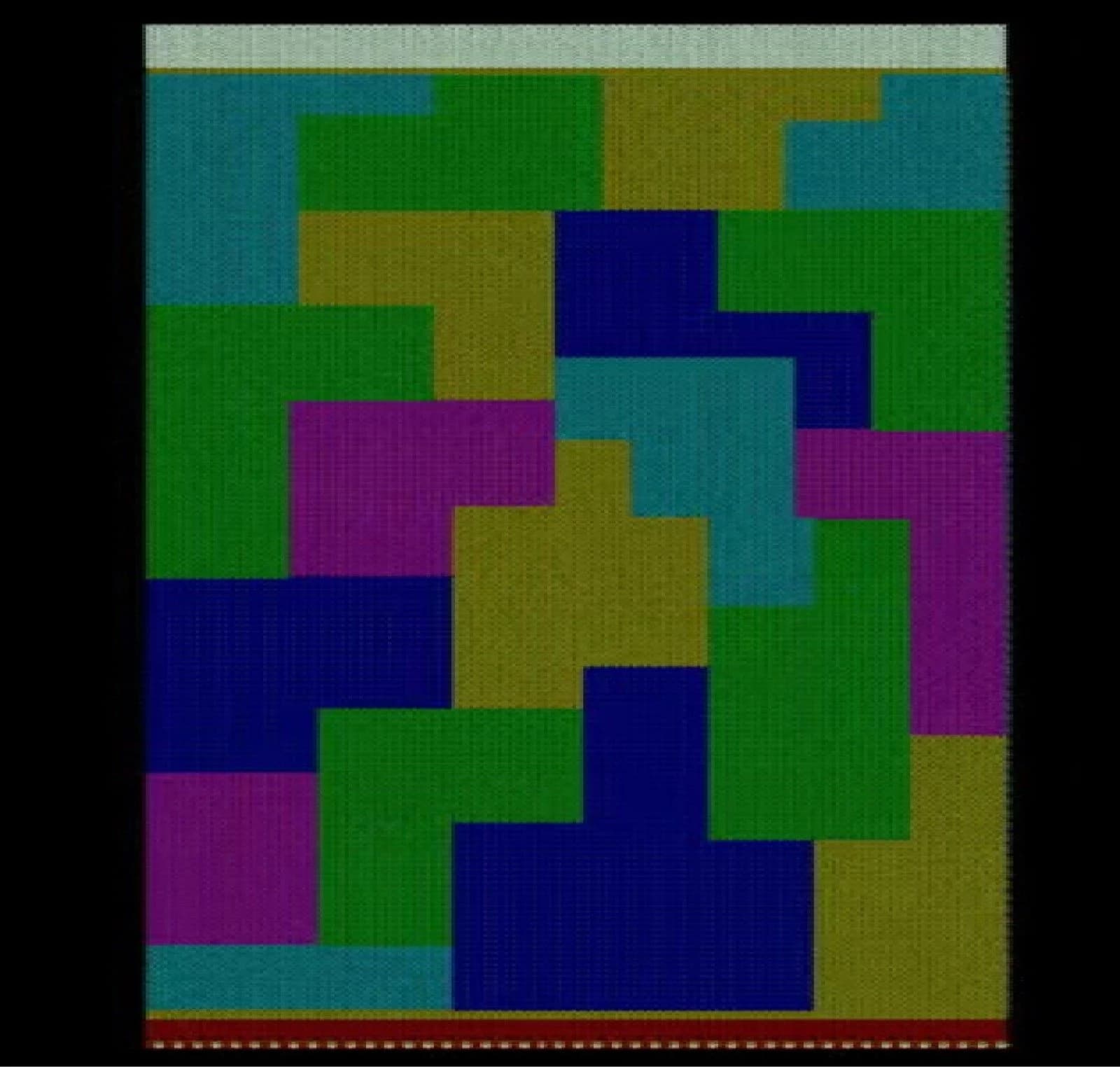
The image below was taken on our programming desk, and it is worth knowing what you are actually looking at. That is not the buyer's artwork on a monitor. It is the needle chart — the file the machine runs. One square equals one needle, and that needle is the smallest unit this design is built from.
The scale is the part buyers underestimate. A highlight in an eye, a millimetre of piping, a two-pixel shadow — a screen renders all of those without effort. On the machine, one stitch is the smallest thing that exists, and here that stitch is several millimetres across. A drawing detail finer than that does not get simplified. It gets deleted, or it turns into a block the size of a thumbnail. Everything a designer leans on dies at that magnification: fine lines disappear, gradients become steps, curves become staircases. Blocky geometric patterns are among the few visual languages that survive the translation intact — but only if the corners are held, which is the work described above.
That translation is also where the sentence "our factory said they couldn't do it" usually comes from. Most of the time the pattern is not impossible. It is that knitting it as drawn would land visibly away from what the buyer pictured, and the factory can see that before the buyer can.
Neither Refusal Was a Lie
The two earlier attempts failed for different reasons, and both reasons were legitimate.
The first could knit the pattern but wanted to change it — soften the right angles into chamfers, or drop from six colours to four. Technically sound. Commercially useless, because what the buyer was selling was the geometry. A sweater with softened corners is a different sweater, and he knew it.
The second could knit it and would not schedule it. That is not a capability problem; it is a business model problem, and it is worth understanding if you are ever sourcing against a date. A large plant earns its margin on continuity — long runs, few changeovers, beds that stay on one style for days. This order asked for six feeder changes, a fresh program and a setup, for a quantity that would occupy a bed for a fraction of a shift. Changeover time does not shrink because the order is small. It has to be absorbed by that order, and at this volume it cannot be.
Which is the practical argument for placing urgent, complex work with a mid-sized plant rather than the largest one you can reach. The big plant is not lying when it says the date will not work. It is telling you your order is too small to justify the disruption, and no amount of negotiation changes that arithmetic.
The Date Was Priced, Not Requested
The brief did not say "as soon as possible". It put a number on the calendar. Bulk delivered in ten days carried a bonus of ten US dollars per piece; thirteen days carried five. That is not a tip. It is the buyer telling the factory, in writing, what his retail window is worth per unit — and it changes the conversation from whether anyone can hurry to whether the arithmetic closes.
The two-step structure is the more useful part. He was not asking for ten days as a preference; he was pricing the gap between ten and thirteen. That is a buyer who has already run the schedule himself, and who has decided what the last three days are worth. Most urgent enquiries arrive as "ASAP", and ASAP cannot be scheduled. A priced date can.
Ten days forces a specific sequence, and every link in it has to be protected: yarn in hand before the needle bed is free, a program signed off in one pass rather than three, and finishing that does not queue behind someone else's order. On the floor, the plan was built backwards from the ten-day line. Not a clause in a contract — the date the whole schedule was wound back from, which is a stricter thing to work against than a request.
The bonus clause was the buyer's, not a rate card we put in front of every customer. And buying speed with money only works if the plant actually has the room: where it does not, the premium does not shorten the calendar, it buys a rushed run. Ask what is being displaced before you price a date.
What First-Pass Approval Actually Requires
This sample passed on the first submission. That sentence usually gets read as luck. It is four decisions, all of them made before the first needle moved.
One — the artwork was separated into yarn references first
Not "six greens and ochres", but Y939, Y874, Y905, Y1001, Y941 and Y983. Once references are fixed, the yarn stops being a subject of discussion. Skip that step and the sample comes back with the buyer saying the green is wrong, and nobody able to say which green, because there were three.
Two — the measurements were agreed before the first panel
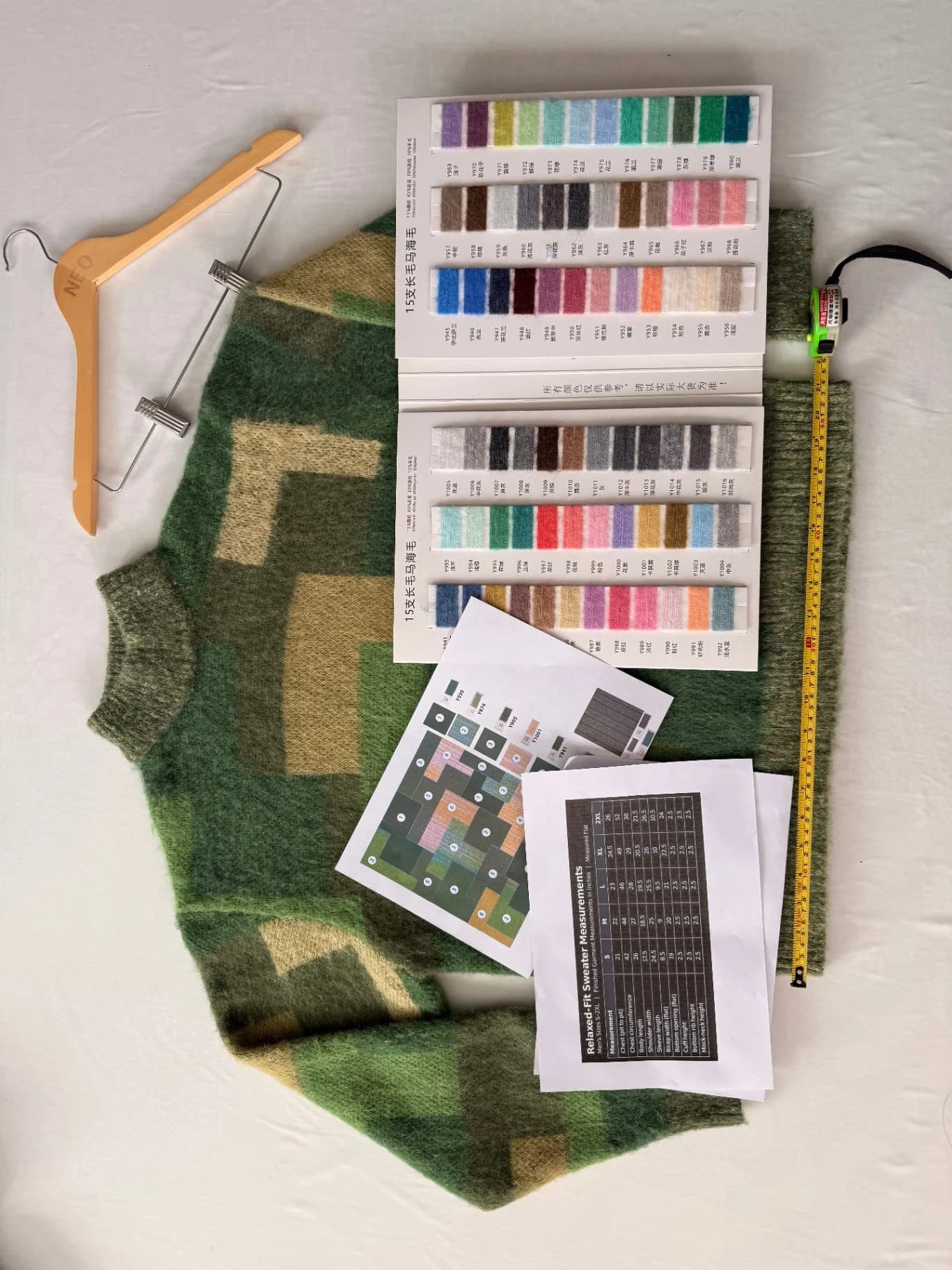
The table in the photo below is nine measurements across five sizes, S to 2XL, and the first thing worth noticing is the heading: finished garment measurements, in inches. Not body measurements. The difference between the two is the ease, and that is where most size arguments actually begin — a buyer sends his body chart, the factory grades from it, and the garment arrives two sizes tighter than he pictured because nobody converted one into the other.
The table also gives chest twice, as pit-to-pit and as full circumference, which is the pair that causes the most confusion in a tech pack. Twenty-one inches pit-to-pit is forty-two inches around; the two numbers describe the same garment, and quoting against the wrong one puts you out by a factor of two. The remaining rows are body length, shoulder width, sleeve length, body width, bottom opening, rib height and mock-neck height. Relaxed fit is forgiving in exactly one direction. Two centimetres across the chest is invisible; one centimetre off the shoulder line and the whole garment reads wrong. Agreeing the table up front is not paperwork — it is the buyer confirming that the ease he is imagining is the ease he is getting.
Three — colour was matched in daylight, not under the factory roof
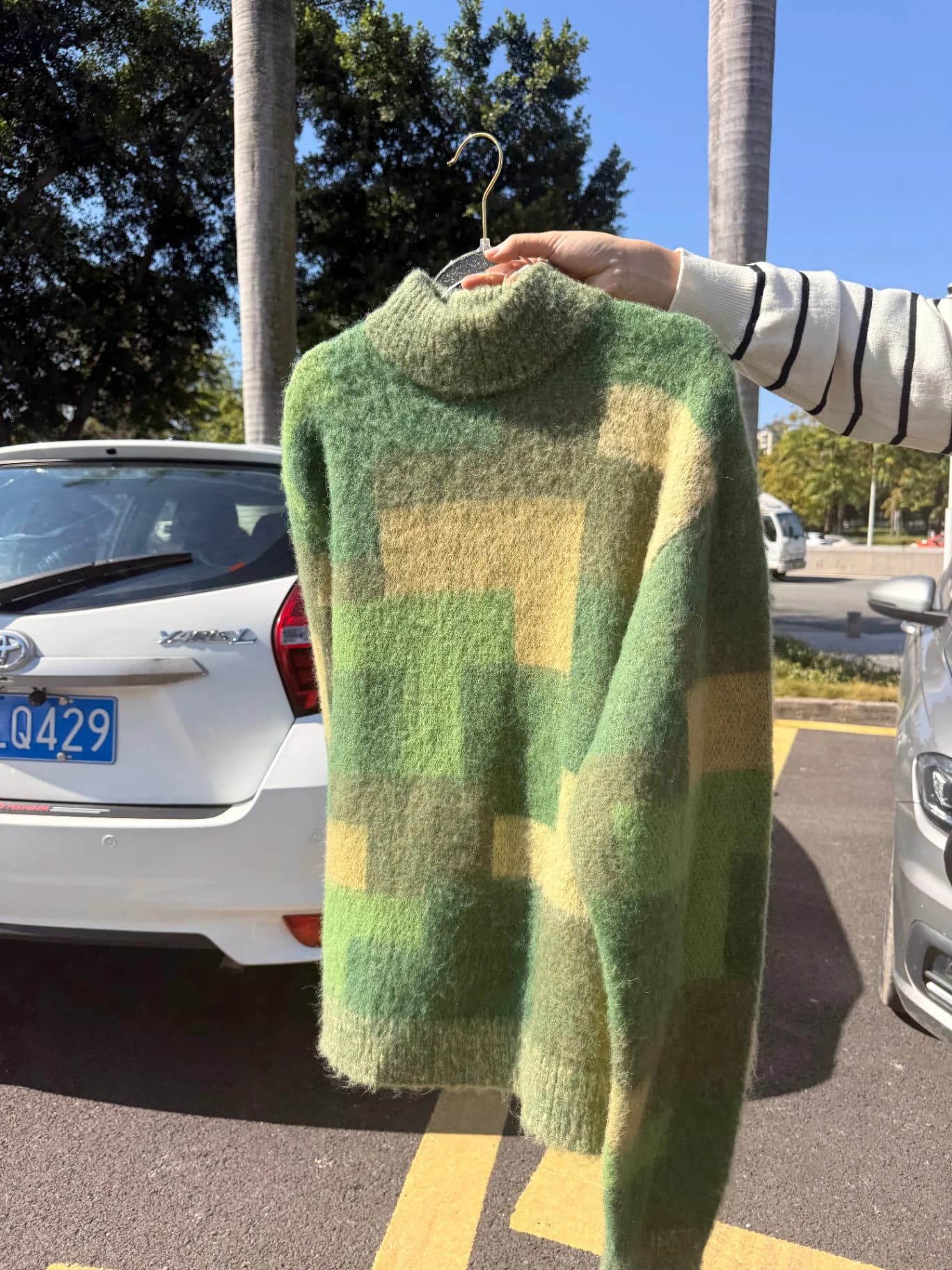
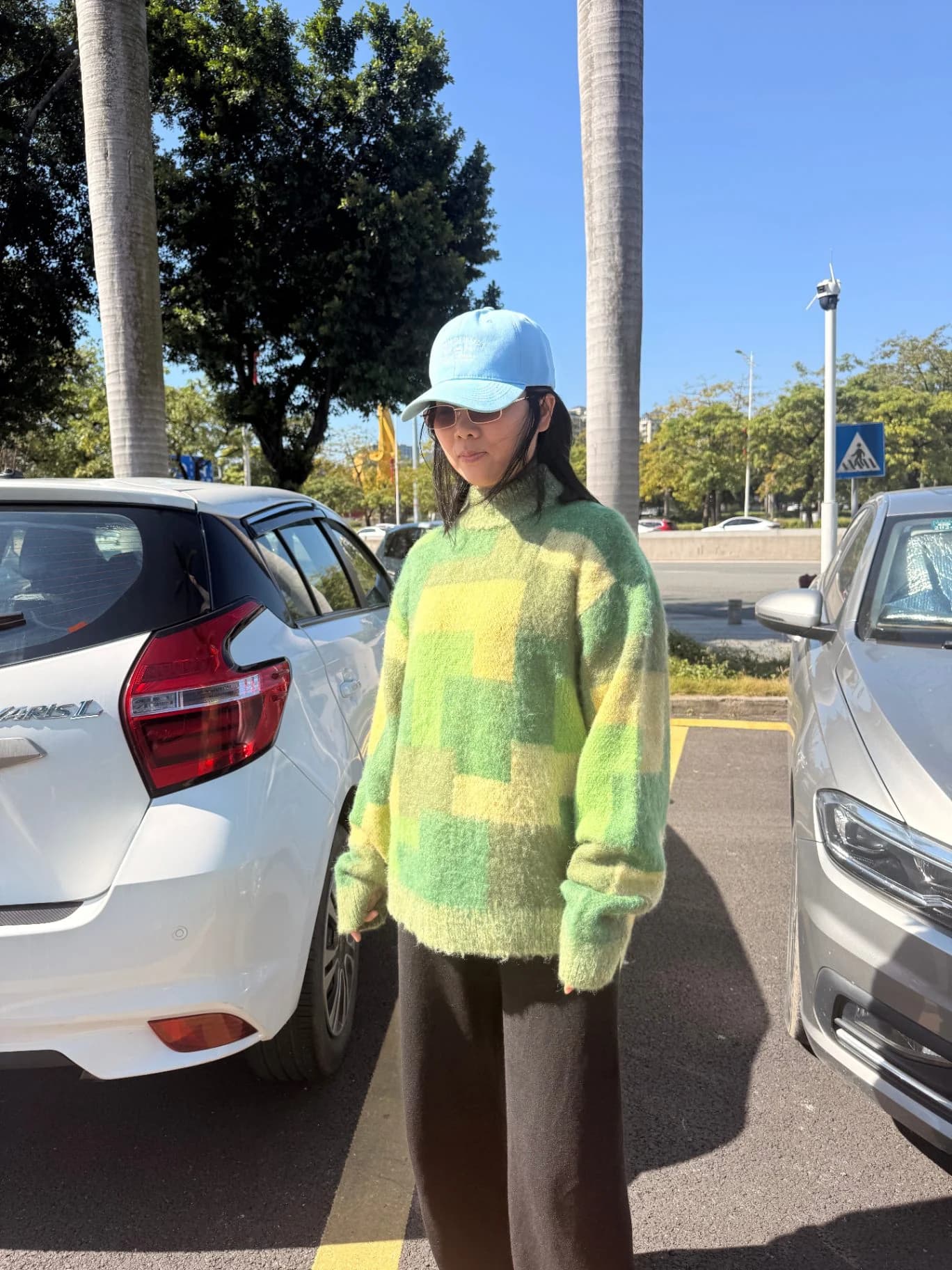
Workshop lighting sits around 3,000 to 4,000 K and leans warm. A dark green judged under it will move toward olive the moment it goes outside. More colour disputes than most factories will admit are not dyehouse failures; they are light-source failures, decided at a table under the wrong lamp. The matching in these photographs was done in daylight because that is the light the garment will eventually be judged in.
Four — the sample was photographed in the light the buyer asked for
The request was specifically for photographs in sunlight. It reads like a stylistic preference. It is cost control. The buyer is in the United States looking at a screen; if we send a workshop-lit photograph of a garment that will sit under retail lighting, the green he approves is not the green he receives, and the correction costs a resample. One walk outside with a hanger removes that entire round.
The Reply
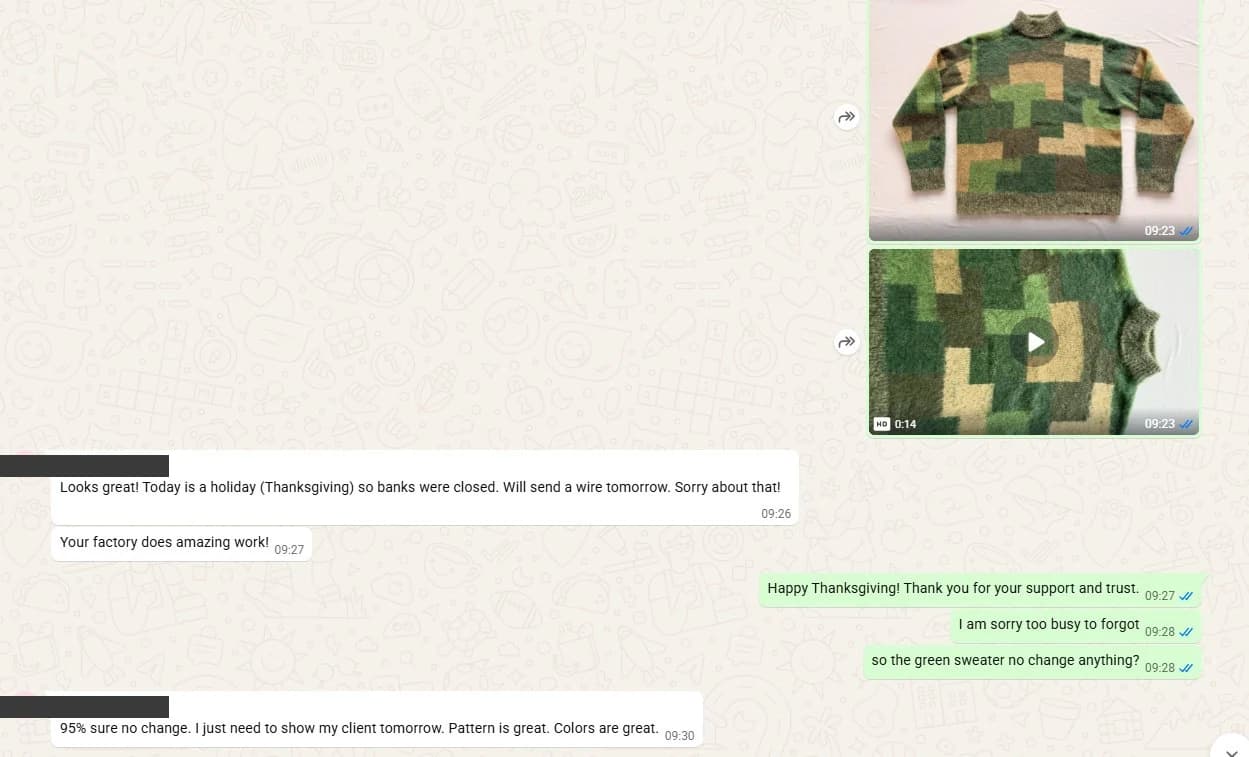
His answer came back the same morning the photographs went out.
“Looks great! Today is a holiday (Thanksgiving) so banks were closed. Will send a wire tomorrow. Sorry about that!”
“Your factory does amazing work!”
Then, a few minutes later, the line that matters more than either of those.
“95% sure no change. I just need to show my client tomorrow. Pattern is great. Colors are great.”
Ninety-five, not one hundred. That gap is normal, and it is not distrust — he had a client of his own to show it to, and no buyer promises a colour on somebody else's behalf. The useful move at that moment is not to chase the missing five per cent. It is to state the change window plainly: colour and artwork can still move, and here is what each change costs in days. A buyer who knows the price of a change usually decides faster than one who is being reassured.
Paid in Full Before a Single Bulk Unit Was Knitted
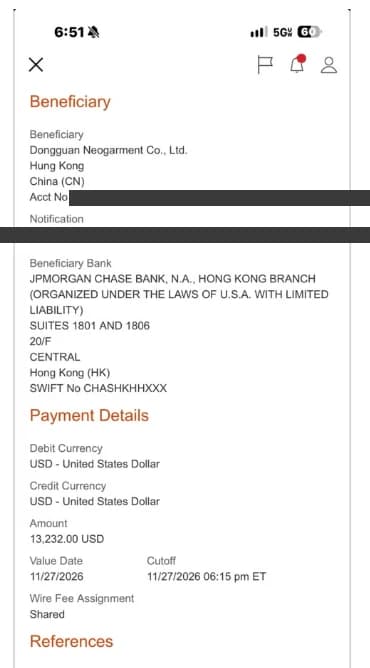
The wire went out the next day, once the banks reopened after the holiday. The full production value, before the bulk run began — this order was not financing itself out of a deposit.
It is tempting to read that as a compliment. It is better read as arithmetic. Every sampling round costs a week, an international courier and a review meeting at the buyer's end, and each of those delays a decision. Three rounds is three weeks of decision latency stacked on top of three weeks of production. For a buyer working to a retail window, first-pass approval is not a saving on sampling fees. It is the difference between making the window and missing it.
What Happens Next
He flies to China next week. Two items on the itinerary: walk the factory, and take the goods with him.
The second is unusual and worth being precise about. The bulk order will travel as checked baggage on his own flight — not by sea freight, and not through an air cargo forwarder, because the date leaves no room for either. That is a decision made for one order under one deadline. It is not how we would normally ship, and it is not a service we offer as standard. It is what the calendar allowed.
His own client sees the sample tomorrow. That is the five per cent. If it holds, the second design moves — the other half of the pair that landed on us that Wednesday night.
The bulk run photographs, and the day he lands in Dongguan, are the next instalment. Same buyer, same two designs, and a finished garment that has to survive a twelve-hour flight inside a suitcase.
If You Are In This Situation
The pattern here repeats often enough to be worth writing down. If you are sourcing something complex against a date that has already slipped once, these five things decide whether a factory can actually help you.
- A file that can be separated. Vector artwork, or at minimum 300 dpi with flat colour areas. A mood-board JPEG cannot be colour-separated, and a factory that agrees to try is guessing on your budget.
- Yarn references, not colour names. "Forest green" is six different greens at six suppliers. A Pantone TCX reference or a mill's own shade number is a decision that stays decided.
- Your boundaries, stated in advance. Which parts can move — gauge, yarn composition, stitch density — and which cannot, usually proportion and colour count. Factories will change whatever you leave open, so leave open only what you can live with.
- The date the goods must arrive, not the date you want to order. Scheduling is planned backwards from arrival. A factory quoting against your order date is quoting against the wrong number.
- One question: what is the closest thing you have already made? A factory with a near match is solving a variation. A factory without one is paying tuition, and you are the tuition.
One Last Thing
First-pass approval is not luck, and it is not a favour. It is what happens when the artwork gets separated, the measurements get agreed, the colour gets judged in the right light, and the corners get built into the graph before anyone starts a machine. Four unglamorous decisions, all of them made early. The interesting part is the sweater.
Looking to manufacture this style at scale?
Send us your design brief and we'll quote a direct-factory run with low MOQs, 72h sampling and DDP worldwide delivery, knitted on our own floor in Dalang.
Knitwear you can manufacture right now
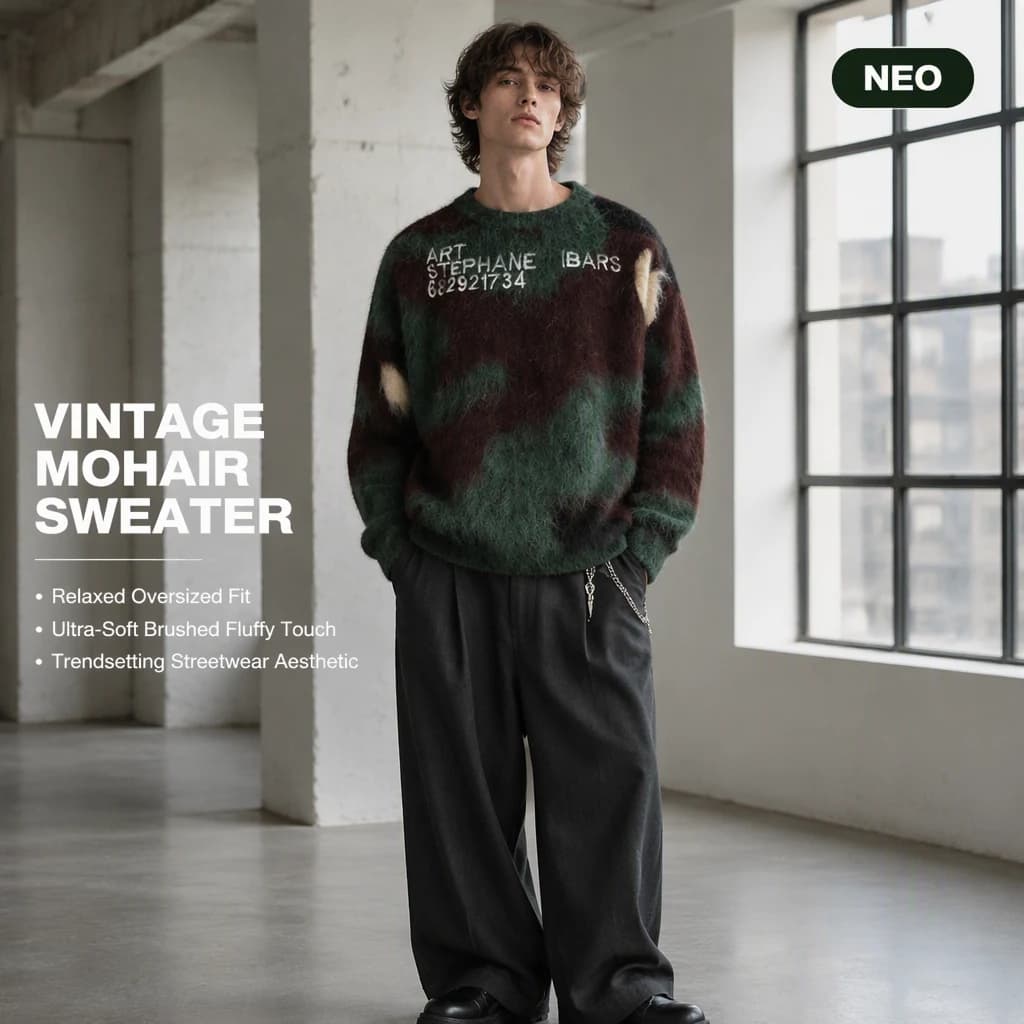
Custom Vintage Mohair Jacquard Sweater with Embroidery
Brushed fluffy mohair in an oversized silhouette — multi-colour jacquard camo ground with high-density 3D embroidered lettering.
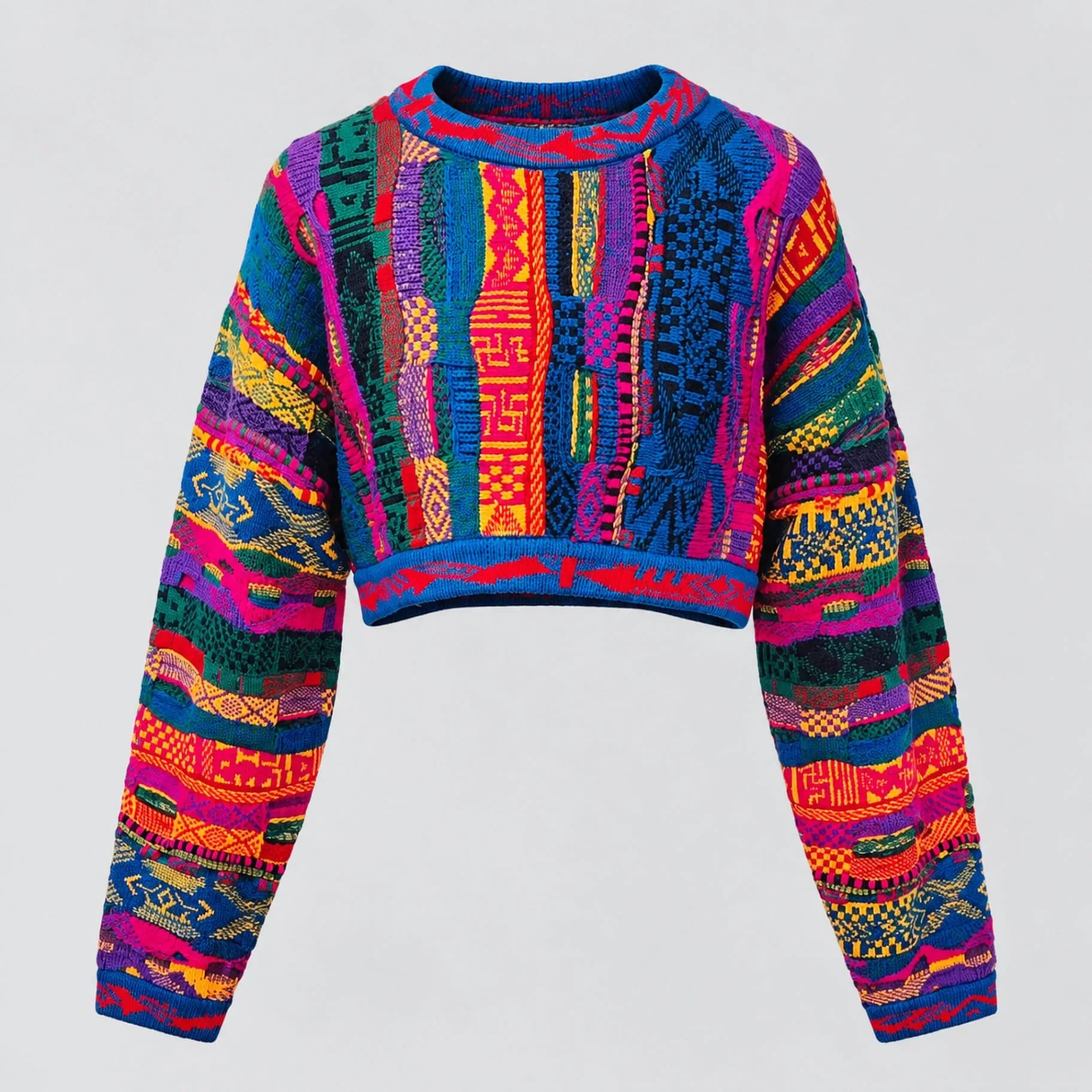
Custom Patchwork Jacquard Crop Sweater
A cropped crew-neck built from columns of folk motifs in up to 13 knitted colours — a statement jacquard piece developed from your colour story.
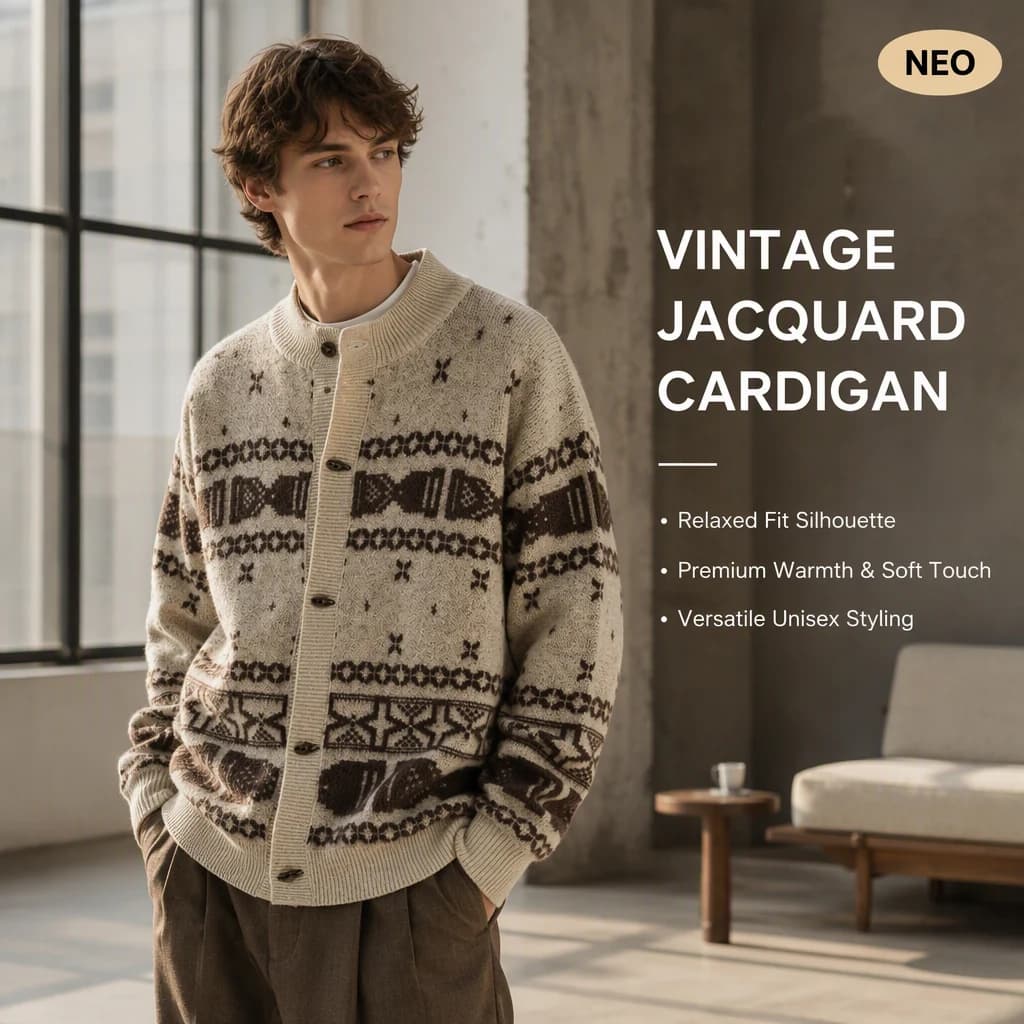
Custom Unisex Fair Isle Jacquard Knit Cardigan
Unisex banded Fair Isle cardigan knitted as true jacquard structure — relaxed fit, Pantone-matched colourways, private label ready.
Keep reading

It's Time to Custom-Own Your Christmas Jumper
A short consumer-oriented overview of the custom Christmas jumper trend — design ideas, group-event tips, and the festive looks defining this year's holiday season.
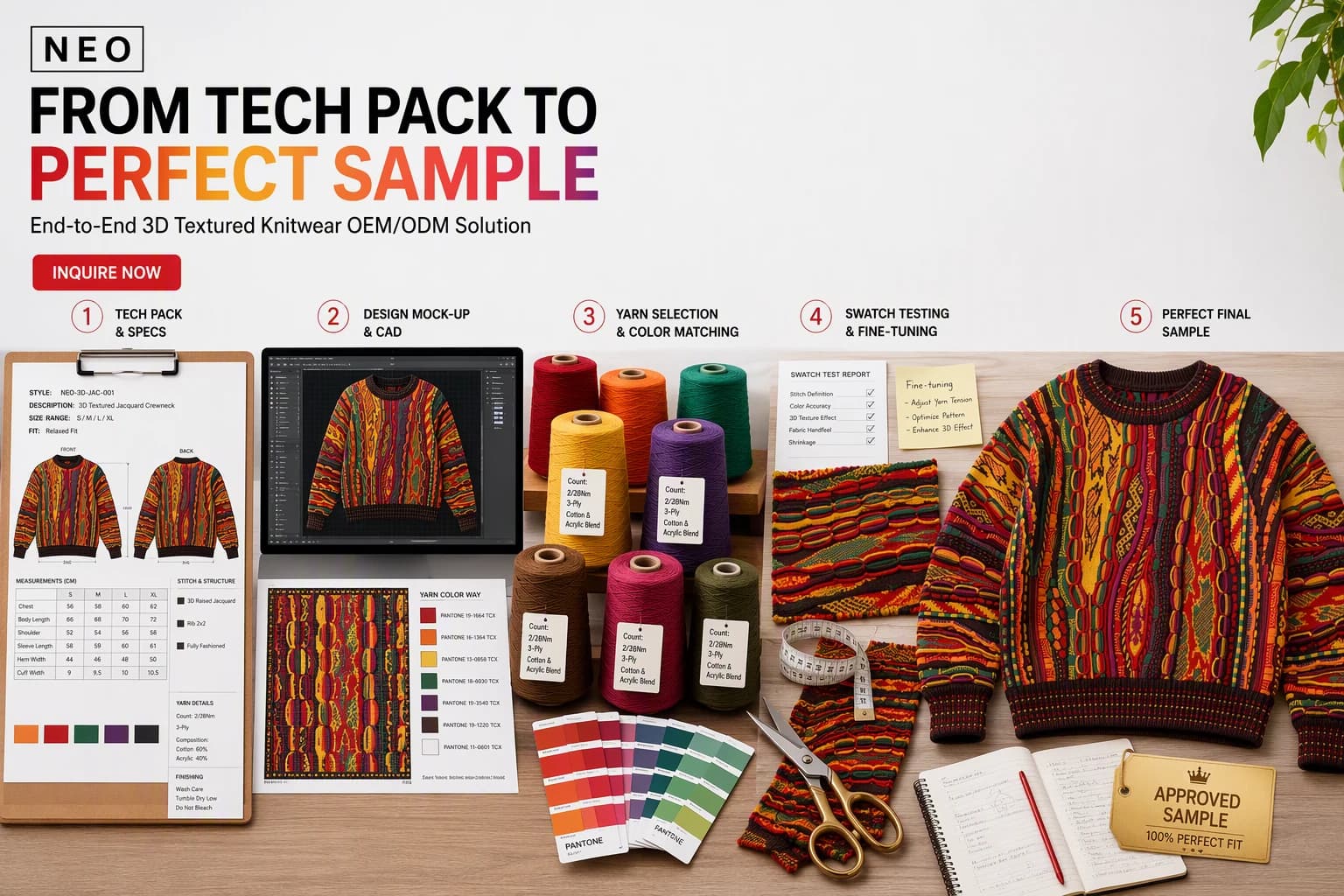
From Tech Pack to Perfect Sample: How Knitwear Sampling Actually Works
A floor-level walkthrough of the five stages between your tech pack and an approvable knit sample — mock-up and CAD programming, yarn colour matching, swatch testing, and the final PPS.
Sourcing Custom Men's Knitwear: What Separates a Knitwear Factory from a Sweater Mill
Mens knitwear briefs rarely fail on the design. They fail on gauge, size grading and reverse-side finishing — three things most price requests never ask about. Here is what to specify before you ask for a quote.
Send us the piece you were told was too hard.
Reference photo, rough sketch, or full tech pack — our Dalang technical punchers evaluate feasibility, machine gauge, yarn options, and pricing within 24 hours.