
Inside Sweater Quality Control: Measured, Checked, Then Boxed
Two stations decide whether a knit order arrives right: the flat inspection table where every piece is measured against its spec sheet, and the floor where cartons are marked and counted. What actually happens at both.
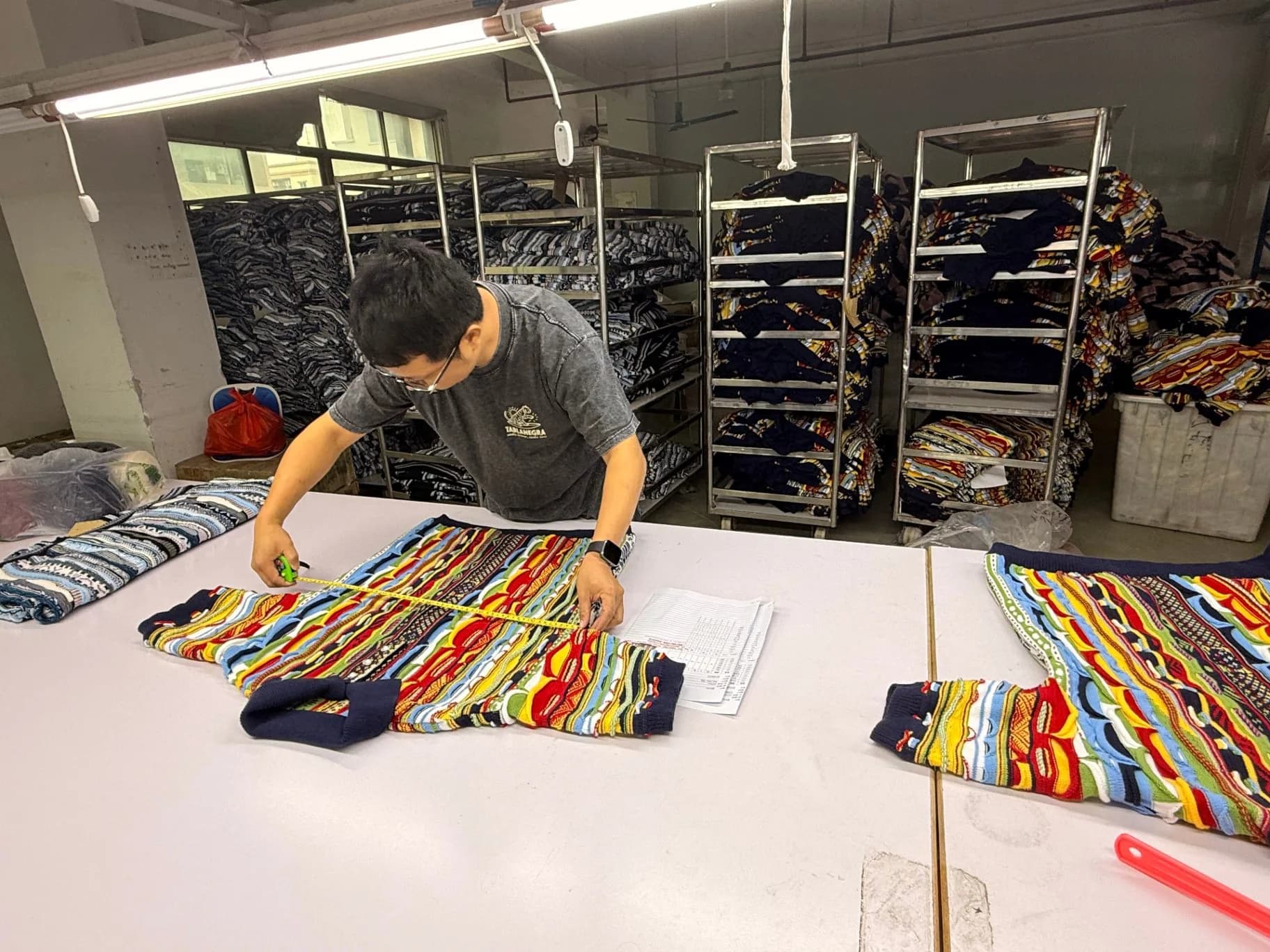
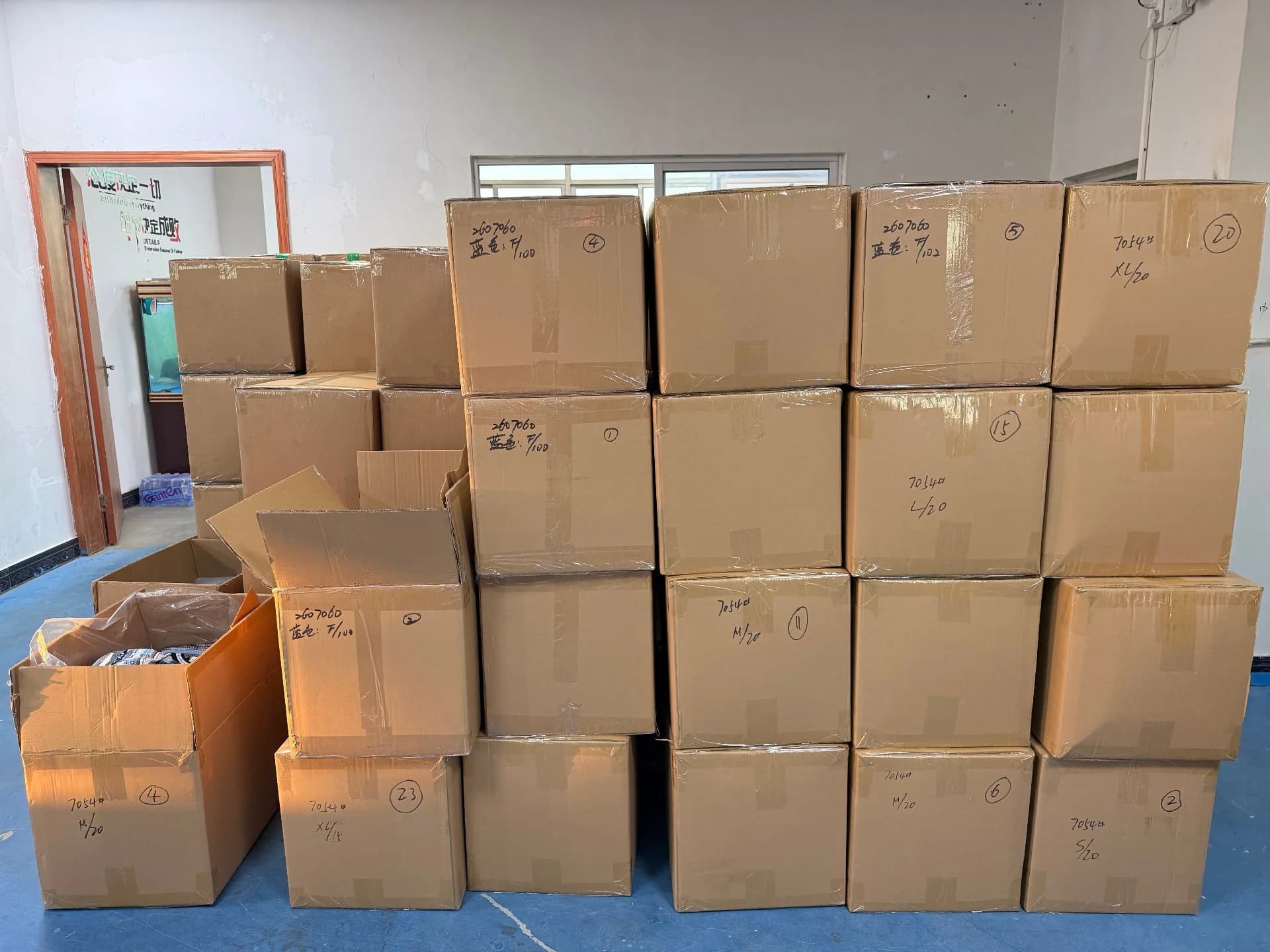
Factory tours show machines. These two photographs show the two stations where a knit order is actually won or lost — a white inspection table where every piece is laid flat and measured against its spec sheet, and the shipping floor where the cartons are stacked, marked and counted before they leave. Neither station is photogenic. Both are what a buyer is really paying for, because a beautiful panel that measures wrong is a chargeback, and a perfect garment in a mislabelled carton is a warehouse problem.
Knitwear Is Measured Flat, Never on a Hanger
The first rule of knitwear quality control is also the one most often broken by factories that learned on wovens: a knitted garment is measured lying flat, relaxed, on a table — never hanging. A sweater is heavy enough to stretch itself. Hang a medium-weight wool crew for a day and the body length grows a centimetre or more while the chest narrows; measure it on the hanger and you will report a length that nobody will ever see on a body. Flat measurement removes the garment's own weight from the equation, which is why every spec sheet you receive from us is written in flat values.
This is also the source of the most common first-sample misunderstanding we deal with. A buyer measures the sample on a hanger, compares it to a flat spec sheet, concludes the garment is short, and asks for two centimetres to be added. The garment was correct; the method was not. If you only remember one thing from this post, make it this: chest width on a spec sheet is half the circumference, measured flat, and the number you compare against is that figure doubled — not the number you get by wrapping a tape around a hanger.
The Points That Get Measured on Every Piece
A knitwear measurement sheet is short and unglamorous. Seven points cover almost every sweater, and a good sheet lists them in the order the garment is built so the inspector works top-down and never has to turn the piece twice.
- Chest, pit to pit — measured straight across about 2.5 cm below the armhole, flat, without stretching. Doubled, this is the chest circumference.
- Body length, HPS to hem — from the high point of the shoulder, the seam where shoulder meets neck, straight down to the bottom edge. Not from the collar, and not from the back neck.
- Shoulder, seam to seam — across the top, flat, following the shoulder line rather than a straight horizontal if the shoulder is dropped.
- Sleeve length — from the shoulder seam along the outer edge to the cuff for a set-in sleeve; from HPS for a raglan, because there is no shoulder seam to start from.
- Cuff and hem opening, relaxed — measured with the rib at rest, never pulled out. A 2x2 rib stretched flat will read three centimetres wider than it wears.
- Neck width, seam to seam — inside the collar opening, which is the number that decides whether the piece pulls over the head comfortably.
- Armhole depth — from the shoulder seam down to the underarm, the point that governs how the sleeve sits when the arm is raised.
Two of those deserve emphasis because they are where cheap factories quietly cheat. Cuff and hem openings must be measured relaxed: a rib measured under tension will pass a spec it does not meet, and the customer discovers it the first time the sleeve slides up the forearm. Sleeve length on a raglan must be measured from HPS, not from a shoulder seam that does not exist — get that wrong and both sleeves read short by the same amount, which looks like a pattern error and is actually a measurement error.
The Sheet on the Table Is Not a Size Chart
Buyers often assume the paper on the inspection table is the size chart from the website. It is not, and the difference matters commercially. A size chart is customer-facing: it lists body measurements — chest circumference, waist, height — for the person who will wear the garment. A measurement spec sheet is factory-facing: it lists garment measurements, the finished dimensions of the actual object, plus the tolerance allowed on each one. The gap between the two is ease, and ease is a design decision, not an error.
That is why we ask for the measurement sheet rather than the size chart before a first sample. If a brand sends only a size chart, we have to infer the intended fit from the tech pack drawing and the reference garment, and inference is where first samples go wrong. A sheet with seven rows, four size columns and a tolerance written next to each row removes the guesswork entirely — and it takes a buyer twenty minutes to produce once, then serves every order for years.
What Tolerance Really Means on a Knitted Panel
A woven shirt can be cut to half a centimetre and hold it, because the fabric is stable and the panel is cut. A knitted panel is not cut, it is built loop by loop, and then it is washed, dried, pressed and linked by hand. Four variables move the finished dimension: yarn relaxation after knitting, shrinkage in the wash-and-dry cycle, the natural stretch of any rib, and the cumulative drift of hand linking at the armholes and shoulders. A factory quoting plus or minus half a centimetre on every point of a heavy cable sweater is either measuring optimistically or has not made many of them.
Our default tolerances, stated up front so nobody argues at the end: plus or minus 1 cm on the large dimensions — chest, body length, sleeve length — and plus or minus 0.5 cm on the small ones, neck width, cuff depth, hem depth. Paired points get a relationship tolerance as well as an absolute one: the two sleeves of a single garment must match each other within 0.5 cm, because a 1 cm difference between left and right is what a wearer actually notices, even when both are inside spec. Tighter tolerances are available — some premium programmes run plus or minus 0.5 cm across the board — but they change the price and the calendar, because tighter tolerance means a first-off approval on every size and more in-process checking, not a promise written on a sheet.
The useful way to read a tolerance is as a contract, not a cushion. If the sheet says chest 52 cm plus or minus 1, then 51.0 and 53.0 both ship and 53.5 does not, regardless of how the garment feels. An inspector with a tape and a printed sheet is applying a rule; an inspector without one is applying an opinion, and opinions do not survive a dispute.
How Much of a Batch Gets Checked
Statistical inspection is the industry default and it is a reasonable one: AQL 2.5 at general inspection level II, which for a 500-piece order means sampling 50 pieces and accepting a small number of minor defects while rejecting the batch on a smaller number of major ones. A hole, a wrong colour in a jacquard block or a dropped stitch is major. A loose thread or a light mark that will press out is minor. The value of AQL is that it is a standard both sides can name in a purchase order; the limitation is that it samples, and sampling assumes defects are randomly distributed.
In jacquard and intarsia work, defects are not randomly distributed — they cluster. A mis-threaded yarn carrier, a programming error in one colour block, a cone from the wrong dye lot: any of these produces a run of identical faults rather than a scatter. Which is why the check that matters most on patterned knitwear happens before the batch is allowed to run: the first-off piece, measured and photographed on the table, signed off by the buyer, and only then released to bulk. Fifty random samples cannot save a batch whose first piece was wrong. One correct first piece makes the fifty a formality.
Between the Table and the Carton
A garment that measures right is not yet shippable. Between the inspection table and the sealed carton sit a series of small operations that each take seconds and matter for years: thread trimming at every linked seam and colour join, a steam or press pass to settle the panel, size and care labels attached at the point the client specifies, swing tags, then folding. Knitwear that skips the press pass measures correct and looks tired, which is the worst combination — the numbers pass and the buyer is still unhappy.
Folding is a client decision and it changes the carton maths. The default for a sweater is a flat cross-fold: back facing up, sleeves folded in to the body, then folded once more so the collar sits on top and is never creased. Hanging garments need a carton built for a rail and cost considerably more in freight volume. Each folded piece goes into its own poly-bag — perforated for air, with a suffocation warning printed for US, EU and UK destinations — and the bag carries the size sticker if the client wants one, because a size sticker applied before folding ends up inside the fold where nobody can read it.
How to Read a Carton Mark
The writing on those boxes is not casual. Four pieces of information go on every carton, in the same order, every time: style number, colour or size, quantity, and a carton number in a circle. The style identifies what is inside, the colour or size narrows it to one variant so nobody has to open the box to find out, the quantity lets the receiving clerk count with a glance instead of a tally, and the circled number is the index — it is what the packing list refers to, and it is how a missing carton gets identified at the destination instead of at the bottom of a discrepancy investigation.
Handwriting rather than printed labels is a deliberate choice at this scale of order. A printed label needs a layout, a printer and a reprint every time a colour split changes; a marker pen needs a decision. But handwriting only works with discipline: the mark is written at the moment the box is closed and counted, and the same numbers are entered on the packing list in the same movement. A carton marked from memory an hour later is a carton marked wrong.
The packing list itself is the document your warehouse will actually use, far more than the invoice. It has one line per carton, not one line per style: carton number, style, colour, size breakdown, quantity, net weight, gross weight, and carton dimensions. When it is built that way, a receiving team can reconcile a forty-carton shipment in twenty minutes and locate any discrepancy to a single box. When it is built as a summary — one line reading 600 pieces, assorted — the same shipment takes half a day and the discrepancy is never found.
Five Failures We Design Out Before the Tape Goes On
- Mixed-colour cartons. One colour and one size per carton unless the client explicitly asks otherwise. Mixed cartons save a box and cost the warehouse a sorting shift.
- Overweight cartons. Knitwear is light and bulky, so volume usually limits before weight does — but a carton pushed past 22.7 kg for air or 25 kg for sea gets split at the airport, and splitting a carton destroys the carton numbering.
- Cartons without numbers. A hand-marked box with no circled number is not traceable, which means the packing list is decorative.
- Vacuum compression on premium fibre. It genuinely saves ocean freight, and it genuinely leaves cashmere and lambswool looking flat for a week after unpacking. Fine for commodity knits, a bad idea for a premium first impression.
- Condensation. A sea container cycles through day and night temperatures for weeks and rains on the inside. Each carton gets a desiccant sachet and an inner liner; unwrapped knitwear arriving damp is the defect that shows up after the buyer has already paid.
What We Need From You Before the Cartons Close
Five documents make the packing stage uneventful, and all five are cheap to prepare: the garment measurement sheet with tolerances per size, not the consumer size chart; the fold method and whether anything ships on a hanger; the units per carton and whether sizes may be mixed; whether carton marks need your logo or a barcode in addition to the hand mark; and the destination country, which decides label language, care-symbol set and poly-bag warnings. Add the destination port or fulfilment centre and the packing plan writes itself.
Where a client wants proof before dispatch — and most first orders should — we photograph the batch as it is packed: the measured piece on the table, the open carton showing the bagged units, the marked box, and the packing list. Photographs taken at the moment of packing are worth more than any inspection certificate issued afterwards, because they cannot be recreated once the container is sealed. Ask for them on the first order even if you never need them again.
If you are preparing a first knitwear order, send the measurement sheet, the quantities per size and colour, and the destination. The reply will include the tolerance table we will hold ourselves to, the carton build and the packing list format, so that what arrives at your warehouse matches what was agreed on the table. MOQ follows our standard programme at 100 pieces per design, sampling in 72 hours from yarn stock confirmation, bulk production 2-3 weeks after PPS approval, DDP door-to-door to US, EU, UK, AU and JP.
Looking to manufacture this style at scale?
Send us your design brief and we'll quote a direct-factory run with low MOQs, 72h sampling and DDP worldwide delivery, knitted on our own floor in Dalang.
Knitwear you can manufacture right now

Ugly Christmas Holiday Jacquard Sweater
Vibrant festive holiday knitwear with high-density jacquard graphics.
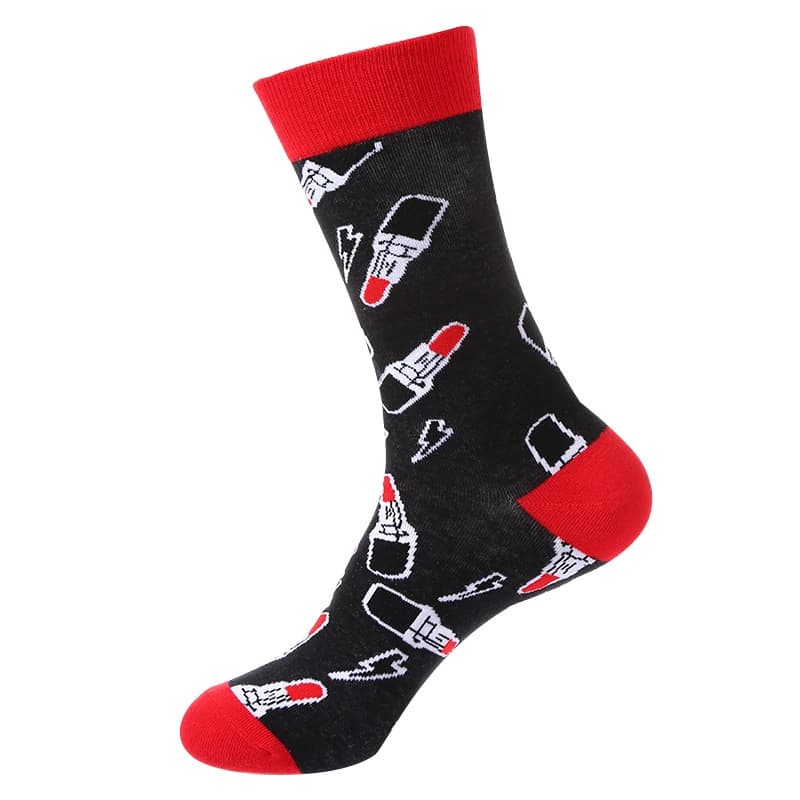
Custom Jacquard Cotton Crew Socks
Two jobs on one machine: a brand mark knitted into the sock, or a full-bleed graphic where the pattern is the product.
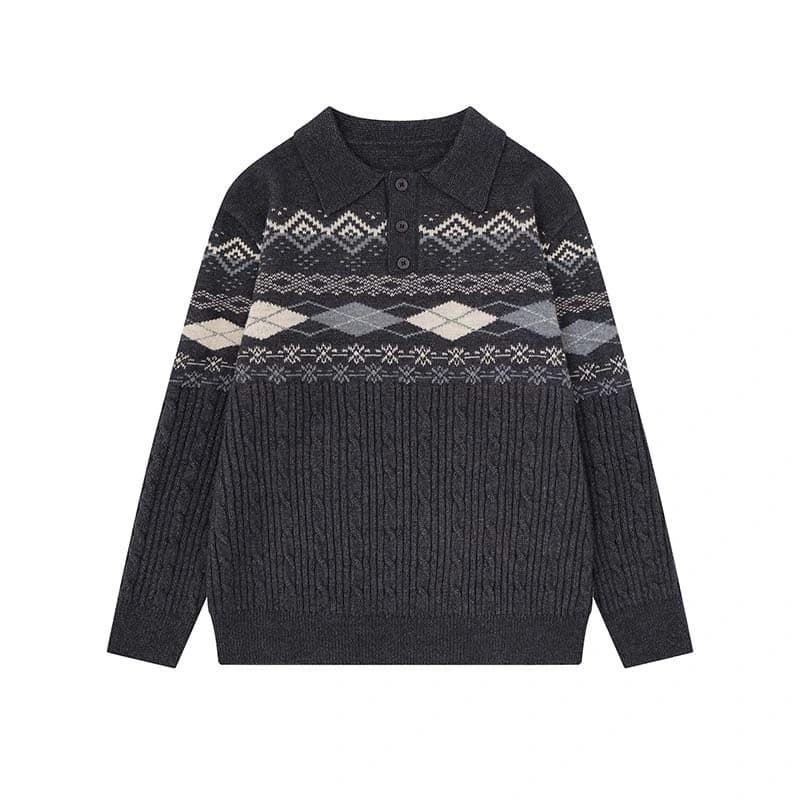
Custom Cable Knit Polo Sweater with Jacquard Yoke
Two stitch languages in one panel — a jacquard yoke across the chest and shoulders, rope cables down the body, joined without a single seam.
Keep reading
It's Time to Custom-Own Your Christmas Jumper
A short consumer-oriented overview of the custom Christmas jumper trend — design ideas, group-event tips, and the festive looks defining this year's holiday season.
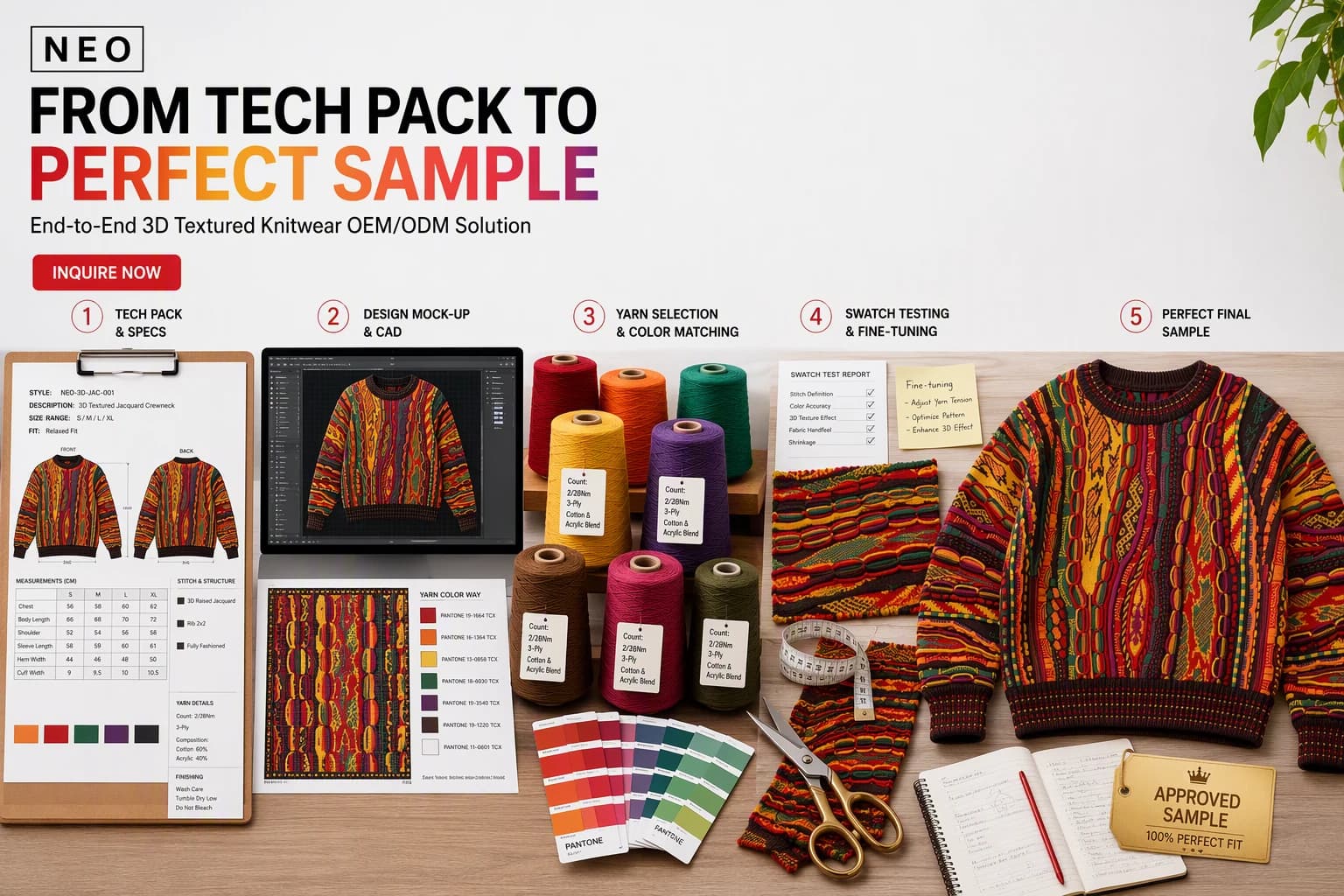
From Tech Pack to Perfect Sample: How Knitwear Sampling Actually Works
A floor-level walkthrough of the five stages between your tech pack and an approvable knit sample — mock-up and CAD programming, yarn colour matching, swatch testing, and the final PPS.
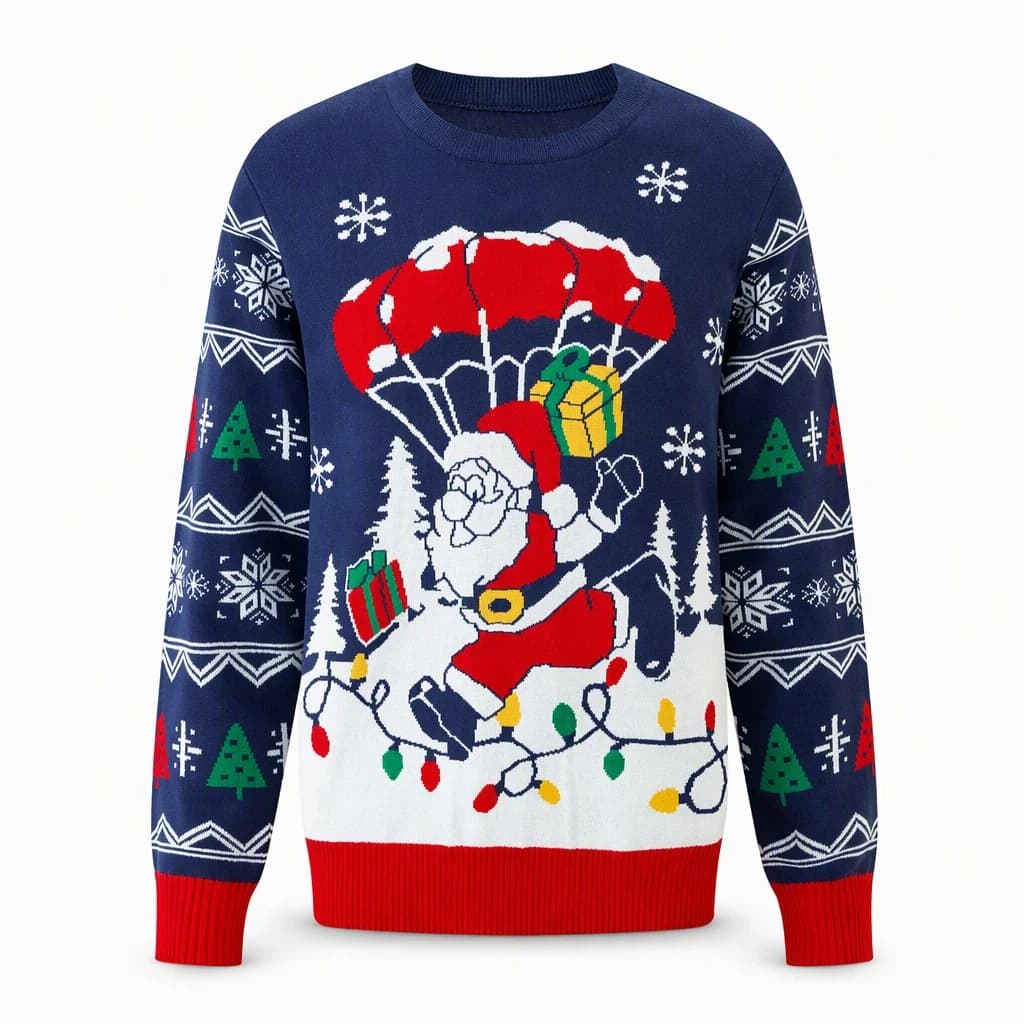
Sourcing Custom Men's Knitwear: What Separates a Knitwear Factory from a Sweater Mill
Mens knitwear briefs rarely fail on the design. They fail on gauge, size grading and reverse-side finishing — three things most price requests never ask about. Here is what to specify before you ask for a quote.
Send us the piece you were told was too hard.
Reference photo, rough sketch, or full tech pack — our Dalang technical punchers evaluate feasibility, machine gauge, yarn options, and pricing within 24 hours.