
The Drawing Meets the Yarn: Inside a Knitwear Artwork Review
A buyer sends a drawing. Before anything reaches the machine, three people sit down with a printed graph, a piece of freshly knitted fabric and a colour card, and decide what the drawing cannot have. That meeting is where most sampling surprises are actually prevented.
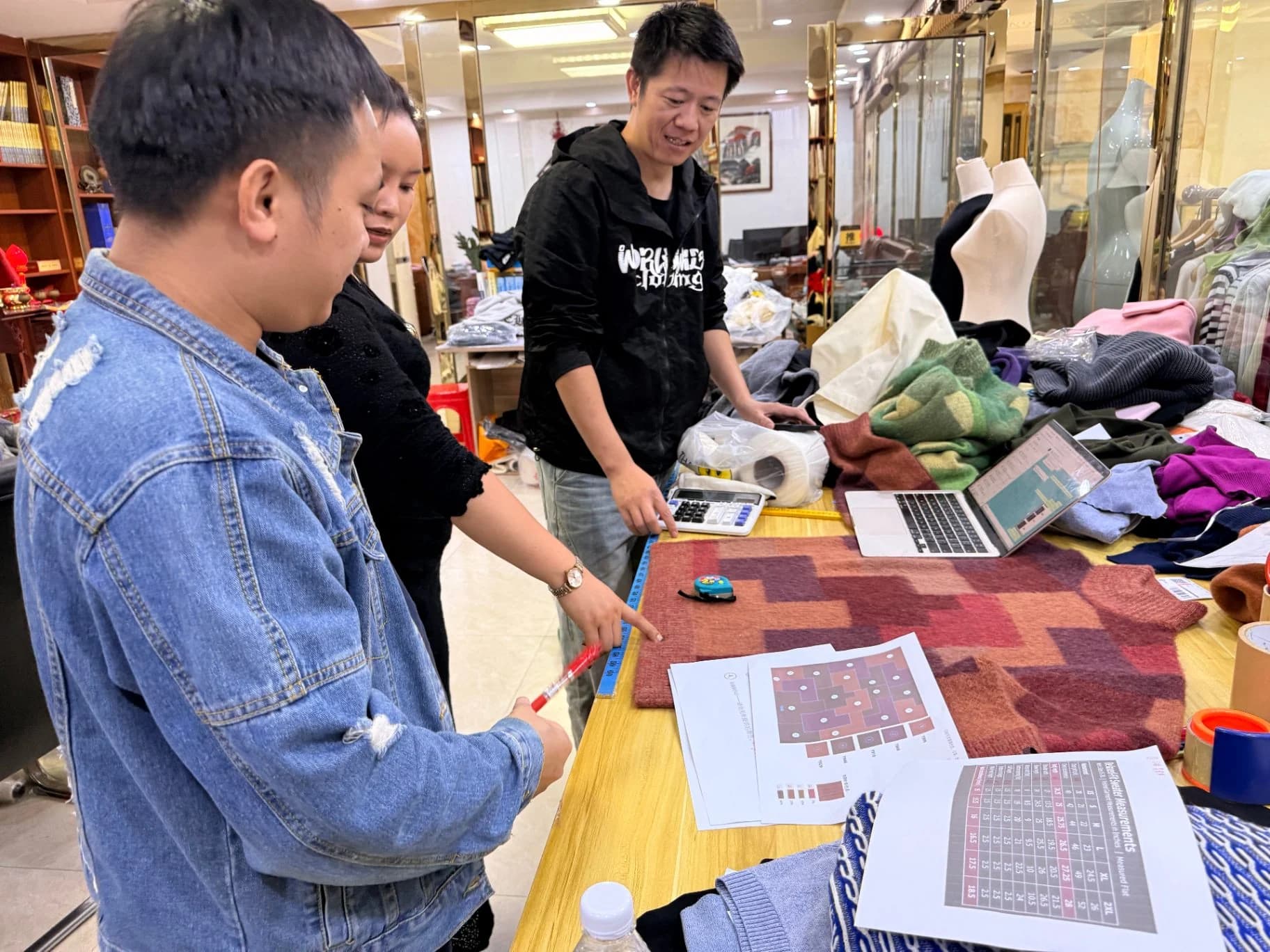
An internal meeting, described as it happens. The technical guides on this site cover the specification, the sample room and the fit check. This one covers the hours in between, when a drawing is turned into something a needle bed can execute.
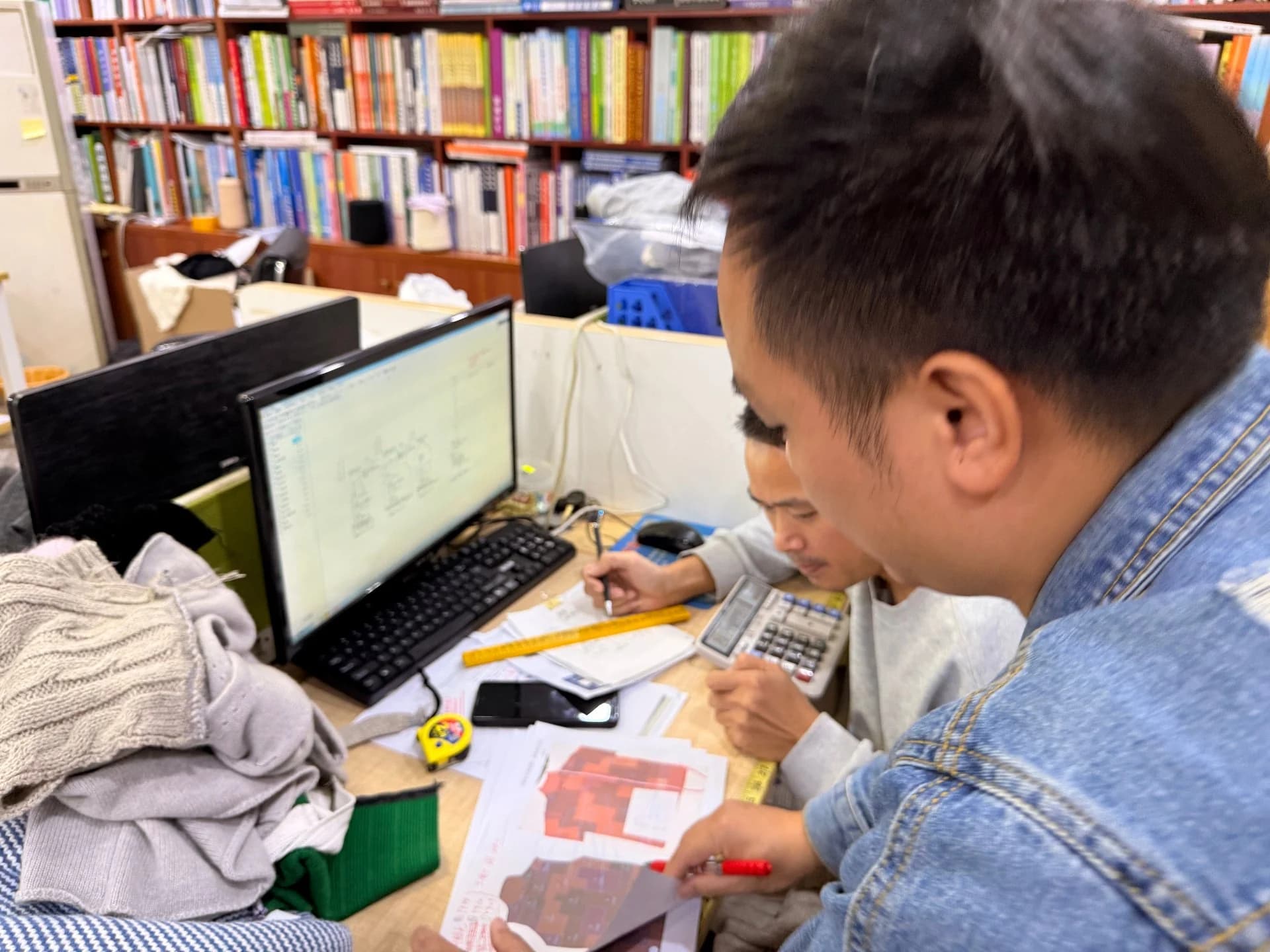
A drawing arrives, it looks finished, and the instinct on both sides is to start a sample. It does not go on the machine for two or three days, because a drawing is not yet a garment. Between the picture and the needle bed sits a translation step, and the translation is done by a person: the pattern technician, who sits at a monitor with a grid on it and decides what the artwork is going to become.
The meeting that follows is not a design critique. Nobody is there to discuss whether the drawing is good. The question is narrower and harder — which parts of this drawing can be knitted, which parts can be knitted only if something else changes, and which parts cannot be knitted at all. Three things are on the table for it: a printed graph, a piece of fabric off the machine, and a colour card.
What the Drawing Does Not Contain
A drawing answers what the garment should look like. A knitting programme answers how it comes into existence, row by row, needle by needle. They are different documents, and the gap between them is not a mistake on anyone’s side. It is simply the part the drawing was never asked to describe.
- Gauge. The same motif at 7GG and at 12GG is not one pattern at two sizes.
- The number of colours sharing a single row. This is what sets the machine programme and most of the price; the total colour count in the file tells you very little.
- Float length. Where two colours pass each other, the idle yarn runs behind the fabric. Past a certain length it catches on rings and fingernails, and has to be tied back or the structure has to change.
- Where the garment narrows. Shoulder, armhole, waist — the places where stitches are cast off are also the places where a pattern walks out of alignment.
- Repeat arithmetic. A motif has to divide into the stitch count. If it does not, the two side seams will not match, and it shows from three metres away on a flat-lay.
- What happens after washing. Every number in the drawing describes the garment before it has been washed and relaxed.
Six items, and none of them can be settled by looking harder at the picture. They are settled at the machine, or on paper beside it, which is what the review is for.
One Square on the Paper Is One Needle
The grid the technician works on is not a design grid. One square is one needle, and one horizontal row of squares is one course — one pass of the carriage. That single fact sets the resolution of everything that will ever be knitted from this drawing.
At 7GG there are seven needles to the inch, which is 2.76 to the centimetre. A 55cm front panel is about 152 needles wide once the edge stitches are allowed for. That is the entire canvas. An A4 printout at 300dpi carries 3,508 pixels across the same width, so the file a designer works in holds roughly twenty-three times more detail than the fabric can express.
This is why a detail that reads beautifully on screen disappears on the garment, and it is not a manufacturing failure. It is a resolution limit, and the review exists to catch it before anyone spends a week on a sample.
A circle is the clearest example, because everybody draws circles. A dot 15 needles across cannot be round. To turn a corner the programme steps sideways: one stitch out, three rows down, one stitch out. A 15-needle dot gets about five visible steps along its edge, and at 7GG each step is roughly 3.6mm — plainly visible once the garment is in a customer’s hands. Blow the dot up to 20 or 24 needles and the same five steps are spread across a longer curve; the yarn’s own bulk fills the corners and the eye reads a circle again. The fix is not a better programmer. The fix is a bigger dot.
The same arithmetic kills type. A wordmark needs a minimum number of needles per stroke to stay legible; below it, letters close up at the serifs and the counters fill in. A thin italic face is the worst case, which is why so many knit logos end up as heavy sans-serif capitals. Not for style — because that is what survives 2.76 needles per centimetre.
And gauge cannot be scaled, only redrawn. Put the same 15-needle dot on a 12GG machine and the dot is physically smaller; to keep its size on the garment it has to be redrawn at about 26 needles, with its own stepping, checked again against the same steps problem. This is the most common misunderstanding in a first sample request: the file is sent to a finer machine in the belief that finer means the same thing, only better. It is not. It is a new pattern, and a new pattern is a new set of decisions.
Where the Shaping Bites the Pattern
Everything above is about resolution. This next part is geometry, and it is where the arguments happen.
A knitted panel is shaped by casting stitches off at the edges, and in full-fashion work that cast-off is meant to be seen: it forms a small stepped edge that is later linked into the seam. A front panel that tapers from 55cm at the hem to 47cm at the chest gives up about 22 needles over that distance, in eight casting-off points. At each of those points, the pattern column nearest the edge has to go somewhere.
If it goes nowhere — if the programme holds the motif at the same stitch position — the pattern drifts relative to the seam. Left and right stop being mirror images. Nothing errors, nothing alarms, the panel measures correctly, and the garment looks wrong in a way most people cannot name.
There are three ways out, and they cost different things.
- Move the pattern with the seam. The motif shifts inward at each cast-off so it stays parallel to the edge. Visually clean, and it is what most buyers want without knowing the term for it.
- Hold the pattern still and accept the drift. Only works when the motif is small, dense and non-directional — a scattered dot or a fine Fair Isle band. On anything with a clear vertical axis it does not work at all.
- Remove the shaping. A straight-side body with side vents has no cast-offs and therefore no drift, and for a boxy silhouette it is a legitimate answer. It changes the block, so it changes the fit, and it has to be agreed as a design decision rather than a technical one.
Then there is the repeat. A motif’s width has to divide into the stitch count, or the pattern will not close at the seam. Twelve stitches repeating into 152 needles leaves eight stitches over — not enough to hide, more than enough to see. The honest options are to widen the panel to 156, narrow it to 144, or redraw the motif at a repeat that divides. All three are cheap on paper. Found at the end of a 2,000-piece run, all three are the most expensive kind of mistake there is, because the garments exist and cannot be sold.
The Colour Card Is Not the Yarn
A colour in a file is three numbers. A colour in a garment is dyed fibre under whatever light the customer happens to be standing in. Between those two states the shade passes through a yarn card, a lab dip and a dye lot, and each of the three can move it.
The practical consequence is that colour is never approved from a screen. Screen colour is emitted light; yarn is reflected light, and the same hex value on a backlit display reads cooler and cleaner than the same yarn in a room. During a review the card is opened on the table beside the fabric, in daylight if the window allows, and the technician’s question is not whether the shade is right but whether the yarn is right. The substrate is part of the colour.
Two further things get decided at the same moment, and both are pattern problems wearing colour clothes.
- Adjacent darkness. A mid-tone placed against a dark ground reads dirtier than it is, because the eye reads the edge rather than the fill. On a jacquard the fix is usually to lift the mid-tone one step, not to change the design.
- Two mid-tones side by side. They merge at distance. A warm grey next to a cool grey, meant as a subtle two-tone, will read as one colour from three metres — which is where retail is judged. Either open the gap or merge the shades and save a yarn carrier.
And lot matching. Two yarn purchases against the same Pantone reference, even from the same mill, dye to slightly different shades, and a delta-E of around two is where the difference starts being visible on a finished garment. For a two-piece set, a colour-blocked design, or any programme that will be replenished, the review specifies a single lot — which means ordering the yarn for the whole run at once. That is a costing decision as much as a technical one, and it is better taken here than discovered at the second delivery.
The Pattern Does Not Know About the Shoulder
A drawing is flat. A garment is not. The shoulder slopes, the armhole is a curve that has to accommodate a rotating joint, and the neckline is a compound curve that has to sit on a body while reading as a straight line from the front.
Knitwear does not cut. A jacquard panel is knitted to shape on the machine, so there is no bolt of patterned fabric to cut around a shoulder. The pattern therefore has to know where the structural lines fall before the first row is knitted, and the structural lines do not care about the pattern.
The visible result: a horizontal band that runs edge to edge across the chest will break at both armholes and again at the shoulder seam, because those are cast-off edges. A vertical panel that looks continuous in the drawing will be interrupted by the neckline. Neither of these is a defect. Both will be read as one by a buyer who was shown only the drawing, which is why they get shown on the form before they get approved. The fit check has its own page on this site, and it exists for exactly this reason: a garment can measure right and still hang wrong.
Intarsia can carry a colour across a structural boundary, because each colour block is knitted from its own yarn carrier instead of being floated behind the fabric. It also doubles the handling at the machine and constrains how many blocks can sit in a single row. That makes it a real option, and it belongs in the review as a priced option rather than as a discovery in the second sample.
Three Questions That Settle Most of It
After a few hundred of these meetings the list of questions shortens. Three of them settle the majority of designs before anyone touches a machine.
- How many colours share a row, not how many are in the file. Carriers are finite. Above the machine’s ceiling the design needs fewer colours in one row, an extra yarn change, or a different technique — three answers with three very different prices. It is the single most misunderstood number in knitwear, which is why it has a page of its own here.
- What is the longest float, in stitches. Behind every colour change a yarn crosses idle. Under about five or six stitches it is invisible and safe; beyond that it catches, and the options are to tie it back, split the motif, or change the structure. Nobody specifies this in a tech pack, and it decides whether the inside of the garment is wearable.
- How much of the pattern are you willing to give up at the side seam. There is no version of a shaped garment where the answer is zero. The only real question is whether the compromise happens in the drawing, where it costs two hours, or in the bulk, where it costs the order.
Two Hours Here, Two Weeks There
The economics of this step are lopsided, and worth stating plainly. Changing a graph on a monitor costs a couple of hours. Changing the same thing after the bulk has run costs the yarn, the machine time, the finishing, the re-packing and the slot in the production calendar — and if the order has already shipped, it costs the customer, who has no reason to give the factory a second chance.
There is also a version of the mistake that never gets caught in the factory at all, because nothing measures wrong. A drifted pattern passes inspection. The panel measures 55cm. The colour is within tolerance. The garment is simply not the one that was drawn, and it arrives that way.
So the review produces a document and not only a decision: what changed from the drawing, why, and what it does to the price. It travels with the sample. Buyers who have worked with several factories tend to report the same thing about this — the factories that argue with the drawing early are the ones whose samples arrive correct, and the ones that accept everything without comment are the ones whose second sample is a surprise.
What to Send So the First Meeting Is Shorter
None of the above requires learning to programme a knitting machine. It requires six things to be in the file.
- The artwork, plus the garment it should feel like. A photograph of an existing piece does more for gauge and hand than three paragraphs of description.
- A gauge preference, or the reference garment’s gauge. If you do not know, send the reference and it gets matched.
- Pantone references, or physical yarn if you have it. TCX codes are enough to start; the physical submission is what closes it.
- The motif’s repeat width, if the design has one. If it does not, say so — that is information too.
- Whether the pattern is allowed to break at the shoulder and armhole. If it is not, the design has to be built around that from the first sketch rather than corrected at the graph.
- The finished measurement chart, and whether those numbers are before or after wash. This one item causes more rework than anything else on the list.
Frequently Asked
Can you knit exactly what I drew?
Not exactly, and no factory can. What comes back is your design at the resolution of the machine: lines heavy enough to read, dots large enough to stay round, colour separations the carriers can carry. In practice that is 90 to 95 per cent of the drawing, and the remaining 5 to 10 per cent is the part the drawing was never able to specify.
How long does the drawing stage take?
Two to three working days for a single-colourway jacquard, up to five for something with several colourways, patches or knitted text. It runs alongside yarn sourcing rather than after it, so it rarely adds to the total sampling time.
Do I need to provide a knitting graph?
No. A flat, a rendering or a photograph of a reference garment is enough. A graph supplied by a designer is welcome and sometimes useful, but it is almost always drawn at the wrong gauge, so it gets redrawn rather than used directly.
What is the smallest detail you can knit?
It depends on gauge, and it is better expressed in stitches than in millimetres. A line needs two needles to read as a line. An eyelet or a counter needs five or six to stay open. A letter stroke needs two to three. At 7GG that puts the practical minimum for a line at roughly 0.7mm, and for legible type at around 25mm cap height. At 12GG both numbers roughly halve.
Can you match a Pantone exactly?
Close, and honestly described. Dyed yarn against a paper swatch typically lands within a delta-E of one to two, which is the range where most people cannot separate the two without putting them side by side. Below one is achievable on some shades and not on others, and a factory that promises zero is describing a lab dip, not a production lot.
What happens if my pattern crosses the side seam?
It gets moved, or the seam gets moved. A motif that has to continue across a seam needs a stitch count that divides and often a change to the panel width. Both are settled at the review, and both are expensive to settle afterwards.
Two days of a technician’s time is the cheapest line in the whole programme, and the only place where a change is free. That is the argument for the meeting — not process for its own sake, but the fact that a drawing is a proposal and a garment is a commitment, and somebody has to stand between the two and say which parts will survive.
Looking to manufacture this style at scale?
Send us your design brief and we'll quote a direct-factory run with low MOQs, 72h sampling and DDP worldwide delivery, knitted on our own floor in Dalang.
Knitwear you can manufacture right now
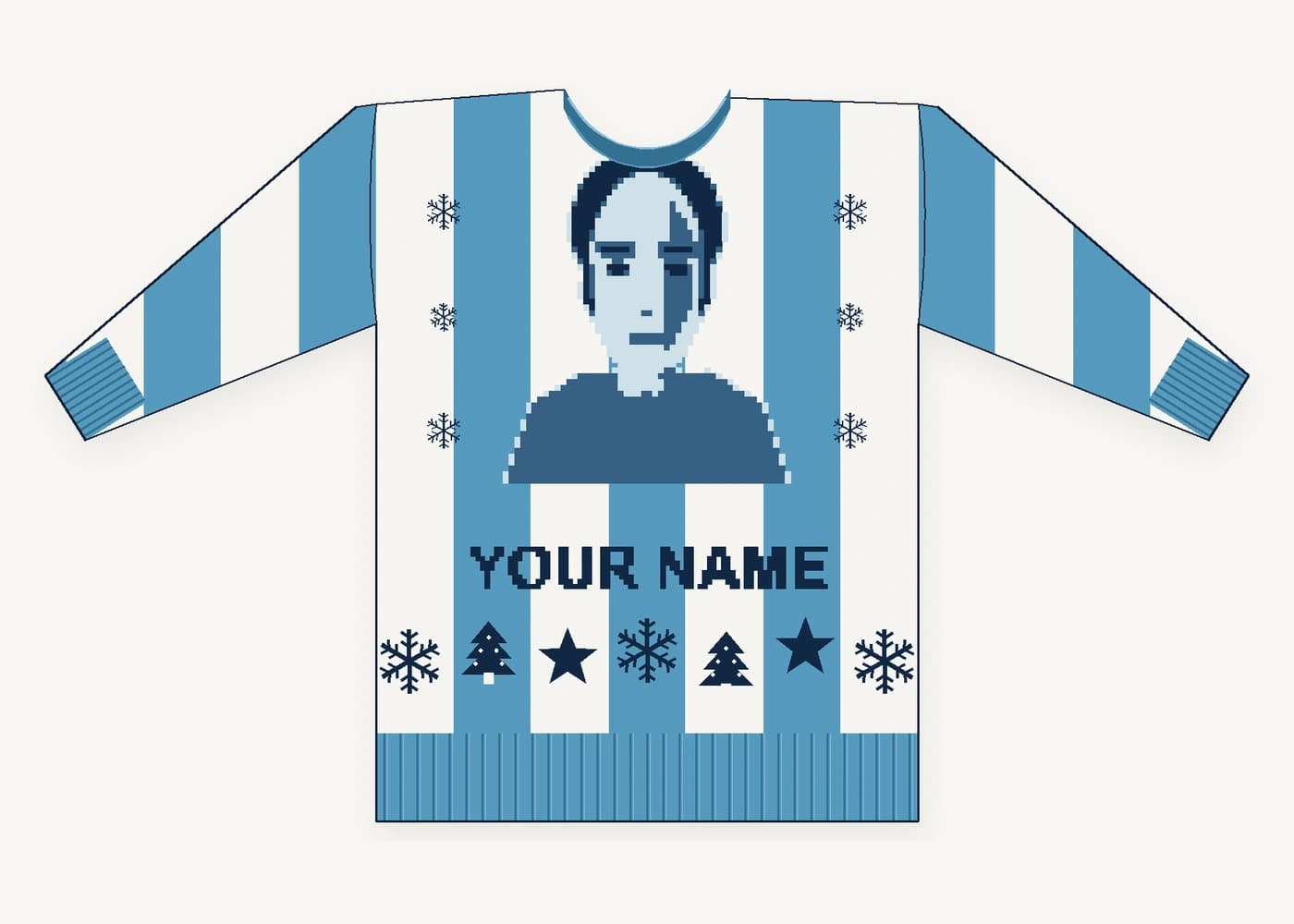
Custom Portrait Knit Christmas Jumper
The only build where the artwork is a photograph: one face re-drawn onto a 100 x 104 stitch grid, three yarns of shading plus the ground, and the rest of the panel kept deliberately quiet.
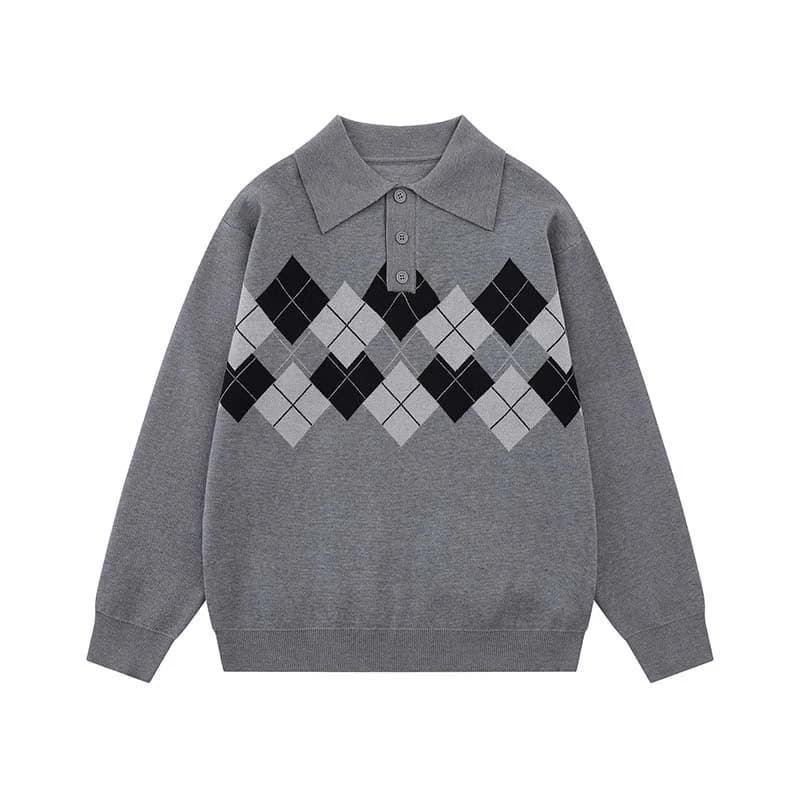
Custom Argyle Jacquard Polo Sweater
Preppy diamond-argyle knit polo — yarn, colourway, hang tag and woven main label all built to your brand.
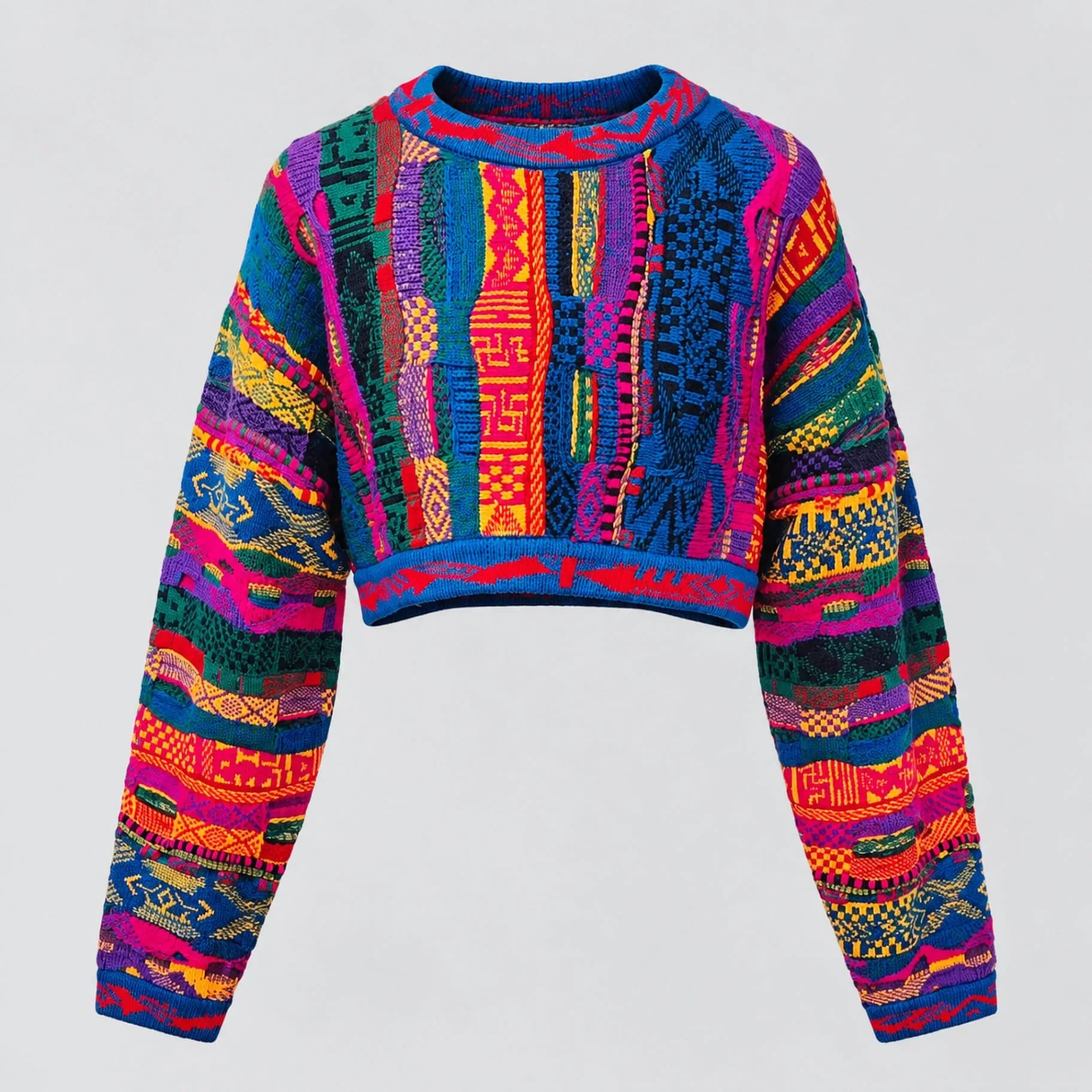
Custom Patchwork Jacquard Crop Sweater
A cropped crew-neck built from columns of folk motifs in up to 13 knitted colours — a statement jacquard piece developed from your colour story.
Techniques behind this product
Multi-Colour Jacquard
CoreUp to 13 colours in one piece — standard mills stop at 4 to 6.
Intarsia
CoreSolid colour blocks knitted side-by-side with zero back floats.
Fine Gauge
Ultra-smooth, lightweight 14GG–16GG luxury knitwear.
Keep reading
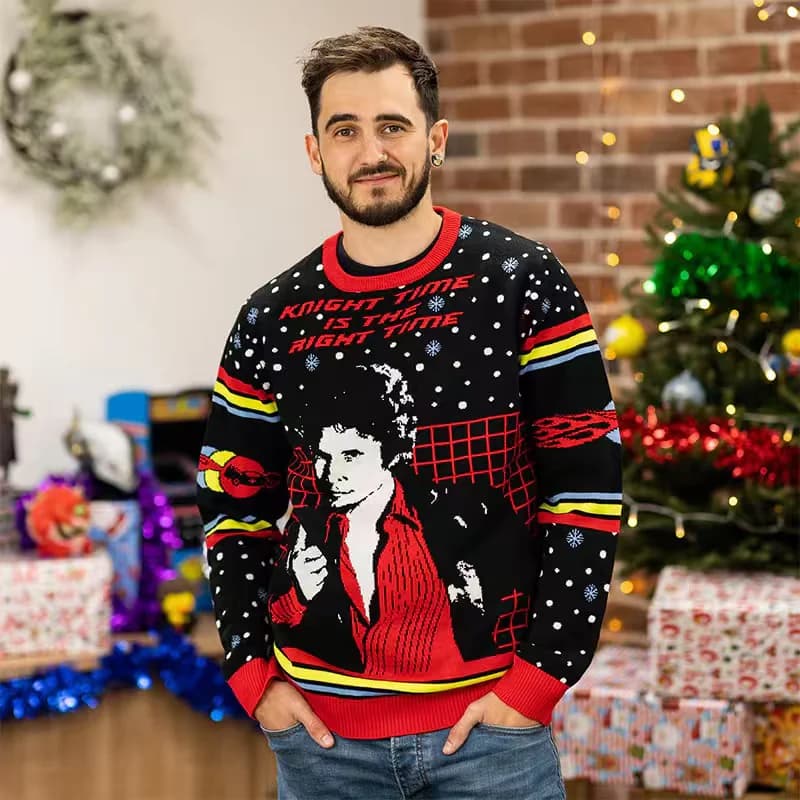
It's Time to Custom-Own Your Christmas Jumper
A short consumer-oriented overview of the custom Christmas jumper trend — design ideas, group-event tips, and the festive looks defining this year's holiday season.
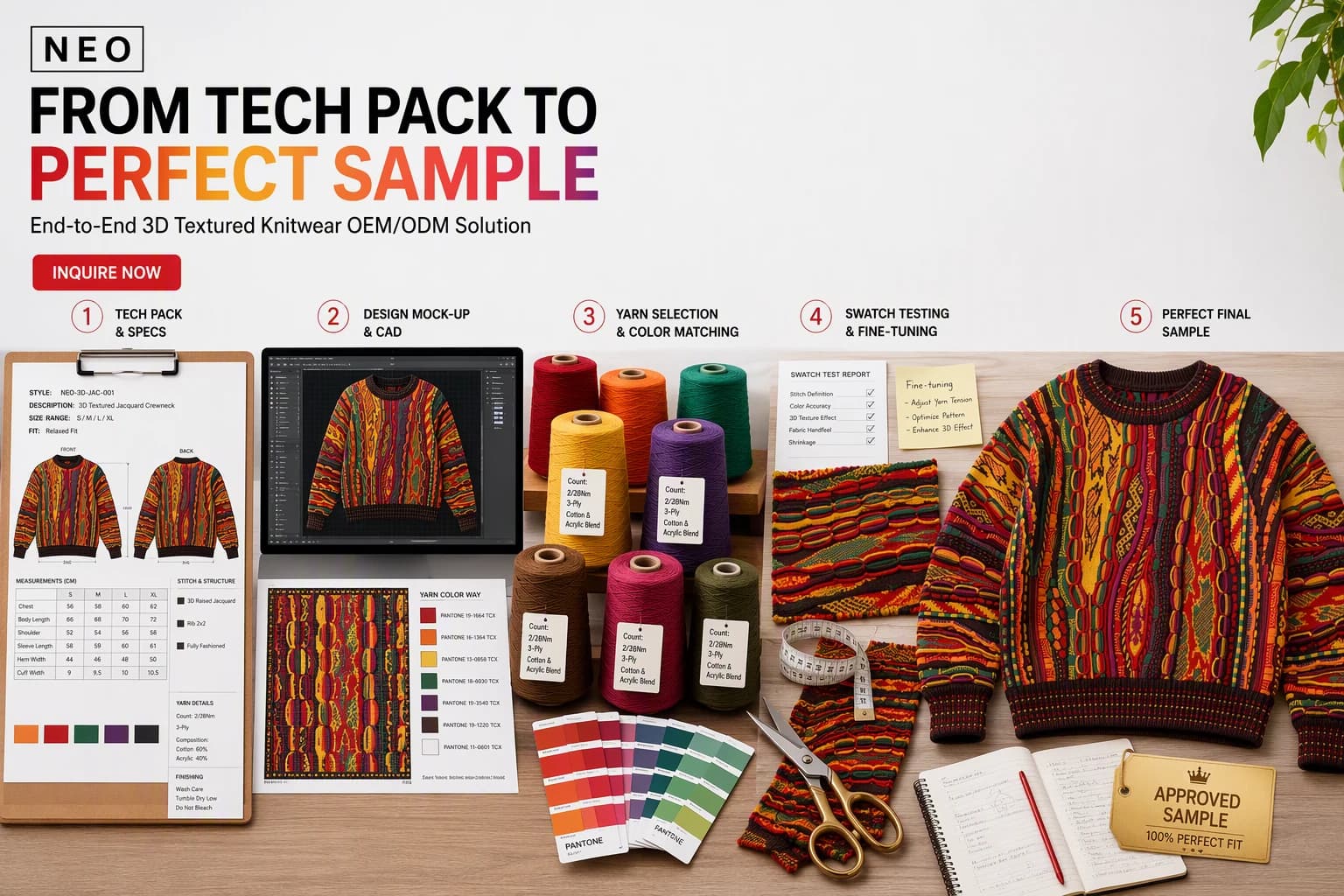
From Tech Pack to Perfect Sample: How Knitwear Sampling Actually Works
A floor-level walkthrough of the five stages between your tech pack and an approvable knit sample — mock-up and CAD programming, yarn colour matching, swatch testing, and the final PPS.
Sourcing Custom Men's Knitwear: What Separates a Knitwear Factory from a Sweater Mill
Mens knitwear briefs rarely fail on the design. They fail on gauge, size grading and reverse-side finishing — three things most price requests never ask about. Here is what to specify before you ask for a quote.
Send us the piece you were told was too hard.
Reference photo, rough sketch, or full tech pack — our Dalang technical punchers evaluate feasibility, machine gauge, yarn options, and pricing within 24 hours.