Knit Bottle Sweaters: Why a 40-Gram Item Is Not a Small Project
A bottle sleeve weighs a tenth of a sweater and costs a tenth as much to make — yet it needs the same programmer, the same machine setup and the same sample round. Here is what actually decides the price, the logo and the fit.
Written for brand owners, promotional gifting buyers, and sourcing managers ordering knitted sleeves at production volume. Everything below is run in-house on our own flat-knit floor in Dalang, Dongguan.
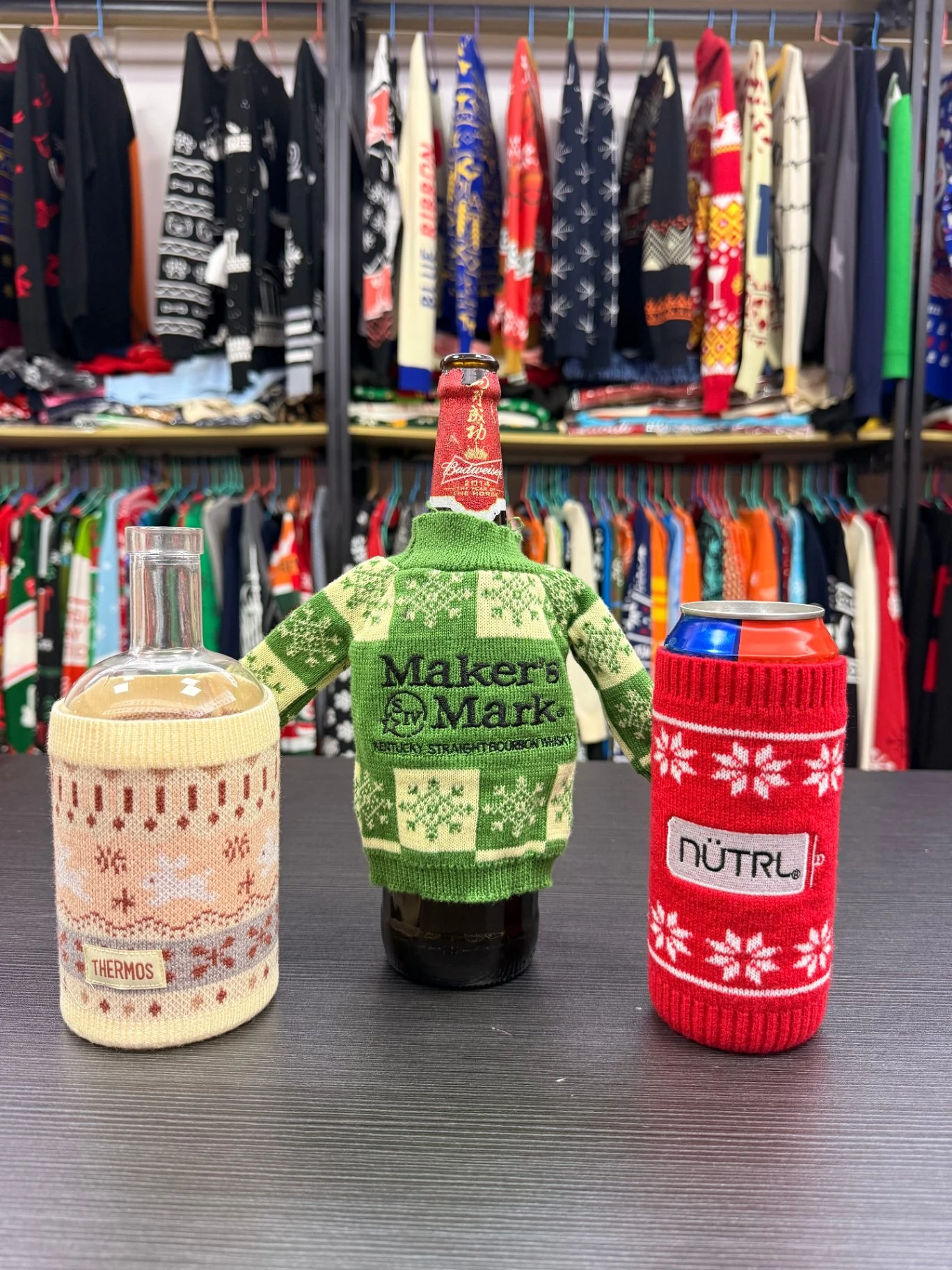
Three pieces, one table. On the left, a ribbed sleeve in oatmeal and peach over a glass flask. In the middle, a green and cream Fair Isle bottle sweater with short knitted sleeves, pulled over a spirits bottle. On the right, a red snowflake sleeve on an aluminium can. Behind them, racks of full-size sweaters waiting to be finished.
That background is the whole point of the photograph. A bottle sleeve is not a separate product category made by a separate kind of supplier. It comes off the same needle beds, from the same yarn store, programmed by the same technicians as everything else on this site — just pushed through a much smaller tube. And that is exactly where the interesting problems start.
Note on the garment marks: the branded pieces in the photograph are shown to demonstrate construction only. Maker's Mark, NÜTRL and Thermos are the property of their respective owners and are not sold, licensed or sublicensed by us. We knit buyer-supplied or buyer-licensed artwork only, and we ask for written confirmation that a mark is yours to use before it enters a sample.
Why a Small Item Is Not a Small Job
A bottle sleeve uses roughly 35 to 50 grams of yarn. A crew neck sweater uses 400 to 500. In material terms the sleeve is one tenth of the job, and in machine time it may be one fifth. In every other respect it is the same order: the artwork still has to be rebuilt as a machine programme, the colours still have to be matched physically, the machine still has to be set up and tied in, and somebody still has to knit a sample, finish it, photograph it and send it for approval.
That asymmetry is the single most useful thing to understand before you ask for a price. The cost of a knitted sleeve is not dominated by what it is made of. It is dominated by the fixed work that happens once per design, and by the number of separate operations the finished piece needs. Both of those scale badly when the piece gets smaller.
The Three Builds in the Photograph
1. The full bottle sweater
The middle piece is the most complex of the three, and the most misunderstood. It is not a tube with a drawing on it. It is a body tube shaped in at the shoulder line, finished at the neck with an edge that grips under the bottle's foil, left open at the base so the bottle stands on its own foot, plus two short sleeve tubes knitted separately and linked into the armholes.
- Shoulder shaping means partial knitting — needles are held and returned to narrow the tube, which is extra programming and extra machine time.
- Each sleeve is its own small panel, which is two more knits and two more linking operations.
- The neck edge has to hold without cutting into the foil, so it is usually a rolled edge or a short 1x1 rib rather than a plain cast-off.
- The base stays open. A closed base turns the piece into a pouch that the bottle cannot stand in.
This is the build to choose when the sleeve is the gift. It is also the build that separates a real knit supplier from a printer with a sewing machine, because the sleeve tubes cannot be faked.
2. The ribbed sleeve
The left-hand piece is the opposite extreme: a straight tube, rib throughout, open at both ends, no shaping anywhere. In production terms it is the cheapest thing on the table by a wide margin, and it is also the most forgiving, because the rib does all the fit work. A 2x2 rib pulls in when relaxed and opens when you pull it on, which is why it will hold a flask, a candle jar and a 750 ml bottle with the same construction.
The one addition here is the sewn patch. Any woven label, patch or badge is a separate hand operation, and it is the first thing to delete if the unit cost has to come down.
3. The can cooler
The right-hand piece looks the simplest and is the fussiest to fit. A standard 355 ml or 500 ml can is about 66 mm across and a slim 330 ml can is about 53 mm, so the tolerance window is narrow. Too loose and the sleeve slides down a wet can the moment it comes out of a cooler. Too tight and it will not go on without tearing the neck rib.
That is why a can cooler is specified around stretch, not around appearance. The construction is a straight tube with a ribbed band at the top and bottom and a plain jacquard body — two rib zones to grip, one flat field to carry artwork. The rib width is a functional decision, and widening it to look more premium eats into the printable area.
The Stitch Budget: What Your Logo Can Survive
This is the conversation worth having before anyone opens Illustrator. A knitted sleeve is not printed. Its resolution is the needle, and on a 75 mm bottle body there are not many needles in play.
- 3GG — one stitch is about 8.5 mm of circumference. Around a 75 mm bottle that is roughly 28 stitches in total, so about 14 across the face you actually see.
- 5GG — about 5 mm per stitch, roughly 46 stitches around, about 23 across the face.
- 7GG — about 3.6 mm per stitch, roughly 65 around, about 32 across the face.
- 12GG — about 2.1 mm per stitch, roughly 111 around, about 55 across the face.
Now put a wordmark into those numbers. Blocky capitals need roughly three stitches per character to stay readable. Fourteen stitches will not hold a ten-letter word. Thirty-two will. So for a sleeve carrying a wordmark, 7GG is a practical floor, and 12GG is where small secondary text and fine detail become possible at all. A design that looked clean on screen at 300 dpi can arrive as an unreadable blur because the gauge was chosen after the artwork rather than before it.
Two further constraints catch people out. First, knitting resolution is not square: one stitch is normally wider than one course is tall, so a circular logo comes off the machine slightly oval unless the artwork was built on the real stitch grid. Second, a gradient cannot be knitted — jacquard works per stitch, so a soft fade either gets reduced to a handful of steps or dithered into noise. Flat colour blocks are the native language here.
Colour Count, and Why a Sleeve Is Less Forgiving Than a Sweater
Six yarn colours is the practical ceiling on a single piece, and that applies to sleeves just as it does to sweaters. The reason is not the artwork but the reverse side: every colour that is not on the face has to travel across the back as a float, and each additional colour adds its own carrier and its own tension problem.
On a sleeve there is far less width for those floats to distribute their tension across, so the face puckers sooner. The counterweight is that the reverse of a sleeve sits against glass or aluminium rather than against a shirt, so a slightly longer float is tolerable there in a way it never is on a sweater. What is not tolerable is a float that goes slack and lets the motif drift out of register halfway round the tube.
Fit Is a Specification, Not a Guess
'Fits a wine bottle' is not a measurement. The body diameter of a standard 750 ml Bordeaux bottle is around 75 mm, a champagne bottle runs 88 to 90 mm, a standard can is about 66 mm, and a 12 to 20 oz tumbler can be anywhere between 70 and 90 mm depending on the brand. Knit a sleeve to the middle of that range and it will be simultaneously loose on one container and impossible on another.
- The container's diameter at the body — the part the sleeve actually sits on.
- The diameter at the widest point the sleeve must pass over. On a champagne bottle that is the shoulder, and on a tumbler it may be the lid. This sets the minimum stretch.
- The height you want covered, measured from the base.
- Open base or closed base.
- Neck finish: rolled edge, rib, drawstring or crochet trim.
The fastest way through this is to post us the actual container. We knit the sample around the physical object, and the fit argument is over before it starts.
Where the Labour Actually Goes
Knitting is only part of the cost, and on a small item it is a smaller part than buyers expect. Linking and finishing are counted in operations, not in grams: seaming the side of a 40-gram tube takes nearly as long as seaming the side of a 400-gram body, because the handling is the same and the piece is just smaller.
That produces a fairly reliable price ladder, cheapest first: a plain rib tube, then a jacquard tube, then a tube with a sewn patch, then a full bottle sweater with attached sleeves. Most of the gap between the first and last rung is handwork, not yarn.
Why the MOQ Is 300 and Not 100
Our MOQ on sleeves is 300 pieces per design, against 100 on knitwear. It looks arbitrary until you do the division. The programming hours, the machine setup and the sample round are the same whether the order is 100 pieces or 300. On a sweater that fixed cost is spread across 40 or 50 kilograms of yarn. On a sleeve it is spread across about 4.5 kilograms at 100 pieces — so the setup ends up dominating the unit price and nobody is happy with the quote.
At 300 pieces the same setup is spread across roughly 13 kilograms and starts to disappear into the background. Below that, the honest advice is to run one colourway and accept a higher unit price, rather than split a small quantity across several designs.
Booking a Holiday Programme
These pieces exist for the fourth quarter, which means the whole category has a deadline that is not negotiable. Sampling is 72 hours from yarn stock confirmation and bulk runs two to three weeks, so the knitting is rarely the bottleneck. What actually decides whether a sleeve lands in December is when the artwork was locked.
Three habits make the difference. Send the physical container with the brief rather than after the first sample. Approve artwork against a stitch grid, not against a mock-up, so the gauge question is settled in week one. And brief the programme early enough that a second sample round is a choice rather than an emergency.
What to Put in the Brief
- The container, or its exact body diameter, widest diameter and the height to be covered.
- Artwork as flat colour blocks, plus a vector logo — we will tell you the minimum gauge it needs.
- Pantone references for every colour, including the ground colour.
- Base and neck finish: open or closed, rolled, ribbed, drawstring or crochet.
- Sleeves or no sleeves, if you are ordering the full bottle build.
- Label treatment: knitted-in mark, woven label, or sewn patch.
- Quantity per colourway, required delivery date, and destination country for DDP quoting.
Frequently Asked
Can you knit a photographic or gradient design?
Not photographically. Jacquard is resolved stitch by stitch, so a photographic image arrives as an abstraction and a gradient arrives as visible steps or dither noise. Logos, mascots, geometric patterns and lettering all work well. If realism is essential, the sleeve is the wrong substrate and a printed or woven label is the better route.
What is the smallest logo you can knit?
It depends entirely on gauge and on the diameter of the container. As a working rule, all-caps lettering needs about three stitches per character. Tell us the container diameter and what the logo has to say, and we will come back with the gauge that makes it legible — or tell you honestly that it will not be.
Can the sleeve be machine washed?
An acrylic or acrylic-cotton sleeve at 7GG handles normal home washing. Wash cold, around 30 degrees, and dry flat. The part that ages first is not the body but the neck edge, which loses recovery before the fabric does — so if the sleeve has to survive repeated use rather than one gifting season, specify a slightly deeper neck rib.
Do you knit the brand mark in, or sew a label on?
Either, and the choice is usually strategic rather than technical. A knitted-in mark sits flush and cannot be removed, which reads as the more premium option — and which is precisely why we ask for written confirmation that the mark is yours or licensed to you before it goes into a sample.
The photograph at the top of this page exists because three sleeves side by side explain a construction decision faster than any spec sheet. If you have a container in mind and a mark to put on it, send us both. The answer on gauge, fit and quantity comes back faster than a quote usually does.
Looking to manufacture Christmas jumpers at scale?
Skip the print-on-demand platforms. Send us your design brief and we'll quote a direct-factory run with low MOQs, 72h sampling, and DDP worldwide delivery.
Knitwear you can manufacture right now
Custom Knitted Wine Bottle & Cup Sleeves
Eco-friendly knitted sleeves that transform beverages into holiday gifts.
Custom Fair Isle Jacquard Knit Sweater
Banded Fair Isle colourwork knitted as true structure — up to 13 yarn colours in a single programme.
Custom Jacquard & Fringe Winter Scarf
Generously sized knitted scarves dyed to match your winter sweater range.
Techniques behind this product
Multi-Colour Jacquard
CoreUp to 13 colours in one piece — standard mills stop at 4 to 6.
Fair Isle
Classic heritage horizontal Nordic pattern bands.
Rib Knit
Elastic ribbed construction with superior stretch recovery.
Crochet & Openwork
Artisanal hand-crocheted openwork and textured trim.
Keep reading
It's Time to Custom-Own Your Christmas Jumper
A short consumer-oriented overview of the custom Christmas jumper trend — design ideas, group-event tips, and the festive looks defining this year's holiday season.
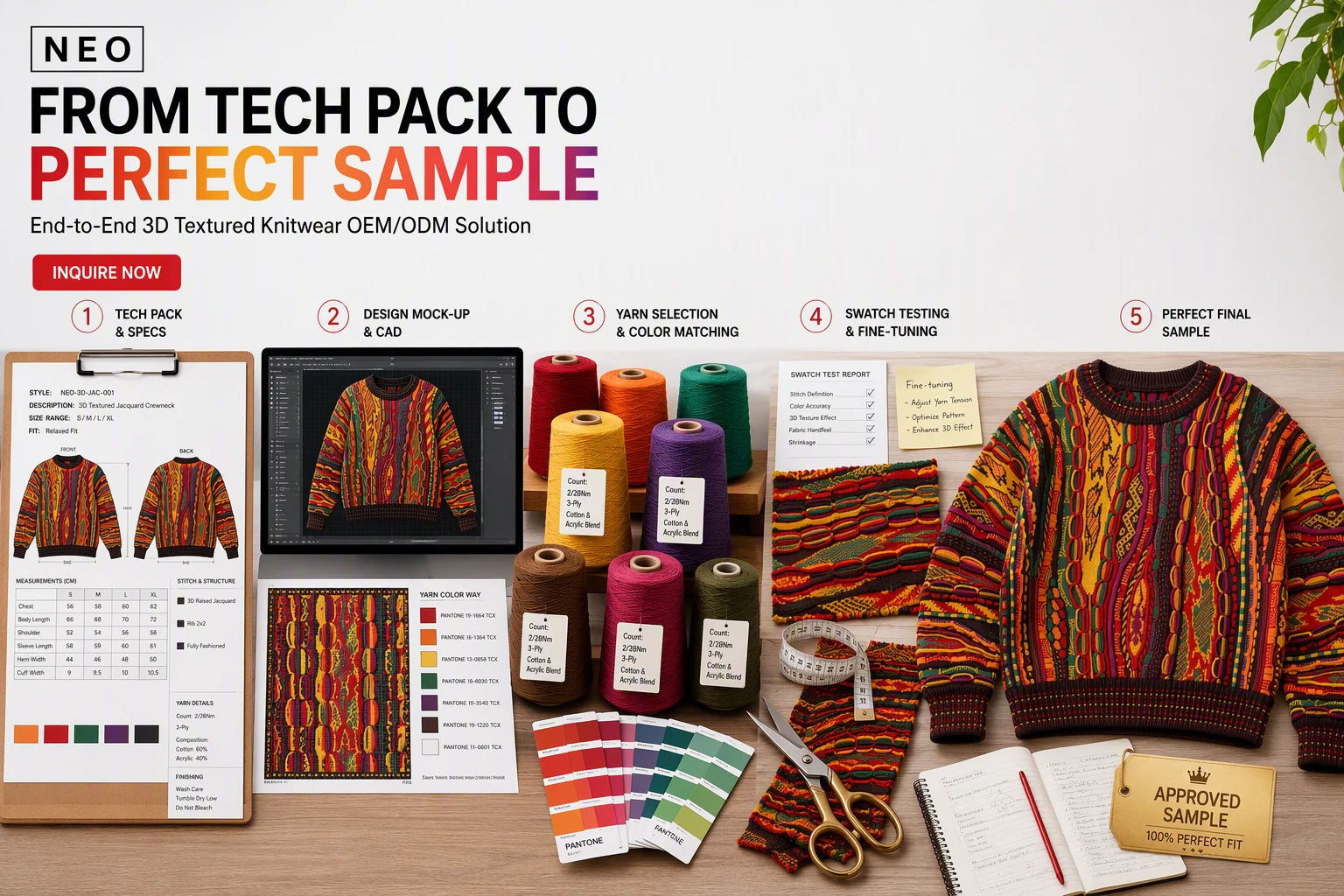
From Tech Pack to Perfect Sample: How Knitwear Sampling Actually Works
A floor-level walkthrough of the five stages between your tech pack and an approvable knit sample — mock-up and CAD programming, yarn colour matching, swatch testing, and the final PPS.
Sourcing Custom Men's Knitwear: What Separates a Knitwear Factory from a Sweater Mill
Mens knitwear briefs rarely fail on the design. They fail on gauge, size grading and reverse-side finishing — three things most price requests never ask about. Here is what to specify before you ask for a quote.
Send us the piece you were told was too hard.
Reference photo, rough sketch, or full tech pack — our Dalang technical punchers evaluate feasibility, machine gauge, yarn options, and pricing within 24 hours.