
Christmas Jumper Shipping Time: What Late Buyers Can Still Get Knitted and Delivered
Our Christmas lines are packing cartons right now. A factory-side guide to what ships when, what air freight can still rescue, and how 7–10 colour jacquard designs stay on schedule.
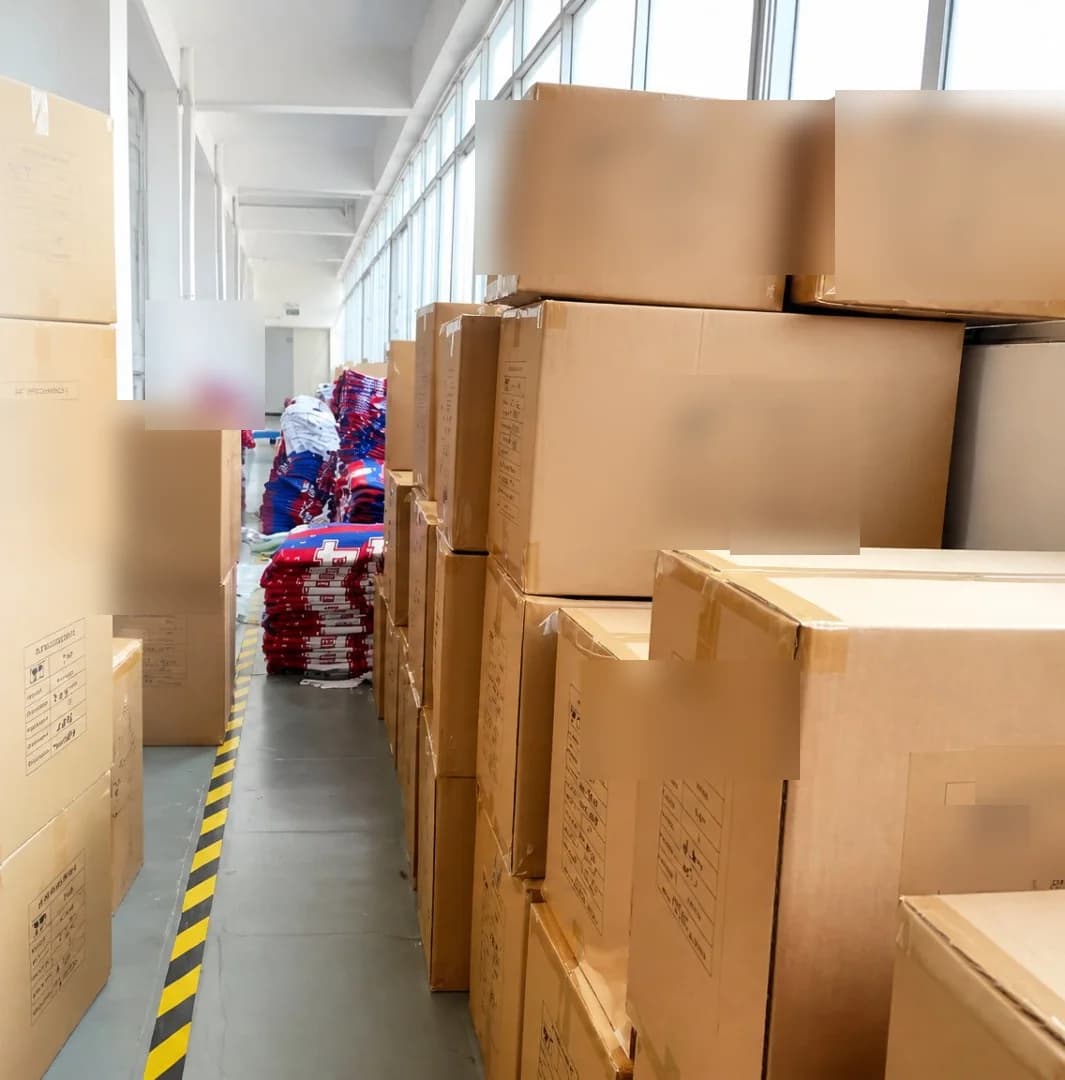
Written in late October, with our Christmas production physically packing cartons for EU clubs and US retail clients right now. If you are a brand, retailer or organisation still deciding whether a custom jumper programme is possible this year, this is the honest calendar — and the colour-count answer most suppliers avoid giving.
The photograph above is the view that matters at the end of October: cartons stacked along the aisle and pallets of finished Christmas jumpers waiting for collection. Christmas knitwear does not ship in December; it ships in late October and November, and everything before this moment — sampling, size grading, yarn allocation — has already happened for the clients who ordered in September. The question buyers ask us at this point in the year is never whether the jumpers look good. It is whether the calendar still has room for them.
So here is the direct answer on christmas jumper shipping time. Production for a jacquard Christmas jumper runs two to three weeks from approved sample, and air freight adds five to eight days door to door into Europe and North America. Working backwards from a mid-December retail deadline, an order confirmed by roughly the twentieth of November is still realistically deliverable before the holidays. Sea freight is a different story: for most EU and US destinations the cutoff has already passed, which is why every serious conversation this month is an air freight conversation, and why sample speed matters more in November than at any other time of the year.
Why Colour Count Is the Real Bottleneck — and the 7 to 10 Colour Answer
The technical limit most buyers never get told about is the yarn carrier. A jacquard row can only knit as many colours as the machine has carriers feeding it in that row, and most factories top out at four to six. Christmas artwork is exactly the kind of design that exposes this: a reindeer motif with snow, lettering, a contrast background and a rib accent routinely wants seven to ten colours across the garment. A mill with six carriers responds by flattening your artwork — merging shades, deleting the lettering outline, or baking the background into the motif — and the design you approved is quietly not the design you receive.
We run up to thirteen electronically controlled carriers per row on our Shima Seiki and Stoll flat machines, which is why seven-to-ten-colour Christmas jumpers are a standard request here rather than a special one. The commercial logic matters as much as the capability: what drives cost is not the total colour count across the garment but the number of colours changing within any single row. A ten-colour design that keeps three or four colours per row knits almost as efficiently as a six-colour one, because the carriers swap in and out between courses. Put eight colours into the same row and machine time roughly doubles. This is the conversation our programming team has with clients at artwork stage, and it is usually worth ten to fifteen percent on the quotation before a single machine hour is booked.
The third colour-related detail is float management. Every colour not knitting on the face runs behind the fabric, and a long float catches on watch straps, rings and coat linings. On a dense Christmas jacquard we tie long floats at programmed intervals so they lock into the reverse side — invisible from the front, but the difference between a jumper that survives December and one that snags by Boxing Day.
How a Late Order Gets Compressed Honestly
There is a fast version of Christmas production and a fake version. The fake version skips the sample and knits bulk directly from artwork, which works until the first wash or the first size check. The fast version keeps every quality step but removes waiting: artwork converted to a stitch file by in-house programmers instead of an external puncher, sampling in seventy-two hours using red, white and green stock yarns already on the shelf in the Dalang yarn hub, air-freight booking prepared in parallel with knitting rather than after it, and DDP documentation so customs never becomes the delay. Run in parallel, the sequence from confirmed artwork to a carton leaving the factory is a little over two weeks — it is not comfortable, but it is honest, and it is how the club orders currently in our packing area were rescued from missed sea-freight windows.
What genuinely helps a late programme is design discipline. A jumper that uses stock yarn colours, keeps the per-row colour count at three or four, and builds on a proven base pattern samples faster, air-freights lighter and lands earlier than one that does not. We will knit the complicated version too — that is most of our normal work — but in November, every simplification buys back days.
The Calendar From Here
Orders confirmed in the first days of November still enjoy a normal sampling cadence and comfortable air freight. Mid-November orders shift into the express lane: same production steps, compressed approvals, freight cost visibly higher. After roughly the twenty-fifth of November, the honest answer is that jumpers confirmed this year will arrive in January — and the smart move becomes placing the deposit now against next season's production slot, with sea freight, at a materially better landed cost. Buyers who were late this year almost always book earlier the next one.
Frequently Asked
Is it too late to order custom Christmas jumpers?
Not yet, for air freight. An order with artwork confirmed by about the twentieth of November can still be sampled, knitted in two to three weeks and air-freighted in five to eight days into most EU and US destinations before Christmas. After that point the calendar flips to next-season planning with sea freight.
How many colours can you knit on a custom Christmas jumper?
Up to thirteen colours across a design on our machines, and seven to ten is a routine Christmas jumper specification here. The cost driver is colours per row, not total colours: keep three or four per row and the machine runs efficiently. Standard mills with four to six carriers have to flatten designs beyond that, which is why their quotes come back cheaper and duller.
Is air freight worth it for knitwear?
For Christmas programmes, yes — the alternative is missing the season entirely. Air freight on a jacquard jumper typically adds a few dollars per piece on a 100 to 500 piece order, which is small against the retail margin a December delivery protects. Sea freight remains the right choice for next year's programme, ordered early with a deposit against a production slot.
If you have artwork ready, send it with your quantities and destination — the reply will tell you three things: the colour-per-row structure, the realistic delivery date, and whether air freight still makes the calendar. If it does not, we will say so and quote you against next season instead of selling you a December that will not happen.
Looking to manufacture this style at scale?
Send us your design brief and we'll quote a direct-factory run with low MOQs, 72h sampling and DDP worldwide delivery, knitted on our own floor in Dalang.
Knitwear you can manufacture right now
Keep reading

It's Time to Custom-Own Your Christmas Jumper
A short consumer-oriented overview of the custom Christmas jumper trend — design ideas, group-event tips, and the festive looks defining this year's holiday season.
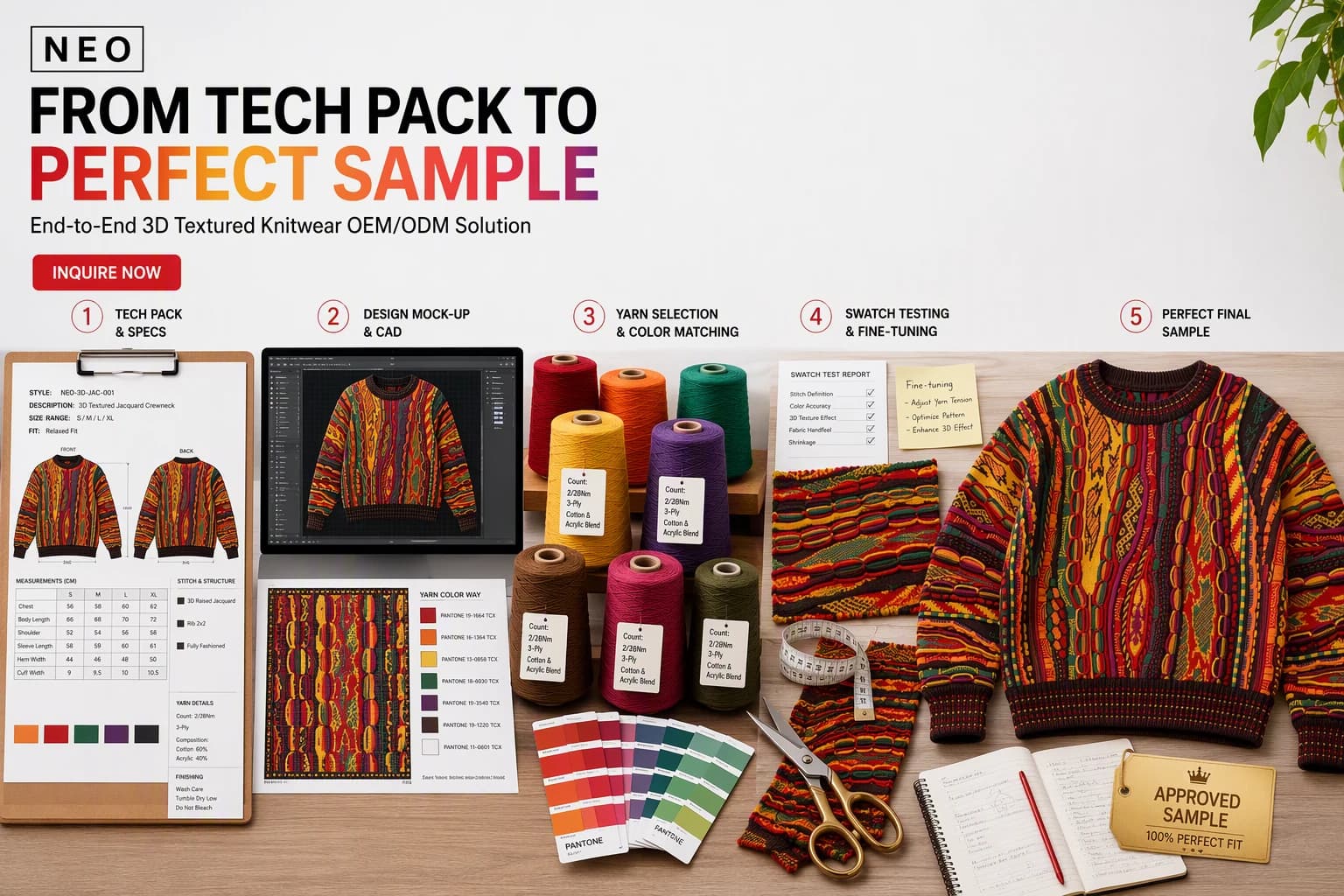
From Tech Pack to Perfect Sample: How Knitwear Sampling Actually Works
A floor-level walkthrough of the five stages between your tech pack and an approvable knit sample — mock-up and CAD programming, yarn colour matching, swatch testing, and the final PPS.
Sourcing Custom Men's Knitwear: What Separates a Knitwear Factory from a Sweater Mill
Mens knitwear briefs rarely fail on the design. They fail on gauge, size grading and reverse-side finishing — three things most price requests never ask about. Here is what to specify before you ask for a quote.
Send us the piece you were told was too hard.
Reference photo, rough sketch, or full tech pack — our Dalang technical punchers evaluate feasibility, machine gauge, yarn options, and pricing within 24 hours.