Custom Cable Knit Merino Wool Scarf
In a cable, softness and depth pull against each other. Merino buys the softness and pays for it in definition.
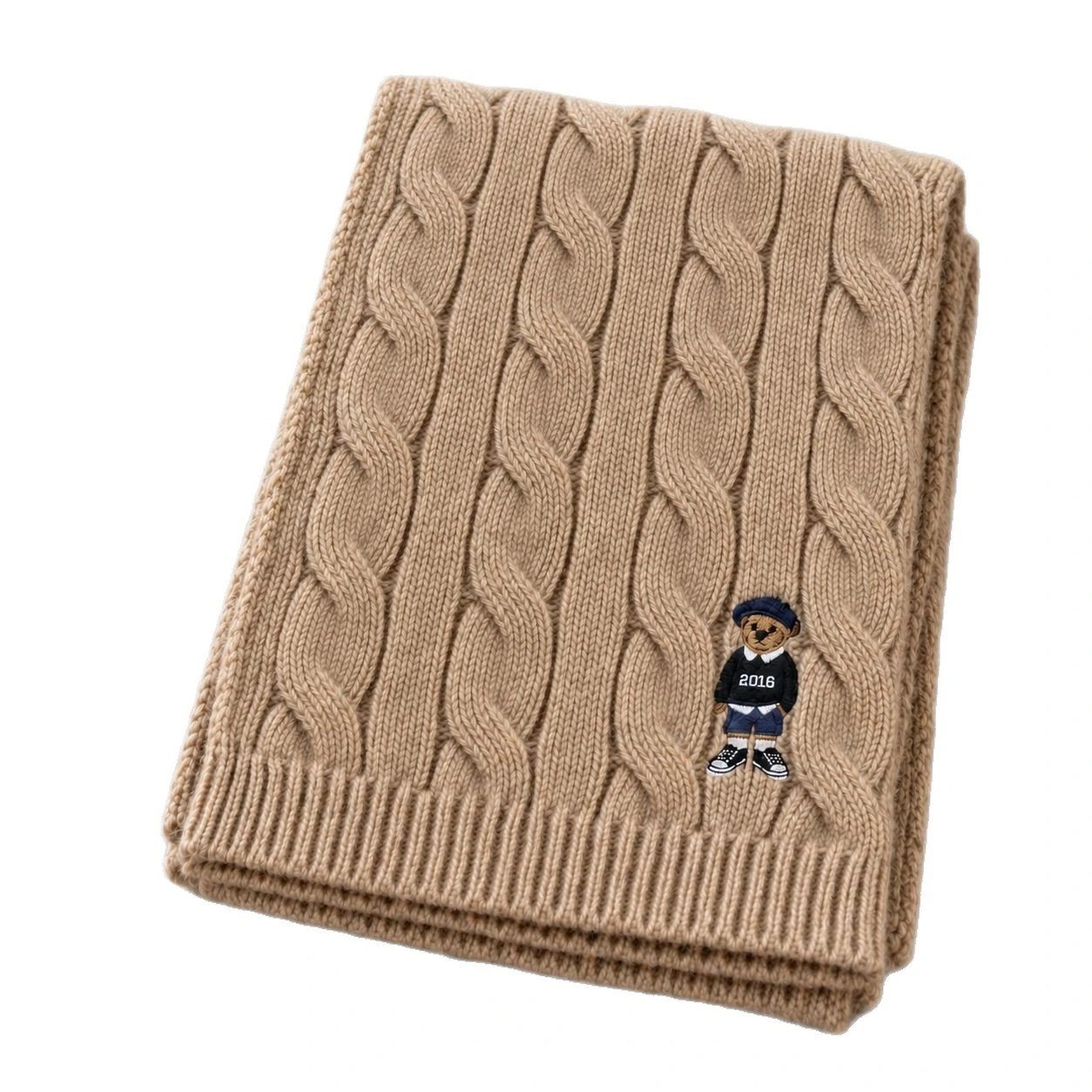
On a cable knit scarf the first decision is not the pattern, it is the panel count — and everything downstream follows from it. A cable cannot be scaled to fit the way a printed graphic can. It is a fixed sequence of stitches in which three or four stitches cross over three or four others, and the crossing has to happen on whole needles, so a cable panel has a fixed width. A 3/3 cable with its purl gutters occupies roughly twelve needles; at 7GG a 30 cm scarf is about 83 needles, which is six whole panels with eleven stitches left over — those eleven become the gutters and the edge. Move to a heavier yarn and you are on 5GG, where the same 30 cm is about 60 needles and only five panels fit. The scarf does not become a thicker version of the same thing: it becomes a different pattern, with wider cables and fewer of them. This is why we ask for the finished width in centimetres rather than just the artwork. The artwork tells us which cable; the width tells us how many. The same logic governs the depth. Cable definition is a ratio between the yarn diameter and the panel width, so a 3/3 cable in a fine yarn reads as a thin braid and the identical cable in a heavy yarn reads as a real cable. If you want the deep ropey relief in these photographs, the yarn has to be heavy enough for it, and that is a yarn decision, not a finishing decision. The second thing that governs cable is mechanical. Every crossing is a transfer: stitches are moved to empty needles and knitted back, and each transfer point is a stress point on the yarn. Fine merino is soft but weaker at the same count than a wool-acrylic blend, and cashmere weaker again, so on a 19.5 micron merino we add twist, add a small nylon fraction at the core, or reduce the cable size — usually the first two, because reducing the cable changes the look. The failure mode when this is ignored is small: a single dropped stitch or a pin hole at a crossing, which almost never appears on the machine and almost always appears after the first wash. On a cable scarf that is the defect to watch, and it is why we knit the transfer points on a trial panel and wash it before we quote a bulk price. The third thing is the honest one about fibre, and it is the reason this page exists. Crimp and resilience are what hold a cable up. Lambswool — first clip, around 23 to 25 micron — is springier than merino and holds a crisper cable, and it costs less. Extra-fine merino at 19.5 micron is next-to-skin soft, which matters enormously on a scarf because the wearer's neck is against it all day, but its cable sits slightly flatter and the yarn costs more. Cashmere is softer still and flatter still. So there is a real trade and we will not pretend otherwise: if the three-dimensional relief of the cable is the selling point, lambswool does that job better than merino and at a lower price. If comfort against the neck is the selling point, merino wins and you accept a cable that is a little less sculpted. There are three ways to claw the definition back without giving up the fibre, and we use them together: go up a cable size (4/4 instead of 3/3), tighten the stitch density so the stitches pack closer and stand taller, and finish with a light fulling wash that blooms the surface and settles the crosses. 'Merino' on its own is not a specification. Micron is. Under about 19.5 micron a scarf does not prickle at the neck; at 23 micron and above it does, on most wearers, and no amount of softener fixes a fibre that is physically too coarse. Between those numbers the price steps noticeably, so the micron should be written into the brief rather than assumed from the word merino. The same applies to washing. Machine-washable merino is a finish, not a property of the fibre: the yarn is given a shrink-resist treatment, and that treatment costs a little of the initial handle. If the care label has to say machine wash, we build the treatment in from the start; it cannot be added to a scarf that was knitted as hand-wash. Merino also pills, because the fibre is fine and its staple is short, and the loose fibre works its way out in the first weeks of wear. An anti-pilling finish reduces it at some cost to softness. Both are quotable options, and both are better decided before the yarn is bought. The ends in these photographs are knitted 2x2 rib blocks, not fringe, and that is a construction choice with real consequences. A rib end is knitted into the scarf, so it is programmed at the same time as the cable body and it cannot come off, fray, or twist out of shape in a bag. It also pulls in — rib is narrower than the body at the same needle count — so the transition has to be handled with a needle adjustment or the end cups inward and the scarf will not lie flat. Rib ends read cleaner for menswear, corporate gifting and gift-box retail, where a fringe looks folky. Fringe, by contrast, is hand labour: two or three yarn ends twisted against each other, which is why it costs more per piece and why it only attaches at an open edge. Neither is better; they are different price structures. The patch on the front is worth explaining because buyers often ask for the wrong thing here. You cannot embroider directly onto a cable knit at commercial density. The surface is three-dimensional and the stitches under the needle are moving; embroidery that dense compresses the pile, puckers the ground fabric, and fights the cable cross. So the motif is produced as a separate embroidered patch and appliquéd on, which is exactly what the photographs show — a satin-stitch bordered patch with a clean outline. Placement is not free either: the stable bed is the purl gutter between two cables, not the cable itself, because a patch stitched across a crossing will distort the cable every time the scarf folds. And it has to go on before the final wash, or the edge lifts. Because it is a separate process, the patch carries its own minimum and its own lead time, independent of the knitting. Length is the last thing that catches people out. A cable panel contains more stitches per centimetre than a plain knit, so the same finished length needs more rows, and the relax-and-fulling wash afterwards shortens the piece — typically a few per cent, and more on cable than on plain because the crosses pull the fabric in. We build that allowance into the block and quote the length after washing, so a 180 cm scarf measures 180 cm when it reaches your customer rather than when it comes off the machine. If a brief specifies a length, it should say which of those two it means. Branding routes are a woven corner label, the embroidered patch shown here, or a printed belly band for shelf presentation, and the patch is the only one that changes the knitting programme, so it needs to be settled at sampling rather than added later. Typical buyers are heritage and country knitwear brands running Aran stories, menswear labels adding a scarf to a coat programme, corporate and institutional gifting programmes that want a logo on a cable scarf, premium gift-set operators who need merino at a gift price point, and private-label retailers building a scarf wall across three fibre tiers from one cable. Artwork for patches and logos is supplied by the customer and we knit and apply what we are given; character marks, club crests and franchise logos are the customer's to clear, and we will ask for that confirmation in writing rather than assume it. MOQ 100 pcs per design, sampling 72 hours, bulk production 2-3 weeks, DDP to US, EU, UK, AU and JP.
Technical Specifications
| MOQ | 100 pcs / design |
| Sampling | 72 hours |
| Production | 2-3 weeks |
| Gauge | 3GG - 12GG |
| Yarn | 100% Extra-Fine Merino (19.5 micron) / Lambswool / Merino-Nylon core / Cashmere-Wool Blend / Cashmere-touch Acrylic |
| Micron | 19.5 micron standard; 21.5 and 23.5 micron quoted as value options |
| Weight | Approx. 250 - 330 g / pc (180 x 30 cm, 5GG - 7GG merino) |
| Size | 180 x 30 cm standard, 200 x 35 cm, 200 x 50 cm blanket format |
| Trim | Knitted 2x2 rib ends 6 - 8 cm, hand-twisted fringe 8 - 12 cm, or folded hem |
| Patch | Embroidered appliqué, up to 5 colours, stitched on the purl gutter between cables |
| Care | Hand wash as standard; machine-washable option via shrink-resist treatment on request |
Why Brands Order This Silhouette From Us
- Panel count built from your finished width in centimetres, so the cable repeat closes at both edges instead of being cropped at one
- Transfer points trialled and washed before a bulk price is quoted, because cable holes appear after the first wash, not on the machine
- Yarn adjusted for transfer stress — extra twist or a nylon core on fine merino, rather than shrinking the cable to hide the problem
- Micron written into the brief (19.5 / 21.5 / 23.5), because '100% merino' says nothing about whether it will prickle at the neck
- Cable definition recovered by going up a cable size, tightening stitch density and a light fulling wash — not by softening the fibre
- Knitted 2x2 rib ends programmed with the body, so the end cannot fray or twist and the cuff transition is needle-adjusted to sit flat
- Embroidered patch appliquéd on rather than embroidered direct, positioned on the stable purl gutter so the cable is not distorted by folding
- Finished length quoted after fulling, with the cable shrinkage allowance built into the block
- Real-time ERP portal tracking: live PPS, bulk knitting, and QC inspection photos
- Custom brand packaging: woven neck labels, care tags, and biodegradable bags
Frequently Asked Questions About Custom Cable Knit Merino Wool Scarf
Related Knitwear Silhouettes
Same category or produced in matching craft techniques
Custom Crew-Neck Jacquard Sweater
The essential knitwear staple — programmed to your exact fit, gauge, and artwork.
Bitter-Gourd 3D Relief Textured Sweater
Sculpted three-dimensional relief knitwear with incredible tactile depth.

Ugly Christmas Holiday Jacquard Sweater
Vibrant festive holiday knitwear with high-density jacquard graphics.
Request a Custom Quote for Custom Cable Knit Merino Wool Scarf
Tell us your target quantity and custom requirements. Direct factory pricing within 24 hours.
Send us the piece you were told was too hard.
Reference photo, rough sketch, or full tech pack — our Dalang technical punchers evaluate feasibility, machine gauge, yarn options, and pricing within 24 hours.